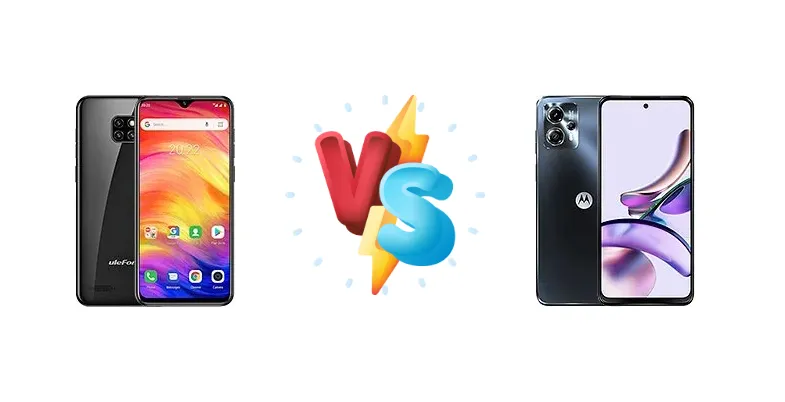
The Ulefone Note 7 and Motorola Moto G13 represent distinct approaches to the ultra-budget smartphone market. The Note 7, utilizing older but proven Mediatek silicon, aims for affordability. The Moto G13, however, leverages a newer Helio G85 chipset, promising a significant performance boost. This comparison dissects these differences to determine which device delivers the best value.
🏆 Quick Verdict
For most users, the Motorola Moto G13 is the superior choice. Its Helio G85 chipset offers a substantial performance advantage over the Ulefone Note 7’s MT6580, translating to smoother multitasking and a more responsive user experience. While the Note 7 is cheaper, the G13’s improved processing power justifies the price difference.
| Network |
|---|
| 2G bands | GSM 850 / 900 / 1800 / 1900 | GSM 850 / 900 / 1800 / 1900 |
| 3G bands | HSDPA 850 / 900 / 1900 / 2100 | HSDPA 850 / 900 / 1900 / 2100 |
| 4G bands | - | 1, 2, 3, 5, 7, 8, 20, 38, 40, 41 |
| Speed | HSPA 21.1/5.76 Mbps | HSPA, LTE |
| Technology | GSM / HSPA | GSM / HSPA / LTE |
| Launch |
|---|
| Announced | 2019, April. Released 2019, April | 2023, January 24 |
| Status | Discontinued | Available. Released 2023, January 24 |
| Body |
|---|
| Build | - | Glass front, plastic frame, plastic back |
| Dimensions | 156.1 x 73.7 x 9.7 mm (6.15 x 2.90 x 0.38 in) | 162.7 x 74.7 x 8.2 mm (6.41 x 2.94 x 0.32 in) |
| SIM | Nano-SIM + Micro-SIM | · Nano-SIM· Nano-SIM + Nano-SIM |
| Weight | 177.5 g (6.28 oz) | 183.5 g (6.49 oz) |
| | - | Water-resistant design |
| Display |
|---|
| Protection | Corning Gorilla Glass 3 | Panda glass |
| Resolution | 600 x 1280 pixels (~232 ppi density) | 720 x 1600 pixels, 20:9 ratio (~270 ppi density) |
| Size | 6.1 inches, 92.3 cm2 (~80.2% screen-to-body ratio) | 6.5 inches, 102.0 cm2 (~83.9% screen-to-body ratio) |
| Type | IPS LCD | IPS LCD, 90Hz, 400 nits (peak) |
| Platform |
|---|
| CPU | Quad-core 1.3 GHz Cortex-A7 | Octa-core (2x2.0 GHz Cortex-A75 & 6x1.8 GHz Cortex-A55) |
| Chipset | Mediatek MT6580 (28 nm) | Mediatek MT6769Z Helio G85 (12 nm) |
| GPU | Mali-400 | Mali-G52 MC2 |
| OS | Android 8.1 Oreo (Go edition) | Android 13 |
| Memory |
|---|
| Card slot | microSDXC (uses shared SIM slot) | microSDXC (dedicated slot) |
| Internal | 32GB 3GB RAM | 64GB 4GB RAM, 128GB 4GB RAM |
| | eMMC 5.1 | - |
| Main Camera |
|---|
| Features | LED flash, HDR | LED flash, HDR, panorama |
| Single | 8 MP, AF | - |
| Triple | 8 MP, f/1.8, (wide), AF
2 MP
2 MP | 50 MP, f/1.8, (wide), 0.64µm, PDAF
2 MP (macro)
Auxiliary lens |
| Video | 720p@30fps | 1080p@30fps |
| Selfie camera |
|---|
| Single | 5 MP | 8 MP, f/2.0, (wide), 1/4.0", 1.12µm |
| Video | 720p@30fps | 1080p@30fps |
| Sound |
|---|
| 3.5mm jack | Yes | Yes |
| 35mm jack | Yes | Yes |
| Loudspeaker | Yes | Yes, with stereo speakers |
| Comms |
|---|
| Bluetooth | 4.0, A2DP | 5.1, A2DP, LE |
| NFC | No | Yes (market/region dependent) |
| Positioning | GPS | GPS, GLONASS, GALILEO |
| Radio | Stereo FM radio, RDS, recording | Unspecified |
| USB | microUSB 2.0 | USB Type-C 2.0 |
| WLAN | Wi-Fi 802.11 b/g/n | Wi-Fi 802.11 a/b/g/n/ac, dual-band |
| Features |
|---|
| Sensors | Accelerometer, proximity | Fingerprint (side-mounted), accelerometer, gyro, proximity |
| Battery |
|---|
| Charging | - | 20W or 10W wired |
| Stand-by | Up to 374 h (3G) | - |
| Talk time | Up to 9 h (3G) | - |
| Type | Li-Po 3500 mAh | Li-Po 5000 mAh |
| Misc |
|---|
| Colors | Black, Gold, Twilight | Matte Charcoal, Blue Lavender, Rose Gold |
| Models | Q345 | - |
| Price | About 120 EUR | About 160 EUR |
| SAR EU | 0.35 W/kg (head) 0.86 W/kg (body) | - |
Ulefone Note 7
- Lower price point
- Functional for basic tasks
- Potentially longer standby time due to less powerful processor
- Significantly slower performance
- Outdated chipset architecture
- Limited multitasking capabilities
Motorola Moto G13
- Much faster performance with Helio G85
- Improved multitasking and gaming
- Faster charging (20W or 10W)
- Slightly higher price
- May not offer significantly better camera quality
- Potential for slightly shorter battery life under heavy load
Display Comparison
Neither device boasts a standout display. Both likely utilize LCD panels, common in this price bracket. However, the lack of detailed display specs for the Ulefone Note 7 makes a direct comparison difficult. The Moto G13’s display is likely to be brighter and more color accurate due to the newer chipset’s image signal processor (ISP) capabilities, even if the panel itself is similar. Bezels are expected to be substantial on both devices, reflecting their budget positioning.
Camera Comparison
Camera performance is likely to be similar in real-world usage, as both phones likely feature budget sensors and image processing. Without detailed sensor information, it’s difficult to make a definitive statement. However, the Helio G85’s ISP in the Moto G13 will likely offer better image processing capabilities, potentially resulting in slightly improved dynamic range and noise reduction. The presence of a 2MP macro camera on the Moto G13 is largely a marketing gimmick and offers limited practical benefit. Focusing on the main sensor’s quality is more important.
Performance
The performance gap is the most significant differentiator. The Ulefone Note 7’s Mediatek MT6580, built on a 28nm process, features a quad-core Cortex-A7 CPU. This architecture is several generations old and struggles with modern app demands. Conversely, the Motorola Moto G13’s Helio G85 (12nm) utilizes an octa-core configuration with a mix of Cortex-A75 and A55 cores. The A75 cores provide a substantial performance uplift for demanding tasks, while the A55 cores offer efficiency. This translates to significantly faster app loading times, smoother multitasking, and a more enjoyable gaming experience on the Moto G13. The 12nm process also contributes to better power efficiency.
Battery Life
Battery life will depend heavily on usage patterns. While the Moto G13 offers 20W or 10W charging, the Ulefone Note 7’s charging speed is unspecified, likely being slower. The faster charging on the Moto G13 allows for quicker top-ups, reducing downtime. The Helio G85’s improved power efficiency may also contribute to slightly longer battery life under heavy load, offsetting any potential capacity differences.
Buying Guide
Buy the Ulefone Note 7 if your primary need is a functional smartphone for basic tasks like calls, texts, and light web browsing, and your budget is extremely limited. You're willing to accept slower performance and limited multitasking capabilities. Buy the Motorola Moto G13 if you prioritize a smoother, more responsive experience, enjoy occasional gaming, or frequently use multiple apps simultaneously. The G13 offers a modern chipset and faster charging for a modest price increase.
Frequently Asked Questions
❓ Will the Motorola Moto G13 struggle with demanding games like PUBG Mobile?
While the Helio G85 isn't a gaming powerhouse, it's capable of running PUBG Mobile at medium settings with reasonable frame rates. Expect some occasional stuttering, but it's a far more playable experience than the Ulefone Note 7, which would likely struggle even at the lowest settings.
❓ Is the 20W charging on the Moto G13 a significant advantage over the Ulefone Note 7?
Yes, 20W charging (or even 10W) is a substantial improvement over the likely slower charging speed of the Ulefone Note 7. It allows you to quickly top up the battery, minimizing downtime and ensuring you have power when you need it.
❓ How much of a performance difference can I realistically expect between the MT6580 and the Helio G85?
The Helio G85 is significantly faster – roughly 2-3 times the performance in CPU benchmarks and a substantial improvement in GPU performance. This translates to noticeably faster app loading, smoother scrolling, and a more responsive overall experience. The MT6580 will feel sluggish in comparison.
❓ Does the Moto G13 support software updates, and for how long?
Motorola typically provides at least one major Android update and a few years of security patches for its G-series phones. While not guaranteed, the Moto G13 is likely to receive Android 13 and potentially Android 14, along with regular security updates for a reasonable period.