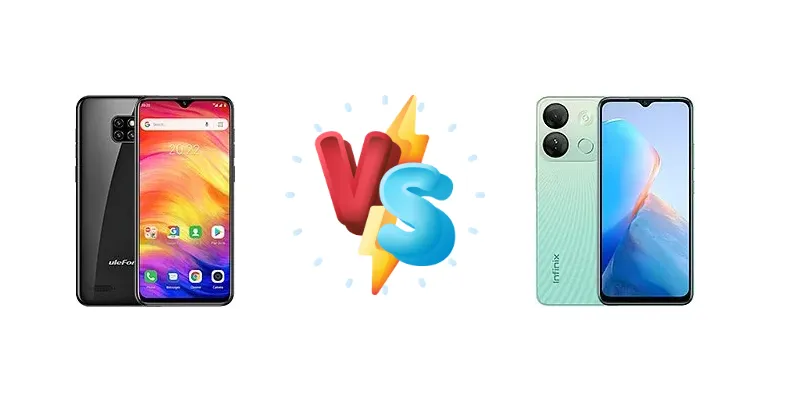
The Ulefone Note 7 and Infinix Smart 7 HD represent the extreme end of the smartphone price spectrum. Both aim to deliver essential functionality at a minimal cost, but they take different approaches to achieving this. The Note 7 relies on a tried-and-true, albeit aging, chipset, while the Smart 7 HD opts for a newer octa-core processor. This comparison will dissect the implications of these choices for everyday users.
🏆 Quick Verdict
For the average user prioritizing responsiveness and multitasking, the Infinix Smart 7 HD is the better choice. Its octa-core CPU provides a noticeable performance advantage over the Ulefone Note 7’s quad-core processor, making it more suitable for modern app usage and light gaming. However, the Note 7 may appeal to those seeking a known quantity in terms of software compatibility.
| Network |
|---|
| 2G bands | GSM 850 / 900 / 1800 / 1900 | GSM 850 / 900 / 1800 / 1900 |
| 3G bands | HSDPA 850 / 900 / 1900 / 2100 | HSDPA 850 / 900 / 2100 |
| 4G bands | - | 1, 3, 5, 8, 38, 40, 41 |
| Speed | HSPA 21.1/5.76 Mbps | HSPA, LTE |
| Technology | GSM / HSPA | GSM / HSPA / LTE |
| | - | 1, 2, 3, 4, 5, 7, 8, 20, 28, 38, 40, 41 |
| Launch |
|---|
| Announced | 2019, April. Released 2019, April | 2023, April 14 |
| Status | Discontinued | Available. Released 2023, April 14 |
| Body |
|---|
| Build | - | Glass front, plastic back, plastic frame |
| Dimensions | 156.1 x 73.7 x 9.7 mm (6.15 x 2.90 x 0.38 in) | 163.9 x 75.5 x 8.7 mm (6.45 x 2.97 x 0.34 in) |
| SIM | Nano-SIM + Micro-SIM | Nano-SIM + Nano-SIM |
| Weight | 177.5 g (6.28 oz) | 196.5 g (6.95 oz) |
| Display |
|---|
| Protection | Corning Gorilla Glass 3 | - |
| Resolution | 600 x 1280 pixels (~232 ppi density) | 720 x 1612 pixels, 20:9 ratio (~267 ppi density) |
| Size | 6.1 inches, 92.3 cm2 (~80.2% screen-to-body ratio) | 6.6 inches, 104.6 cm2 (~84.6% screen-to-body ratio) |
| Type | IPS LCD | IPS LCD, 500 nits |
| Platform |
|---|
| CPU | Quad-core 1.3 GHz Cortex-A7 | Octa-core 1.6 GHz |
| Chipset | Mediatek MT6580 (28 nm) | - |
| GPU | Mali-400 | - |
| OS | Android 8.1 Oreo (Go edition) | Android 12 (Go edition) |
| Memory |
|---|
| Card slot | microSDXC (uses shared SIM slot) | microSDXC (dedicated slot) |
| Internal | 32GB 3GB RAM | 64GB 2GB RAM |
| | eMMC 5.1 | UFS 2.1 |
| Main Camera |
|---|
| Dual | - | 8 MP, f/2.0
0.08 MP, (depth) |
| Features | LED flash, HDR | Dual-LED flash, HDR, panorama |
| Single | 8 MP, AF | 8 MP, f/2.0
Auxiliary lens |
| Triple | 8 MP, f/1.8, (wide), AF
2 MP
2 MP | - |
| Video | 720p@30fps | 1080p@30fps |
| Selfie camera |
|---|
| Features | - | LED flash |
| Single | 5 MP | 5 MP, f/2.0 |
| Video | 720p@30fps | 720p@30fps |
| Sound |
|---|
| 3.5mm jack | Yes | Yes |
| 35mm jack | Yes | Yes |
| Loudspeaker | Yes | Yes |
| Comms |
|---|
| Bluetooth | 4.0, A2DP | 5.0, A2DP, LE |
| NFC | No | No |
| Positioning | GPS | GPS |
| Radio | Stereo FM radio, RDS, recording | FM radio |
| USB | microUSB 2.0 | microUSB 2.0, OTG |
| WLAN | Wi-Fi 802.11 b/g/n | Wi-Fi 802.11 b/g/n |
| Features |
|---|
| Sensors | Accelerometer, proximity | Fingerprint (rear-mounted), accelerometer, proximity |
| Battery |
|---|
| Charging | - | 10W wired |
| Stand-by | Up to 374 h (3G) | - |
| Talk time | Up to 9 h (3G) | - |
| Type | Li-Po 3500 mAh | 5000 mAh |
| Misc |
|---|
| Colors | Black, Gold, Twilight | Ink Black, Silk Blue, Jade White, Green Apple |
| Models | Q345 | X6516 |
| Price | About 120 EUR | About 110 EUR |
| SAR EU | 0.35 W/kg (head) 0.86 W/kg (body) | - |
Ulefone Note 7
- Potentially better software compatibility due to older chipset.
- May be available at a lower price point.
- Simple and straightforward user experience.
- Significantly slower performance compared to the Smart 7 HD.
- Less efficient processor leading to shorter battery life.
- Likely wider bezels and a less modern design.
Infinix Smart 7 HD
- Faster octa-core processor for smoother multitasking.
- 10W wired charging for convenient power replenishment.
- Potentially better battery life due to a more efficient processor.
- May have limited software support in the long term.
- Potential for software bugs or instability.
- Camera quality likely similar to the Ulefone Note 7.
Display Comparison
Neither device's display specifications are provided, so a direct comparison is limited. However, given their price points, both likely utilize LCD panels with 720p resolution. The Ulefone Note 7, being an older model, may exhibit wider bezels. Color accuracy is expected to be basic on both, prioritizing power efficiency over fidelity. The absence of details like peak brightness or refresh rate suggests neither phone is geared towards media consumption.
Camera Comparison
Without detailed camera specifications, a meaningful comparison is difficult. Both phones likely feature basic camera setups geared towards casual photography. The absence of information regarding sensor size, aperture, or image stabilization suggests neither device will excel in low-light conditions. It's reasonable to assume both will include a primary camera and potentially a secondary depth or macro sensor, but the quality of these sensors is likely to be minimal. Image processing will likely be basic on both, focusing on simplicity over advanced features.
Performance
The core difference lies in the CPU. The Ulefone Note 7’s Mediatek MT6580, built on a 28nm process, features a quad-core Cortex-A7 configuration running at 1.3 GHz. This is a significantly older architecture. Conversely, the Infinix Smart 7 HD boasts an octa-core CPU clocked at 1.6 GHz. While the specific core architecture isn't specified, an octa-core setup inherently allows for better parallel processing and multitasking. The 28nm process of the MT6580 will also result in higher power consumption and potentially more heat generation compared to a more modern node, even if the exact node of the Infinix CPU is unknown. This translates to a smoother user experience on the Smart 7 HD, especially when switching between apps.
Battery Life
Battery capacity isn't specified for the Ulefone Note 7, but given its age and chipset, it's likely in the 2500-3000 mAh range. The Infinix Smart 7 HD supports 10W wired charging, a standard for this price segment. The MT6580's less efficient 28nm process will likely result in shorter battery life on the Ulefone Note 7, even if the capacity is comparable. The 10W charging on the Smart 7 HD, while not fast, provides a convenient way to top up the battery throughout the day.
Buying Guide
Buy the Ulefone Note 7 if you need a device with a well-established chipset and are comfortable with potentially limited performance in demanding applications. It's a good option for users who primarily make calls, send texts, and use basic apps. Buy the Infinix Smart 7 HD if you prefer a more responsive experience for everyday tasks, appreciate the benefits of an octa-core processor for smoother multitasking, and value the convenience of 10W wired charging.
Frequently Asked Questions
❓ Will the Infinix Smart 7 HD struggle with popular social media apps like Facebook and Instagram?
While not a powerhouse, the octa-core processor in the Infinix Smart 7 HD should handle Facebook and Instagram reasonably well. Expect some occasional slowdowns with multiple apps open, but the overall experience should be usable. The Ulefone Note 7’s quad-core processor will likely exhibit more noticeable lag.
❓ Is the Ulefone Note 7 a good choice for someone who primarily uses their phone for calls and texts?
Yes, the Ulefone Note 7 is a viable option for basic communication. Its older chipset is sufficient for making calls, sending texts, and using simple apps. However, be aware that its performance will be limited if you attempt to use more demanding applications.
❓ Can the Infinix Smart 7 HD handle light gaming?
The Infinix Smart 7 HD can handle some light gaming, but don't expect high frame rates or demanding graphics settings. Simple 2D games and less intensive 3D titles should be playable, but more complex games will likely experience significant lag. The Ulefone Note 7 will struggle even more with gaming.