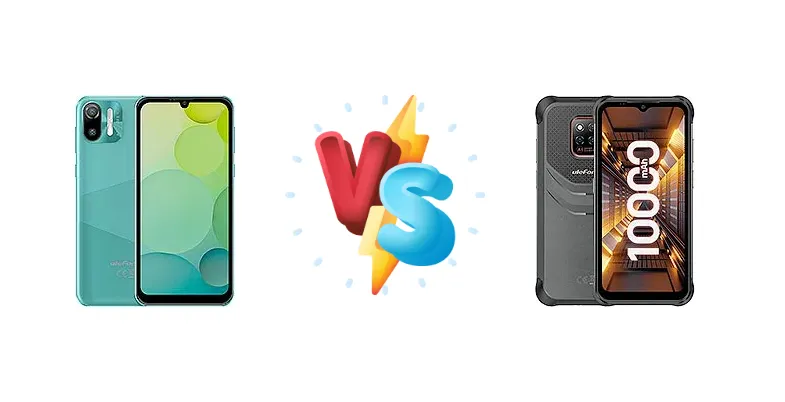
Ulefone caters to two distinct segments: users prioritizing extreme durability and those seeking an affordable, everyday smartphone. The Power Armor 14 Pro represents Ulefone’s rugged line, built to withstand harsh conditions, while the Note 6T focuses on delivering essential features at a budget price point. This comparison dissects the core differences between these two devices, focusing on performance, battery, and build quality to help you determine which Ulefone best suits your needs.
🏆 Quick Verdict
For the average user, the Ulefone Power Armor 14 Pro is the superior choice. Its Helio G85 chipset offers a substantial performance uplift over the Note 6T’s Helio A22, enabling smoother multitasking and gaming. The addition of 18W wired and 15W wireless charging, alongside its ruggedized build, justifies the price premium for those needing durability and faster power replenishment.
| Network |
|---|
| 2G bands | GSM 850 / 900 / 1800 / 1900 | GSM 850 / 900 / 1800 / 1900 |
| 3G bands | HSDPA 850 / 900 / 1700(AWS) / 1900 / 2100 | HSDPA 850 / 900 / 1700(AWS) / 1900 / 2100 |
| 4G bands | 1, 2, 3, 4, 5, 7, 8, 12, 17, 19, 20, 26, 66 | 1, 2, 3, 4, 5, 7, 8, 12, 13, 17, 18, 19, 20, 25, 26, 28, 38, 40 |
| Speed | HSPA 21.1/5.76 Mbps | HSPA, LTE |
| Technology | GSM / HSPA / LTE | GSM / HSPA / LTE |
| Launch |
|---|
| Announced | 2022, May 13 | 2022, March 09 |
| Status | Available. Released 2022, May 13 | Available. Released 2022, March 09 |
| Body |
|---|
| Dimensions | 155.4 x 73.4 x 8.5 mm (6.12 x 2.89 x 0.33 in) | 175.6 x 82.5 x 17.2 mm (6.91 x 3.25 x 0.68 in) |
| SIM | Nano-SIM + Nano-SIM | Nano-SIM + Nano-SIM |
| Weight | 163 g (5.75 oz) | 358.2 g (12.63 oz) |
| | - | IP68 dust/water resistant (up to 1.5m for 30 min)
Drop-to-concrete resistance from up to 1.5m
MIL-STD-810G compliant |
| Display |
|---|
| Protection | - | Corning Gorilla Glass 3 |
| Resolution | 720 x 1560 pixels, 19.5:9 ratio (~282 ppi density) | 720 x 1600 pixels, 20:9 ratio (~269 ppi density) |
| Size | 6.1 inches, 91.3 cm2 (~80.1% screen-to-body ratio) | 6.52 inches, 102.6 cm2 (~70.8% screen-to-body ratio) |
| Type | IPS LCD | IPS LCD |
| Platform |
|---|
| CPU | Quad-core 2.0 GHz Cortex-A53 | Octa-core (2x2.0 GHz Cortex-A75 & 6x1.8 GHz Cortex-A55) |
| Chipset | Mediatek MT6761 Helio A22 (12 nm) | Mediatek MT6769Z Helio G85 (12 nm) |
| GPU | PowerVR GE8320 | Mali-G52 MC2 |
| OS | Android 12 | Android 12 |
| Memory |
|---|
| Card slot | microSDXC (dedicated slot) | microSDXC (uses shared SIM slot) |
| Internal | 64GB 3GB RAM | 128GB 6GB RAM, 128GB 8GB RAM |
| | eMMC 5.1 | eMMC 5.1 |
| Main Camera |
|---|
| Dual | 13 MP, (wide), AF
Auxiliary lens | - |
| Features | LED flash | LED flash, HDR, panorama |
| Single | 5 MP | 16 MP, f/2.2 |
| Triple | - | 20 MP, f/1.8, 26mm (wide), 1/2.78", 1.0µm, PDAF
2 MP (macro)
Auxiliary lens |
| Video | 1080p@30fps | 1080p@30fps |
| Selfie camera |
|---|
| Features | - | HDR, panorama |
| Single | 5 MP | 16 MP, f/2.2 |
| Video | Yes | 1080p@30fps |
| Sound |
|---|
| 3.5mm jack | Yes | Yes |
| 35mm jack | Yes | Yes |
| Loudspeaker | Yes | Yes |
| Comms |
|---|
| Bluetooth | 5.0, A2DP, LE | 5.0, A2DP, LE |
| NFC | No | Yes |
| Positioning | GPS, GLONASS, GALILEO, BDS | GPS, GLONASS, GALILEO, BDS |
| Radio | Stereo FM radio, RDS, recording | FM radio, RDS, recording |
| USB | microUSB 2.0 | USB Type-C 2.0, OTG |
| WLAN | Wi-Fi 802.11 a/b/g/n/ac, dual-band, Wi-Fi Direct | Wi-Fi 802.11 a/b/g/n/ac, dual-band |
| Features |
|---|
| Sensors | Accelerometer, proximity | Fingerprint (side-mounted), accelerometer, proximity, compass |
| Battery |
|---|
| Charging | - | 18W wired
15W wireless |
| Type | Li-Po 3300 mAh | Li-Po 10000 mAh |
| Misc |
|---|
| Colors | Black, Green, Purple, Red | Black |
| Price | - | About 260 EUR |
Ulefone Note 6T
- Significantly more affordable
- Lightweight and compact design (likely)
- Sufficient for basic smartphone tasks
- Weak performance with Helio A22
- Slow charging speeds (likely)
- Limited multitasking capabilities
Ulefone Power Armor 14 Pro
- Powerful Helio G85 chipset for smooth performance
- Ruggedized design for enhanced durability
- Convenient 18W wired and 15W wireless charging
- Higher price point
- Bulkier and heavier due to rugged construction
- Potentially less refined software experience
Display Comparison
Neither device’s display specifications are provided, so a direct comparison is limited. However, given the Power Armor 14 Pro’s positioning, it likely features a more robust display with higher scratch resistance. The Note 6T, being a budget device, likely utilizes a simpler panel. Expect the Power Armor 14 Pro to have better outdoor visibility due to its likely higher peak brightness, crucial for a rugged device used in bright environments.
Camera Comparison
Without detailed camera specifications, a precise comparison is difficult. However, the Power Armor 14 Pro, being the higher-end model, likely features a more sophisticated camera system with a larger sensor and improved image processing. Ulefone often includes features like night mode and HDR on their Pro models, which are likely absent on the Note 6T. The Note 6T likely relies on basic image processing algorithms, resulting in less detailed and dynamic photos, especially in challenging lighting conditions. The inclusion of a dedicated macro lens on either device is unlikely to significantly impact image quality, given the typical 2MP resolution found in this segment.
Performance
The core difference lies in the chipsets. The Ulefone Power Armor 14 Pro’s Mediatek Helio G85, with its octa-core configuration (2x2.0 GHz Cortex-A75 & 6x1.8 GHz Cortex-A55), represents a significant leap in performance over the Note 6T’s quad-core 2.0 GHz Cortex-A53 Helio A22. The G85’s Cortex-A75 cores provide substantially more processing power for demanding applications and multitasking. This translates to faster app loading times, smoother animations, and a more responsive user experience. The G85 also features a more capable GPU, making it suitable for casual gaming, while the A22 struggles with even moderately demanding titles. The 12nm process node is shared between both chips, so thermal efficiency differences will be less pronounced, but the G85’s architecture will still deliver better sustained performance.
Battery Life
While the battery capacities aren’t specified, the Power Armor 14 Pro’s inclusion of both 18W wired and 15W wireless charging is a major advantage. The Note 6T likely relies solely on slower wired charging. Wireless charging adds significant convenience, especially for users who frequently use their phone throughout the day. The Power Armor 14 Pro’s rugged design and more powerful chipset likely necessitate a larger battery capacity to maintain all-day battery life, even with increased power consumption. The faster charging speeds on the 14 Pro will also reduce downtime, allowing users to quickly top up their battery when needed.
Buying Guide
Buy the Ulefone Note 6T if you need a basic, functional smartphone for everyday tasks like calls, messaging, and light web browsing, and prioritize affordability above all else. Buy the Ulefone Power Armor 14 Pro if you work in a demanding environment, enjoy outdoor activities, or simply prefer a phone that can withstand drops and impacts, and value significantly improved performance and convenient wireless charging.
Frequently Asked Questions
❓ Is the Helio G85 in the Power Armor 14 Pro capable of playing demanding games like PUBG or Call of Duty?
Yes, the Helio G85 is a capable gaming chipset. While it won't deliver flagship-level performance, it can comfortably run PUBG and Call of Duty at medium settings with stable frame rates. The Power Armor 14 Pro’s rugged design also provides better heat dissipation, potentially reducing thermal throttling during extended gaming sessions compared to other phones with similar chipsets.
❓ How durable is the Ulefone Power Armor 14 Pro, and what certifications does it have?
Ulefone’s Power Armor series is known for its ruggedness. While specific certifications aren’t provided, these phones typically meet MIL-STD-810G standards for shock, drop, and vibration resistance, and often have an IP68 or IP69K rating for water and dust resistance. This means the Power Armor 14 Pro can withstand drops onto hard surfaces, submersion in water, and exposure to dust and extreme temperatures.
❓ Will the Ulefone Note 6T struggle with common apps like Facebook, WhatsApp, and Chrome?
The Ulefone Note 6T’s Helio A22 chipset is a basic processor. While it can run these apps, you may experience noticeable lag and slowdowns when multitasking or using demanding features within these apps. It’s best suited for light usage and avoiding running too many apps simultaneously.