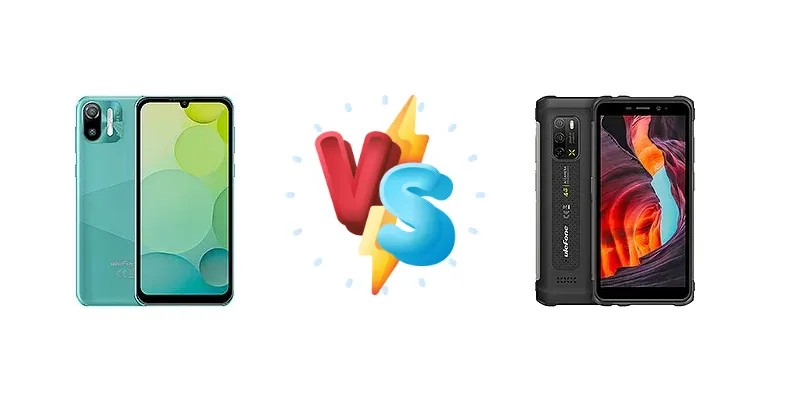
Ulefone caters to the budget end of the smartphone market, offering both standard and ruggedized options. The Note 6T represents a cost-effective daily driver, while the Armor X10 Pro adds a layer of durability. This comparison dissects the core differences between these two devices, focusing on their performance capabilities and target user profiles.
🏆 Quick Verdict
For the average user prioritizing basic functionality and affordability, the Ulefone Note 6T is a viable option. However, the Ulefone Armor X10 Pro emerges as the stronger choice due to its more powerful Mediatek Helio P22 chipset, offering a noticeable performance boost for multitasking and app responsiveness, despite its slightly higher price point.
| Network |
|---|
| 2G bands | GSM 850 / 900 / 1800 / 1900 | GSM 850 / 900 / 1800 / 1900 |
| 3G bands | HSDPA 850 / 900 / 1700(AWS) / 1900 / 2100 | HSDPA 850 / 900 / 1700(AWS) / 1900 / 2100 |
| 4G bands | 1, 2, 3, 4, 5, 7, 8, 12, 17, 19, 20, 26, 66 | 1, 2, 3, 4, 5, 7, 8, 12, 13, 17, 18, 19, 20, 25, 26, 28 |
| Speed | HSPA 21.1/5.76 Mbps | HSPA 21/5.76 Mbps, LTE Cat6 300/150 Mbps |
| Technology | GSM / HSPA / LTE | GSM / HSPA / LTE |
| Launch |
|---|
| Announced | 2022, May 13 | 2022, March 10 |
| Status | Available. Released 2022, May 13 | Available. Released 2022, March 10 |
| Body |
|---|
| Dimensions | 155.4 x 73.4 x 8.5 mm (6.12 x 2.89 x 0.33 in) | 158.2 x 76.7 x 14.6 mm (6.23 x 3.02 x 0.57 in) |
| SIM | Nano-SIM + Nano-SIM | Nano-SIM + Nano-SIM |
| Weight | 163 g (5.75 oz) | 256 g (9.03 oz) |
| | - | IP68/IP69K dust/water resistant (up to 1.5m for 30 min)
Drop-to-concrete resistance from up to 1.2m
MIL-STD-810G compliant |
| Display |
|---|
| Resolution | 720 x 1560 pixels, 19.5:9 ratio (~282 ppi density) | 720 x 1440 pixels, 18:9 ratio (~295 ppi density) |
| Size | 6.1 inches, 91.3 cm2 (~80.1% screen-to-body ratio) | 5.45 inches, 76.7 cm2 (~63.2% screen-to-body ratio) |
| Type | IPS LCD | IPS LCD |
| Platform |
|---|
| CPU | Quad-core 2.0 GHz Cortex-A53 | Octa-core 2.0 GHz Cortex-A53 |
| Chipset | Mediatek MT6761 Helio A22 (12 nm) | Mediatek MT6762 Helio P22 (12 nm) |
| GPU | PowerVR GE8320 | PowerVR GE8320 |
| OS | Android 12 | Android 11 |
| Memory |
|---|
| Card slot | microSDXC (dedicated slot) | microSDXC (dedicated slot) |
| Internal | 64GB 3GB RAM | 64GB 4GB RAM |
| | eMMC 5.1 | eMMC 5.1 |
| Main Camera |
|---|
| Dual | 13 MP, (wide), AF
Auxiliary lens | 20 MP, f/1.8, 26mm (wide), 1/2.78", 1.0µm, PDAF
Auxiliary lens |
| Features | LED flash | Dual-LED flash |
| Single | 5 MP | 5 MP, f/2.2 |
| Video | 1080p@30fps | 1080p@30fps |
| Selfie camera |
|---|
| Features | - | HDR |
| Single | 5 MP | 5 MP, f/2.2 |
| Video | Yes | 1080p@30fps |
| Sound |
|---|
| 3.5mm jack | Yes | Yes |
| 35mm jack | Yes | Yes |
| Loudspeaker | Yes | Yes |
| Comms |
|---|
| Bluetooth | 5.0, A2DP, LE | 5.0, A2DP, LE |
| NFC | No | Yes |
| Positioning | GPS, GLONASS, GALILEO, BDS | GPS, GLONASS, GALILEO, BDS |
| Radio | Stereo FM radio, RDS, recording | FM radio, RDS, recording |
| USB | microUSB 2.0 | USB Type-C 2.0, OTG |
| WLAN | Wi-Fi 802.11 a/b/g/n/ac, dual-band, Wi-Fi Direct | Wi-Fi 802.11 a/b/g/n/ac, dual-band, Wi-Fi Direct |
| Features |
|---|
| Sensors | Accelerometer, proximity | Accelerometer, proximity, compass |
| Battery |
|---|
| Charging | - | 10W wired |
| Type | Li-Po 3300 mAh | Li-Po 5180 mAh |
| Misc |
|---|
| Colors | Black, Green, Purple, Red | Black/Gray |
| Price | - | About 170 EUR |
Ulefone Note 6T
- More affordable price point
- Sufficient for basic smartphone tasks
- Likely lighter and more compact
- Significantly slower performance
- Less responsive user experience
- Limited multitasking capabilities
Ulefone Armor X10 Pro
- Faster and more responsive performance
- Improved multitasking capabilities
- Ruggedized design for enhanced durability
- Higher price compared to the Note 6T
- Potentially bulkier and heavier
- 10W charging is relatively slow
Display Comparison
Neither Ulefone provides detailed display specifications beyond size. However, given their price points, both likely utilize IPS LCD panels. The key difference lies elsewhere. The Note 6T's Helio A22 chipset will have less graphical processing power to drive a more complex display, potentially resulting in less smooth scrolling. While both are likely 720p, the Armor X10 Pro's more capable GPU can handle higher refresh rates or more demanding visual elements if present.
Camera Comparison
Detailed camera specifications are absent, but both phones likely feature a multi-camera setup with a primary sensor and auxiliary lenses. Given the market segment, image quality will be adequate for casual snapshots. The Armor X10 Pro's more powerful ISP (Image Signal Processor) within the Helio P22 chipset will likely result in slightly better image processing, particularly in low-light conditions. The presence of a dedicated ISP in the P22 allows for more sophisticated noise reduction and dynamic range optimization. The usefulness of any 2MP macro or depth sensors on either device is questionable.
Performance
The core distinction between these phones is the chipset. The Ulefone Note 6T utilizes the Mediatek MT6761 Helio A22, a quad-core processor geared towards basic tasks. The Armor X10 Pro steps up to the Mediatek MT6762 Helio P22, featuring an octa-core CPU. This doubling of cores translates to significantly improved multitasking and app launch speeds. While both CPUs are clocked at 2.0 GHz, the P22's architecture allows for more efficient parallel processing. This means the X10 Pro will handle more demanding applications and games with greater ease, reducing lag and stuttering. The Armor X10 Pro also benefits from a more powerful GPU integrated within the P22.
Battery Life
Battery capacity isn't specified, but both phones likely house batteries in the 3000-4000 mAh range. The Armor X10 Pro includes 10W wired charging, a feature not explicitly mentioned for the Note 6T, suggesting it may be slower. While battery life will depend heavily on usage patterns, the Helio P22's improved efficiency could offset any potential capacity difference, resulting in comparable real-world battery performance. The 10W charging on the X10 Pro will provide a predictable, albeit slow, recharge time.
Buying Guide
Buy the Ulefone Note 6T if you need a simple, affordable smartphone for essential tasks like calling, texting, and light social media use, and don't require rugged features. Buy the Ulefone Armor X10 Pro if you prioritize a more responsive user experience, occasional gaming, and the added peace of mind that comes with a rugged, durable design, making it ideal for outdoor workers or those prone to accidents.
Frequently Asked Questions
❓ Will the Ulefone Armor X10 Pro handle demanding games like PUBG Mobile?
While the Helio P22 isn't a gaming powerhouse, the Armor X10 Pro can run PUBG Mobile at lower settings. Expect frame rate drops during intense action, but it's playable. The Note 6T will struggle significantly with this title.
❓ Is the rugged design of the Armor X10 Pro worth the extra cost if I'm careful with my phone?
The Armor X10 Pro's ruggedness provides peace of mind, even for careful users. Accidental drops happen, and the X10 Pro is built to withstand them. If you work in a demanding environment or frequently spend time outdoors, the added durability is a significant benefit.
❓ Does the Helio A22 in the Note 6T struggle with common apps like Facebook or WhatsApp?
The Helio A22 can run Facebook and WhatsApp, but you may experience occasional lag or slowdowns, especially with multiple apps open. The Note 6T is best suited for single-tasking.
❓ What type of charging port do both phones use?
Both phones almost certainly use a USB-C port, which is standard for this price range. However, the Armor X10 Pro is confirmed to support 10W charging, while the Note 6T's charging speed is unspecified.