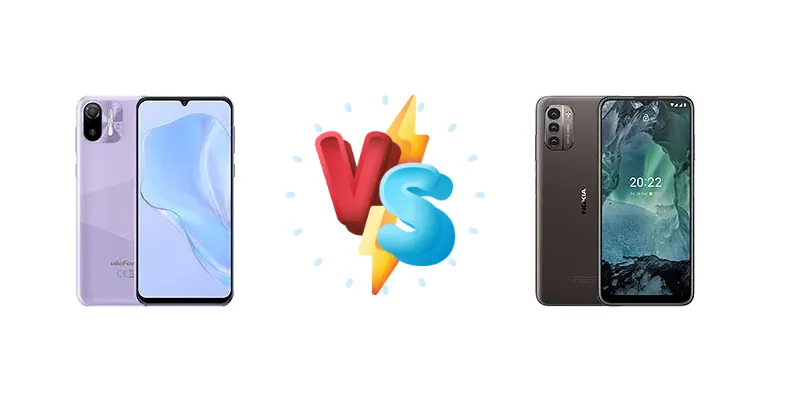
The Ulefone Note 6P and Nokia G21 represent the fiercely competitive sub-$200 smartphone market. Both aim to deliver essential functionality at an accessible price, but they take different approaches. The Note 6P focuses on offering a slightly more modern CPU architecture, while the G21 prioritizes battery endurance and a more refined user experience, backed by Nokia's software commitment.
🏆 Quick Verdict
For the average user prioritizing longevity and consistent performance, the Nokia G21 is the better choice. Its Unisoc T606 chipset, built on a smaller 12nm process, offers improved efficiency and a more capable CPU configuration, offsetting the similar battery endurance rating. The Ulefone Note 6P is a viable option for those seeking the absolute lowest price.
| Network |
|---|
| 2G bands | GSM 850 / 900 / 1800 / 1900 | GSM 850 / 900 / 1800 / 1900 |
| 3G bands | HSDPA 850 / 900 / 2100 | HSDPA 850 / 900 / 2100 - International |
| 4G bands | 1, 3, 5, 7, 8, 20 | 1, 3, 5, 7, 8, 20, 28, 38, 40, 41 - International |
| Speed | HSPA 21.1/5.76 Mbps, LTE | HSPA 42.2/5.76 Mbps, LTE Cat4 150/50 Mbps |
| Technology | GSM / HSPA / LTE | GSM / HSPA / LTE |
| | - | 1, 2, 3, 4, 5, 7, 8, 12, 17, 28, 40, 66 - LATAM |
| Launch |
|---|
| Announced | 2021, October 25 | 2022, February 14 |
| Status | Available. Released 2021, October 25 | Available. Released 2022, February 15 |
| Body |
|---|
| Build | - | Glass front, plastic frame, plastic back |
| Dimensions | 155.4 x 73.4 x 8.5 mm (6.12 x 2.89 x 0.33 in) | 164.6 x 75.9 x 8.5 mm (6.48 x 2.99 x 0.33 in) |
| SIM | Nano-SIM + Nano-SIM | · Nano-SIM· Nano-SIM + Nano-SIM |
| Weight | 155 g (5.47 oz) | 190 g (6.70 oz) |
| Display |
|---|
| Resolution | 720 x 1560 pixels, 19.5:9 ratio (~282 ppi density) | 720 x 1600 pixels, 20:9 ratio (~270 ppi density) |
| Size | 6.1 inches, 91.3 cm2 (~80.1% screen-to-body ratio) | 6.5 inches, 102.0 cm2 (~81.6% screen-to-body ratio) |
| Type | IPS LCD | IPS LCD, 90Hz, 400 nits (typ) |
| Platform |
|---|
| CPU | Octa-core (4x1.6 GHz Cortex-A55 & 4x1.2 GHz Cortex-A55) | Octa-core (2x1.6 GHz Cortex-A75 & 6x1.6 GHz Cortex-A55) |
| Chipset | Unisoc SC9863A (28 nm) | Unisoc T606 (12 nm) |
| GPU | IMG8322 | Mali-G57 MP1 |
| OS | Android 11 (Go edition) | Android 11, upgradable to Android 13 |
| Memory |
|---|
| Card slot | microSDXC (dedicated slot) | microSDXC (dedicated slot) |
| Internal | 32GB 2GB RAM | 64GB 3GB RAM, 64GB 4GB RAM, 128GB 4GB RAM, 128GB 6GB RAM |
| | eMMC 5.1 | eMMC 5.1 |
| Main Camera |
|---|
| Features | LED flash | LED flash, HDR, panorama |
| Single | 8 MP | 8 MP, f/2.0, (wide) |
| Triple | - | 50 MP, f/1.8, 28mm (wide), 1/2.76", 0.64µm, PDAF
2 MP (macro)
Auxiliary lens |
| Video | 1080p@30fps | 1080p@30fps |
| Selfie camera |
|---|
| Single | 5 MP | 8 MP, f/2.0, (wide) |
| Video | - | 1080p@30fps |
| Sound |
|---|
| 3.5mm jack | Yes | Yes |
| 35mm jack | Yes | Yes |
| Loudspeaker | Yes | Yes |
| Comms |
|---|
| Bluetooth | 4.2, A2DP | 5.0, A2DP, LE |
| NFC | No | Yes (market/region dependent) |
| Positioning | GPS, GLONASS, BDS | GPS, GLONASS, GALILEO |
| Radio | Stereo FM radio, RDS, recording | FM radio, RDS |
| USB | microUSB 2.0 | USB Type-C 2.0, OTG |
| WLAN | Wi-Fi 802.11 b/g/n | Wi-Fi 802.11 a/b/g/n/ac, dual-band, Wi-Fi Direct |
| Features |
|---|
| Sensors | Accelerometer, proximity | Fingerprint (side-mounted), accelerometer, proximity |
| Battery |
|---|
| Charging | - | 18W wired, PD3.0 |
| Type | Li-Po 3300 mAh | Li-Po 5050 mAh |
| Misc |
|---|
| Colors | Black, Green, Purple, Red | Nordic Blue, Dusk |
| Models | - | TA-1418, TA-1477, TA-1415, TA-1405, TA-1404, TA-1412 |
| Price | About 90 EUR | About 90 EUR |
| SAR | - | 1.00 W/kg (head) 1.10 W/kg (body) |
| SAR EU | - | 0.34 W/kg (head) 1.05 W/kg (body) |
| Tests |
|---|
| Battery life | - |
Endurance rating 126h
|
| Camera | - |
Photo / Video |
| Display | - |
Contrast ratio: 1631:1 (nominal) |
| Loudspeaker | - |
-30.7 LUFS (Below average)
|
| Performance | - |
AnTuTu: 171299 (v9)
GeekBench: 1193 (v5.1)
GFXBench: 8.9fps (ES 3.1 onscreen) |
Ulefone Note 6P
- Potentially lower price point
- Functional for basic smartphone tasks
- Acceptable performance for light usage
- Less efficient chipset (28nm)
- Older CPU architecture
- Likely slower app loading times
Nokia G21
- More efficient chipset (12nm)
- Faster CPU cores (Cortex-A75)
- 18W charging with PD3.0
- Nokia's software support
- Slightly higher price
- Similar battery endurance rating doesn't guarantee longer real-world use without chipset efficiency
- Camera specs are unknown
Display Comparison
Both the Ulefone Note 6P and Nokia G21 feature displays with a 1631:1 contrast ratio, suggesting similar visual characteristics in terms of black levels and color pop. However, the Nokia G21 boasts a measured peak brightness of 500 nits, which will translate to better visibility outdoors under direct sunlight. While both likely utilize IPS LCD panels, the Nokia G21’s higher brightness provides a tangible advantage for usability in bright environments. Details regarding the panel technology (e.g., PWM dimming rate) are missing, making it difficult to assess potential eye strain for sensitive users.
Camera Comparison
Both devices are listed as having 'Photo / Video' capabilities, offering minimal insight into their camera performance. Without specific sensor details (megapixel count, sensor size, aperture), it’s difficult to draw meaningful conclusions. It’s likely both phones feature basic camera setups geared towards casual photography. The absence of information regarding Optical Image Stabilization (OIS) suggests neither phone will excel in low-light conditions. Focusing on the main sensor specifications would be crucial for a proper camera comparison.
Performance
The core difference lies in the chipsets. The Ulefone Note 6P utilizes the Unisoc SC9863A, fabricated on a larger 28nm process. Its CPU configuration consists of four Cortex-A55 cores clocked at 1.6GHz and four at 1.2GHz. The Nokia G21, conversely, employs the Unisoc T606, built on a more efficient 12nm process. This chipset features a more potent CPU arrangement: two Cortex-A75 cores at 1.6GHz and six Cortex-A55 cores at 1.6GHz. The inclusion of the Cortex-A75 cores in the G21 provides a significant performance boost in single-threaded tasks and overall responsiveness, making app launches and multitasking smoother. The 12nm process also contributes to lower power consumption, enhancing battery life.
Battery Life
Both the Ulefone Note 6P and Nokia G21 share an endurance rating of 126 hours, indicating comparable battery life under similar usage patterns. However, the Nokia G21’s more efficient Unisoc T606 chipset, manufactured on a 12nm process, will likely translate to longer real-world usage. The G21 also supports 18W wired charging with PD3.0, offering faster and more versatile charging options compared to the Ulefone Note 6P, where charging specifications are not provided. This faster charging capability reduces downtime and enhances the overall user experience.
Buying Guide
Buy the Ulefone Note 6P if you need a functional smartphone for basic tasks like calls, messaging, and light web browsing, and your budget is extremely limited. Buy the Nokia G21 if you prefer a more responsive user experience, slightly better performance for everyday apps, and the peace of mind of Nokia’s software update policy, even if it means spending a little more.
Frequently Asked Questions
❓ Does the Unisoc T606 in the Nokia G21 struggle with demanding games like PUBG Mobile?
While the Unisoc T606 isn't a gaming powerhouse, it's capable of running PUBG Mobile at medium settings with reasonable frame rates. Expect some occasional stuttering, especially in intense firefights. The Ulefone Note 6P's SC9863A will likely offer a less smooth gaming experience due to its less powerful CPU and GPU.
❓ How does Nokia's software support compare to Ulefone's for the G21?
Nokia is known for providing relatively consistent software updates and security patches for its Android devices, even in the budget segment. Ulefone's software support is less predictable. Choosing the Nokia G21 means you're more likely to receive security updates and bug fixes, extending the lifespan and security of your device.
❓ Is the 18W charging on the Nokia G21 significantly faster than a standard 10W charger?
Yes, 18W charging with PD3.0 will noticeably reduce charging times compared to a standard 10W charger. While a full 0-100% charge time isn't specified, you can expect to gain a substantial percentage of battery life in a shorter period, making it more convenient for users on the go.