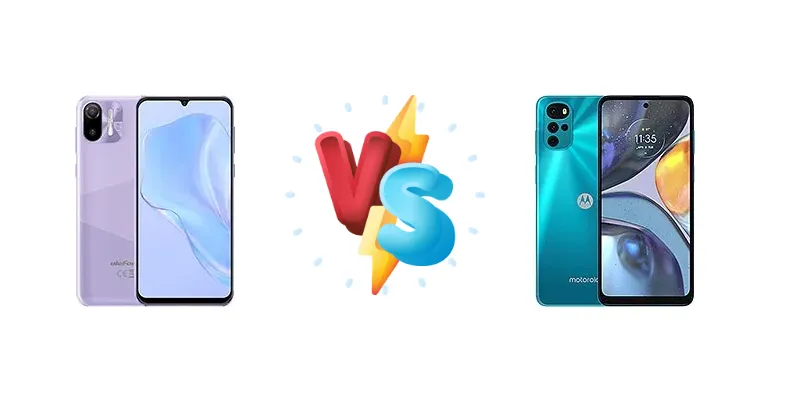
The Ulefone Note 6P and Motorola Moto G22 represent two compelling options in the ultra-budget smartphone space. While both aim to deliver essential smartphone functionality at a low price point, they take different approaches to achieving this, primarily through their chipset choices. This comparison dissects those differences, focusing on performance, efficiency, and the user experience.
🏆 Quick Verdict
For the average user prioritizing overall efficiency and slightly better performance in sustained tasks, the Motorola Moto G22 is the stronger choice. Its 12nm Helio G37 chipset offers a noticeable advantage over the Ulefone Note 6P’s 28nm Unisoc SC9863A, despite the latter’s higher core count. However, the Note 6P remains a viable option for basic usage.
| Network |
|---|
| 2G bands | GSM 850 / 900 / 1800 / 1900 | GSM 850 / 900 / 1800 / 1900 |
| 3G bands | HSDPA 850 / 900 / 2100 | HSDPA 850 / 900 / 1900 / 2100 |
| 4G bands | 1, 3, 5, 7, 8, 20 | 1, 3, 5, 7, 8, 20, 38, 40, 41 |
| Speed | HSPA 21.1/5.76 Mbps, LTE | HSPA 42.2/5.76 Mbps, LTE Cat4 150/50 Mbps |
| Technology | GSM / HSPA / LTE | GSM / HSPA / LTE |
| Launch |
|---|
| Announced | 2021, October 25 | 2022, March 04 |
| Status | Available. Released 2021, October 25 | Available. Released 2022, March 04 |
| Body |
|---|
| Build | - | Glass front, plastic frame, plastic back |
| Dimensions | 155.4 x 73.4 x 8.5 mm (6.12 x 2.89 x 0.33 in) | 164 x 75 x 8.5 mm (6.46 x 2.95 x 0.33 in) |
| SIM | Nano-SIM + Nano-SIM | · Nano-SIM· Nano-SIM + Nano-SIM |
| Weight | 155 g (5.47 oz) | 185 g (6.53 oz) |
| | - | Water-repellent design |
| Display |
|---|
| Resolution | 720 x 1560 pixels, 19.5:9 ratio (~282 ppi density) | 720 x 1600 pixels, 20:9 ratio (~268 ppi density) |
| Size | 6.1 inches, 91.3 cm2 (~80.1% screen-to-body ratio) | 6.5 inches, 103.5 cm2 (~84.2% screen-to-body ratio) |
| Type | IPS LCD | IPS LCD, 90Hz |
| Platform |
|---|
| CPU | Octa-core (4x1.6 GHz Cortex-A55 & 4x1.2 GHz Cortex-A55) | Octa-core (4x2.3 GHz Cortex-A53 & 4x1.8 GHz Cortex-A53) |
| Chipset | Unisoc SC9863A (28 nm) | Mediatek MT6765V/CB Helio G37 (12 nm) |
| GPU | IMG8322 | PowerVR GE8320 |
| OS | Android 11 (Go edition) | Android 12 |
| Memory |
|---|
| Card slot | microSDXC (dedicated slot) | microSDXC (dedicated slot) |
| Internal | 32GB 2GB RAM | 64GB 4GB RAM, 128GB 4GB RAM |
| | eMMC 5.1 | - |
| Main Camera |
|---|
| Features | LED flash | LED flash, HDR, panorama |
| Quad | - | 50 MP, f/1.8, (wide), 0.64µm, PDAF
8 MP, f/2.2, 118˚ (ultrawide), 1/4.0", 1.12µm
2 MP (macro)
Auxiliary lens |
| Single | 8 MP | - |
| Video | 1080p@30fps | 1080p@30fps |
| Selfie camera |
|---|
| Features | - | HDR |
| Single | 5 MP | 16 MP, f/2.5, (wide), 1.0µm |
| Video | - | 1080p@30fps |
| Sound |
|---|
| 3.5mm jack | Yes | Yes |
| 35mm jack | Yes | Yes |
| Loudspeaker | Yes | Yes |
| Comms |
|---|
| Bluetooth | 4.2, A2DP | 5.0, A2DP, LE |
| NFC | No | Yes (market/region dependent) |
| Positioning | GPS, GLONASS, BDS | GPS, GLONASS, GALILEO |
| Radio | Stereo FM radio, RDS, recording | Unspecified |
| USB | microUSB 2.0 | USB Type-C 2.0 |
| WLAN | Wi-Fi 802.11 b/g/n | Wi-Fi 802.11 a/b/g/n/ac, dual-band, Wi-Fi Direct |
| Features |
|---|
| Sensors | Accelerometer, proximity | Fingerprint (side-mounted), accelerometer, gyro, proximity, compass |
| Battery |
|---|
| Charging | - | 20W wired (India)
15W wired (Global) |
| Type | Li-Po 3300 mAh | Li-Po 5000 mAh |
| Misc |
|---|
| Colors | Black, Green, Purple, Red | Pearl White, Iceberg Blue, Cosmic Black, Mint Green |
| Models | - | XT2231-1, XT2231-2, XT2231-5 |
| Price | About 90 EUR | About 120 EUR |
Ulefone Note 6P
- Potentially lower price point
- Likely larger storage options (depending on configuration)
- May offer a larger battery capacity (speculative)
- Less efficient Unisoc SC9863A chipset
- Likely slower charging speeds
- Poorer sustained performance due to thermal throttling
Motorola Moto G22
- More efficient MediaTek Helio G37 chipset
- Faster charging (20W/15W)
- Better sustained performance
- Potentially higher price
- May have smaller base storage
- Potentially smaller battery capacity
Display Comparison
Neither device boasts a standout display. Details are missing regarding panel type, brightness, and color accuracy. However, the focus here is on the internal hardware. We can assume both utilize IPS LCD panels common in this price bracket. The absence of high refresh rates or advanced features like LTPO is expected. Bezels are likely comparable, contributing minimally to a differentiating factor.
Camera Comparison
Both phones likely feature basic camera setups. Without specific sensor details, it’s difficult to make a definitive judgment. However, the market segment suggests both will rely on budget sensors. The presence of a 2MP macro camera on either device is largely a marketing gimmick and offers minimal practical benefit. Image processing will likely be basic on both, prioritizing speed over quality. The G22 may have a slight edge if it utilizes a larger primary sensor, but this is speculative without further information.
Performance
The core difference lies in the chipsets. The Motorola Moto G22’s MediaTek Helio G37 (12nm) utilizes a more modern fabrication process than the Ulefone Note 6P’s Unisoc SC9863A (28nm). While the Ulefone has eight Cortex-A55 cores, split between 1.6GHz and 1.2GHz, the Moto G22 features four Cortex-A53 cores clocked at 2.3GHz and four at 1.8GHz. The A53 architecture, despite being older, generally outperforms the A55 at similar clock speeds. Crucially, the 12nm process of the Helio G37 translates to significantly better power efficiency and thermal management. This means the Moto G22 is less likely to throttle under sustained load, offering a smoother experience during prolonged app usage or light gaming. The Unisoc chip, being older and on a larger node, will struggle with heat and performance consistency.
Battery Life
Battery capacity is not specified for the Ulefone Note 6P, but we can assume it's in the 4000-5000mAh range, typical for this class. The Moto G22 benefits from 20W (India) / 15W (Global) wired charging, a significant advantage over the likely 10W or slower charging on the Ulefone. While a larger battery capacity on the Note 6P *could* offset the G22’s faster charging, the Helio G37’s superior efficiency means the G22 will likely consume less power overall, resulting in comparable or even better real-world battery life despite potentially having a smaller battery.
Buying Guide
Buy the Ulefone Note 6P if you need a phone for extremely light tasks – basic calling, texting, and occasional social media browsing – and prioritize the absolute lowest possible price. Buy the Motorola Moto G22 if you prefer a phone that can handle more demanding apps, occasional gaming, and benefits from a more efficient chipset, even if it means spending a little more. The G22 is better suited for users who want a phone that feels responsive for longer.
Frequently Asked Questions
❓ Will the Unisoc SC9863A in the Ulefone Note 6P struggle with multitasking?
Yes, the Unisoc SC9863A’s older architecture and less efficient fabrication process mean it will likely struggle with heavy multitasking. Switching between multiple apps may result in noticeable lag and slowdowns. It's best suited for running one app at a time.
❓ Does the Motorola Moto G22 support fast charging, and how long does it take to fully charge?
The Moto G22 supports 20W fast charging in India and 15W globally. While not exceptionally fast, it's significantly quicker than the likely 10W charging on the Ulefone Note 6P. A full charge from 0-100% should take approximately 1.5-2.5 hours, depending on the charger and usage.
❓ Is the Helio G37 in the Moto G22 capable of playing popular mobile games like PUBG Mobile?
The Helio G37 can run PUBG Mobile, but you'll need to lower the graphics settings to medium or low to achieve a playable framerate. Don't expect a smooth, high-fidelity gaming experience. The Ulefone Note 6P will likely struggle even at the lowest settings.