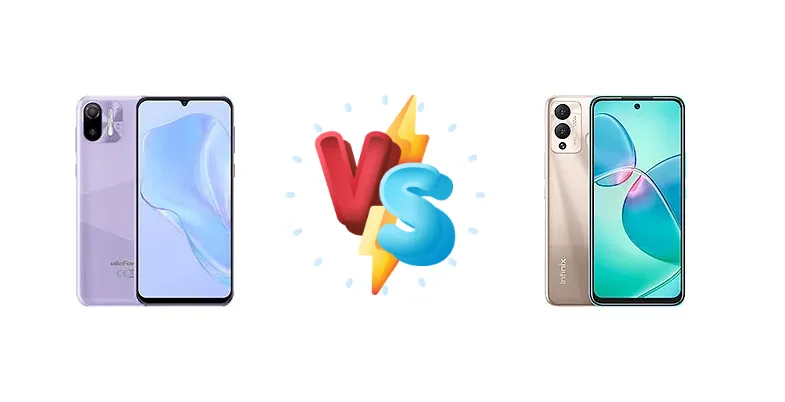
The Ulefone Note 6P and Infinix Hot 12 Play represent the fiercely competitive sub-$150 smartphone market. Both aim to deliver essential functionality at an accessible price, but they take different approaches to achieving this. The Note 6P relies on an older, power-efficient chipset, while the Hot 12 Play opts for a newer, though still entry-level, Mediatek processor. This comparison will dissect their strengths and weaknesses to determine which device offers the best value.
🏆 Quick Verdict
For the average user prioritizing efficiency and a slightly more responsive experience, the Infinix Hot 12 Play is the better choice. Its 12nm Helio G37 chipset offers a performance edge over the Ulefone Note 6P’s 28nm Unisoc SC9863A, despite the latter’s octa-core configuration. While neither phone excels in any single area, the Hot 12 Play provides a more balanced package.
| Network |
|---|
| 2G bands | GSM 850 / 900 / 1800 / 1900 | GSM 850 / 900 / 1800 / 1900 |
| 3G bands | HSDPA 850 / 900 / 2100 | HSDPA 850 / 900 / 2100 |
| 4G bands | 1, 3, 5, 7, 8, 20 | 1, 3, 5, 8, 38, 40, 41 |
| Speed | HSPA 21.1/5.76 Mbps, LTE | HSPA, LTE |
| Technology | GSM / HSPA / LTE | GSM / HSPA / LTE |
| | - | 1, 2, 3, 4, 5, 7, 8, 20, 28, 38, 40, 41 |
| Launch |
|---|
| Announced | 2021, October 25 | 2022, May 23 |
| Status | Available. Released 2021, October 25 | Available. Released 2022, May 30 |
| Body |
|---|
| Build | - | Glass front, plastic back, plastic frame |
| Dimensions | 155.4 x 73.4 x 8.5 mm (6.12 x 2.89 x 0.33 in) | 171 x 78 x 8.9 mm (6.73 x 3.07 x 0.35 in) |
| SIM | Nano-SIM + Nano-SIM | Nano-SIM + Nano-SIM |
| Weight | 155 g (5.47 oz) | 209 g (7.37 oz) |
| Display |
|---|
| Resolution | 720 x 1560 pixels, 19.5:9 ratio (~282 ppi density) | 720 x 1612 pixels, 20:9 ratio (~259 ppi density) |
| Size | 6.1 inches, 91.3 cm2 (~80.1% screen-to-body ratio) | 6.82 inches, 111.7 cm2 (~83.8% screen-to-body ratio) |
| Type | IPS LCD | IPS LCD, 90Hz |
| Platform |
|---|
| CPU | Octa-core (4x1.6 GHz Cortex-A55 & 4x1.2 GHz Cortex-A55) | Octa-core (4x2.3 GHz Cortex-A53 & 4x1.8 GHz Cortex-A53) - X6816Octa-core (2x1.8 GHz Cortex-A75 & 6x1.8 GHz Cortex-A55) - X6816C |
| Chipset | Unisoc SC9863A (28 nm) | Mediatek MT6765V/CB Helio G37 (12 nm) - X6816Unisoc T610 (12 nm) - X6816C |
| GPU | IMG8322 | PowerVR GE8320 - X6816Mali-G52 MP2 - X6816C |
| OS | Android 11 (Go edition) | Android 11, XOS 10 |
| Memory |
|---|
| Card slot | microSDXC (dedicated slot) | microSDXC (dedicated slot) |
| Internal | 32GB 2GB RAM | 64GB 4GB RAM, 128GB 4GB RAM, 128GB 6GB RAM |
| | eMMC 5.1 | eMMC 5.1 |
| Main Camera |
|---|
| Dual | - | 13 MP, f/1.8, (wide), 1/3.1", 1.12µm, AF
Auxiliary lens |
| Features | LED flash | Dual-LED flash, panorama, HDR |
| Single | 8 MP | 8 MP |
| Video | 1080p@30fps | 1080p@30fps |
| Selfie camera |
|---|
| Features | - | Dual-LED flash |
| Single | 5 MP | 8 MP |
| Video | - | 1080p@30fps |
| Sound |
|---|
| 3.5mm jack | Yes | Yes |
| 35mm jack | Yes | Yes |
| Loudspeaker | Yes | Yes |
| Comms |
|---|
| Bluetooth | 4.2, A2DP | Yes |
| NFC | No | No |
| Positioning | GPS, GLONASS, BDS | GPS |
| Radio | Stereo FM radio, RDS, recording | FM radio |
| USB | microUSB 2.0 | USB Type-C 2.0, OTG |
| WLAN | Wi-Fi 802.11 b/g/n | Wi-Fi 802.11 a/b/g/n/ac, dual-band, Wi-Fi Direct |
| Features |
|---|
| Sensors | Accelerometer, proximity | Fingerprint (rear-mounted), accelerometer, proximity, compass |
| Battery |
|---|
| Charging | - | 10W wired |
| Type | Li-Po 3300 mAh | 6000 mAh |
| Misc |
|---|
| Colors | Black, Green, Purple, Red | Racing Black, Horizon Blue, Daylight Green, Champagne Gold |
| Models | - | X6816C, X6816 |
| Price | About 90 EUR | About 60 EUR |
Ulefone Note 6P
- Potentially longer battery life due to efficient chipset.
- Lower manufacturing cost, potentially translating to a lower price.
- Simpler processor may result in less software bloat.
- Significantly slower performance compared to the Hot 12 Play.
- Older chipset architecture.
- Larger fabrication node (28nm) leads to higher power consumption for equivalent tasks.
Infinix Hot 12 Play
- More responsive user experience thanks to the Helio G37.
- Newer chipset architecture (though A53 cores).
- 12nm fabrication process offers better efficiency than 28nm.
- 10W charging is relatively slow.
- Potentially shorter battery life compared to the Note 6P.
- May include more pre-installed bloatware.
Display Comparison
Neither Ulefone nor Infinix provide display specifications beyond resolution in their marketing materials. However, given the price point, both likely utilize IPS LCD panels. The key difference lies under the hood: the Hot 12 Play’s Helio G37, fabricated on a 12nm process, suggests a more modern manufacturing process potentially leading to better color reproduction and viewing angles compared to the Note 6P’s older 28nm Unisoc chip. Bezels are expected to be substantial on both devices, reflecting their budget nature.
Camera Comparison
Camera details are sparse for both devices. It’s safe to assume both feature a primary camera and potentially a depth or macro sensor. Given the price bracket, image quality will be heavily reliant on software processing. Without specific sensor size or aperture information, it’s difficult to definitively declare a winner. However, the Hot 12 Play’s more modern chipset *may* offer slightly better image signal processing (ISP) capabilities, potentially leading to improved dynamic range and noise reduction. The presence of a 2MP macro lens on either device should be considered a marketing gimmick rather than a genuine photographic feature.
Performance
The performance disparity is the most significant factor in this comparison. The Infinix Hot 12 Play, equipped with the Mediatek Helio G37 (12nm), boasts a CPU clock speed of up to 2.3 GHz using Cortex-A53 cores. This contrasts with the Ulefone Note 6P’s Unisoc SC9863A (28nm) which peaks at 1.6 GHz with Cortex-A55 cores. While both are octa-core, the newer architecture and smaller fabrication node of the Helio G37 provide a clear advantage in both single-core and multi-core performance. The Hot 12 Play’s CPU architecture (A53 vs A55) is older, but the process node and clock speed compensate. The Note 6P’s 28nm process will likely result in higher power consumption for similar tasks.
Battery Life
Battery capacity isn’t specified in the provided data. However, the Ulefone Note 6P’s power-efficient Unisoc SC9863A (28nm) will likely translate to longer battery life, even with a smaller capacity battery, compared to the Infinix Hot 12 Play. The Hot 12 Play is limited to 10W wired charging, suggesting slower charging times. The Note 6P’s charging speed is unknown, but the efficiency of its chipset could offset a slower charging rate with extended usage time.
Buying Guide
Buy the Ulefone Note 6P if you prioritize maximizing battery life and are primarily using the phone for basic tasks like calls, texts, and light social media. Its older, less powerful chipset consumes less energy. Buy the Infinix Hot 12 Play if you prefer a slightly snappier user experience, even for moderate multitasking, and appreciate the potential for smoother gaming, albeit at low settings. The Hot 12 Play is the better all-rounder.
Frequently Asked Questions
❓ Does the Helio G37 in the Infinix Hot 12 Play struggle with demanding games like PUBG Mobile?
While the Helio G37 isn't a gaming powerhouse, it can run PUBG Mobile at low to medium settings with acceptable frame rates. Expect some stuttering and reduced graphical fidelity. The Ulefone Note 6P would likely struggle even more with this title.
❓ Is the Ulefone Note 6P a good choice for someone who primarily uses their phone for calls and basic messaging?
Yes, the Ulefone Note 6P is well-suited for basic communication tasks. Its power-efficient chipset will maximize battery life, making it ideal for users who don't require demanding features or applications.
❓ How much bloatware is pre-installed on the Infinix Hot 12 Play?
Infinix phones are known to include a moderate amount of pre-installed apps. While most can be uninstalled, it's something to be aware of. The Ulefone Note 6P may have less bloatware due to its simpler software implementation.
❓ Will either phone receive significant software updates?
Neither the Ulefone Note 6P nor the Infinix Hot 12 Play are likely to receive extensive software updates. Expect security patches at best, and potentially one major Android version upgrade, if any.