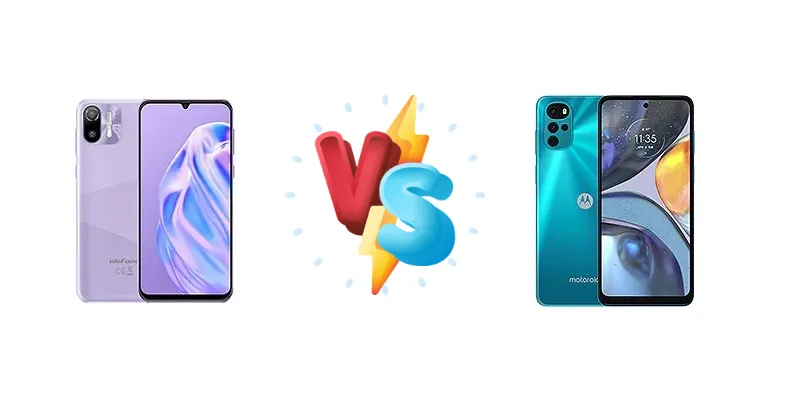
The Ulefone Note 6 and Motorola Moto G22 represent two distinct approaches to the ultra-budget smartphone market. The Ulefone aims for affordability above all else, while the Moto G22 attempts to balance cost with a more modern chipset and faster charging. This comparison dissects their key differences to determine which device delivers the best value.
🏆 Quick Verdict
For most users, the Motorola Moto G22 is the superior choice. Its MediaTek Helio G37 chipset, featuring an octa-core CPU, provides a significantly more responsive experience than the Ulefone Note 6’s quad-core Unisoc SC7731e. While the Ulefone is cheaper, the performance gap justifies the slight price increase for the Moto G22.
| Network |
|---|
| 2G bands | GSM 850 / 900 / 1800 / 1900 | GSM 850 / 900 / 1800 / 1900 |
| 3G bands | HSDPA 850 / 900 / 1900 / 2100 | HSDPA 850 / 900 / 1900 / 2100 |
| 4G bands | - | 1, 3, 5, 7, 8, 20, 38, 40, 41 |
| Speed | HSPA 21.1/5.76 Mbps | HSPA 42.2/5.76 Mbps, LTE Cat4 150/50 Mbps |
| Technology | GSM / HSPA | GSM / HSPA / LTE |
| Launch |
|---|
| Announced | 2021, July 11 | 2022, March 04 |
| Status | Available. Released 2021, July 11 | Available. Released 2022, March 04 |
| Body |
|---|
| Build | - | Glass front, plastic frame, plastic back |
| Dimensions | 155.4 x 73.4 x 8.5 mm (6.12 x 2.89 x 0.33 in) | 164 x 75 x 8.5 mm (6.46 x 2.95 x 0.33 in) |
| SIM | Nano-SIM + Micro-SIM | · Nano-SIM· Nano-SIM + Nano-SIM |
| Weight | 155 g (5.47 oz) | 185 g (6.53 oz) |
| | - | Water-repellent design |
| Display |
|---|
| Resolution | 720 x 1560 pixels, 19.5:9 ratio (~282 ppi density) | 720 x 1600 pixels, 20:9 ratio (~268 ppi density) |
| Size | 6.1 inches, 91.3 cm2 (~80.1% screen-to-body ratio) | 6.5 inches, 103.5 cm2 (~84.2% screen-to-body ratio) |
| Type | IPS LCD | IPS LCD, 90Hz |
| Platform |
|---|
| CPU | Quad-core 1.3 GHz Cortex-A7 | Octa-core (4x2.3 GHz Cortex-A53 & 4x1.8 GHz Cortex-A53) |
| Chipset | Unisoc SC7731e | Mediatek MT6765V/CB Helio G37 (12 nm) |
| GPU | Mali-T820 MP1 | PowerVR GE8320 |
| OS | Android 11 (Go edition) | Android 12 |
| Memory |
|---|
| Card slot | microSDXC (dedicated slot) | microSDXC (dedicated slot) |
| Internal | 32GB 1GB RAM | 64GB 4GB RAM, 128GB 4GB RAM |
| | eMMC 5.1 | - |
| Main Camera |
|---|
| Features | LED flash | LED flash, HDR, panorama |
| Quad | - | 50 MP, f/1.8, (wide), 0.64µm, PDAF
8 MP, f/2.2, 118˚ (ultrawide), 1/4.0", 1.12µm
2 MP (macro)
Auxiliary lens |
| Single | 5 MP | - |
| Video | 1080p@30fps | 1080p@30fps |
| Selfie camera |
|---|
| Features | - | HDR |
| Single | 2 MP | 16 MP, f/2.5, (wide), 1.0µm |
| Video | - | 1080p@30fps |
| Sound |
|---|
| 3.5mm jack | Yes | Yes |
| 35mm jack | Yes | Yes |
| Loudspeaker | Yes | Yes |
| Comms |
|---|
| Bluetooth | 4.2, A2DP | 5.0, A2DP, LE |
| NFC | No | Yes (market/region dependent) |
| Positioning | GPS | GPS, GLONASS, GALILEO |
| Radio | Stereo FM radio, RDS, recording | Unspecified |
| USB | microUSB 2.0 | USB Type-C 2.0 |
| WLAN | Wi-Fi 802.11 b/g/n | Wi-Fi 802.11 a/b/g/n/ac, dual-band, Wi-Fi Direct |
| Features |
|---|
| Sensors | Accelerometer, proximity | Fingerprint (side-mounted), accelerometer, gyro, proximity, compass |
| Battery |
|---|
| Charging | - | 20W wired (India)
15W wired (Global) |
| Type | Li-Po 3300 mAh | Li-Po 5000 mAh |
| Misc |
|---|
| Colors | Black, Green, Purple, Red | Pearl White, Iceberg Blue, Cosmic Black, Mint Green |
| Models | - | XT2231-1, XT2231-2, XT2231-5 |
| Price | - | About 120 EUR |
Ulefone Note 6
- Lowest possible price point
- Potentially longer battery life (depending on capacity)
- Simple and straightforward user experience
- Extremely slow performance
- Outdated chipset architecture
- Likely poor camera quality
- Slow charging speeds
Motorola Moto G22
- Significantly faster performance
- Faster charging (20W in India, 15W globally)
- More efficient chipset
- Better multitasking capabilities
- Slightly higher price
- Camera performance still limited by budget sensors
- May not be ideal for heavy gaming
Display Comparison
Neither device boasts a standout display. Both likely utilize IPS LCD panels, common in this price bracket. However, details like resolution and peak brightness are missing for the Ulefone Note 6. The Moto G22’s display is likely the more visually appealing of the two, given Motorola’s generally better display calibration. The absence of high refresh rates on either device is expected, but the Moto G22’s panel benefits from the more modern chipset’s image processing capabilities.
Camera Comparison
Camera performance is likely to be similar in real-world usage, as both phones will rely heavily on software processing to compensate for their budget sensors. Details regarding sensor sizes and apertures are unavailable for the Ulefone Note 6, but it’s safe to assume they are modest. The Moto G22 likely features a larger main sensor, benefiting from the more powerful ISP within the Helio G37. The inclusion of a 2MP macro camera on both devices is largely a marketing gimmick, offering limited practical value. Expect acceptable photos in good lighting conditions, but significant noise and lack of detail in low light.
Performance
The performance disparity is the most significant difference. The Ulefone Note 6’s Unisoc SC7731e, with its quad-core Cortex-A7 CPU, is a decidedly entry-level chipset. In contrast, the Motorola Moto G22’s MediaTek Helio G37 utilizes an octa-core configuration (4x2.3 GHz Cortex-A53 & 4x1.8 GHz Cortex-A53) built on a more efficient 12nm process. This translates to substantially faster processing speeds and improved multitasking capabilities for the Moto G22. The Helio G37’s GPU will also offer a better gaming experience, though both phones will struggle with graphically intensive titles. The Ulefone will likely exhibit noticeable lag even with everyday apps.
Battery Life
Battery capacity is not specified for the Ulefone Note 6, but it's likely around 4000-5000mAh, typical for this segment. The Moto G22 offers a significant advantage in charging speed, supporting 20W wired charging in India (15W globally). This faster charging capability will reduce downtime compared to the Ulefone, which likely supports only 10W or 5W charging. While a larger battery capacity on the Ulefone *could* offset the slower charging, the Helio G37’s improved power efficiency means the Moto G22 will likely deliver comparable, if not better, real-world battery life.
Buying Guide
Buy the Ulefone Note 6 if your primary need is an extremely affordable device for basic tasks like calls, texts, and light web browsing, and you are willing to accept noticeable performance limitations. Buy the Motorola Moto G22 if you prioritize a smoother user experience, faster app loading times, and the ability to handle moderately demanding tasks, even if it means spending a little more.
Frequently Asked Questions
❓ Will the Motorola Moto G22 struggle with demanding games like PUBG Mobile?
Yes, while the Helio G37 is a step up from the Ulefone’s chipset, it’s still an entry-level processor. PUBG Mobile will likely be playable at low settings and frame rates, but expect stuttering and lag, especially in intense scenes. The Ulefone Note 6 will struggle even more.
❓ Is the 2MP macro camera on either phone worth using?
Not really. 2MP macro cameras typically produce low-resolution, blurry images with limited detail. They are primarily a marketing feature and offer little practical benefit. You'll get better results using the main camera in standard photo mode.
❓ How long will it take to fully charge the Motorola Moto G22 with the 20W charger (in India)?
With the 20W charger, the Motorola Moto G22 should charge from 0-100% in approximately 1 hour and 45 minutes to 2 hours, depending on usage during charging. The 15W global version will take longer, closer to 2.5-3 hours.
❓ Can the Ulefone Note 6 handle basic social media apps like Facebook and WhatsApp smoothly?
The Ulefone Note 6 *can* run these apps, but expect noticeable lag and slow loading times, especially when switching between them. The Unisoc SC7731e chipset is simply not powerful enough for a fluid multitasking experience.