
Ulefone Note 20 Pro vs OnePlus Nord 2 5G: A Deep Dive into Value and Performance
| Phones Images | |||||
|---|---|---|---|---|---|
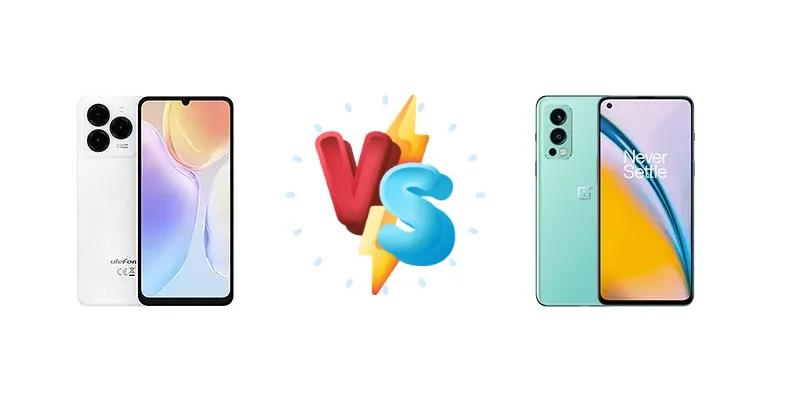
|
🏆 Quick Verdict
For the average user prioritizing speed and convenience, the OnePlus Nord 2 5G is the clear winner. Its Dimensity 1200 chipset and 65W charging are significantly faster. However, if maximizing battery life and value are paramount, the Ulefone Note 20 Pro’s 61:18h endurance is unmatched.
| PHONES | ||
|---|---|---|
| Phone Names | Ulefone Note 20 Pro | OnePlus Nord 2 5G |
| Network | ||
|---|---|---|
| 2G bands | GSM 850 / 900 / 1800 / 1900 | GSM 850 / 900 / 1800 / 1900 |
| 3G bands | HSDPA 850 / 900 / 2100 | HSDPA 800 / 850 / 900 / 1700(AWS) / 1800 / 1900 / 2100 |
| 4G bands | 1, 2, 3, 4, 5, 7, 8, 12, 17, 19, 20, 26, 28, 38, 40, 41, 66 - International | 1, 2, 3, 4, 5, 7, 8, 12, 17, 18, 19, 20, 26, 28, 32, 34, 38, 39, 40, 41, 66 - EU |
| 5G bands | - | 1, 3, 7, 8, 20, 28, 38, 41, 66, 78 SA/NSA - EU |
| Speed | HSPA, LTE | HSPA 42.2/5.76 Mbps, LTE Cat18 1200/150 Mbps, 5G |
| Technology | GSM / HSPA / LTE | GSM / HSPA / LTE / 5G |
| Launch | ||
|---|---|---|
| Announced | 2024, September | 2021, July 22 |
| Status | Available. Released 2024, September | Available. Released 2021, July 28 |
| Body | ||
|---|---|---|
| Build | - | Glass front (Gorilla Glass 5), glass back (Gorilla Glass 5), plastic frame |
| Dimensions | 167.8 x 77.4 x 9.1 mm (6.61 x 3.05 x 0.36 in) | 159.1 x 73.3 x 8.3 mm (6.26 x 2.89 x 0.33 in) |
| SIM | Nano-SIM + Nano-SIM | Nano-SIM + Nano-SIM |
| Weight | 217 g (7.65 oz) | 189 g (6.67 oz) |
| Display | ||
|---|---|---|
| Protection | Mohs level 4 | Corning Gorilla Glass 5 |
| Resolution | 720 x 1610 pixels, 20:9 ratio (~261 ppi density) | 1080 x 2400 pixels, 20:9 ratio (~409 ppi density) |
| Size | 6.75 inches, 109.5 cm2 (~84.3% screen-to-body ratio) | 6.43 inches, 99.8 cm2 (~85.6% screen-to-body ratio) |
| Type | IPS LCD, 90Hz | Fluid AMOLED, 90Hz, HDR10+ |
| Platform | ||
|---|---|---|
| CPU | Octa-core (2x1.6 GHz Cortex-A75 & 6x1.6 GHz Cortex-A55) | Octa-core (1x3.0 GHz Cortex-A78 & 3x2.6 GHz Cortex-A78 & 4x2.0 GHz Cortex-A55) |
| Chipset | Unisoc T606 (12 nm) | Mediatek Dimensity 1200 (6 nm) |
| GPU | Mali-G57 MP1 | Mali-G77 MC9 |
| OS | Android 14 | Android 11, upgradable to Android 13, OxygenOS 13 |
| Memory | ||
|---|---|---|
| Card slot | microSDXC (uses shared SIM slot) | No |
| Internal | 128GB 4GB RAM, 256GB 4GB RAM | 128GB 6GB RAM, 128GB 8GB RAM, 256GB 8GB RAM, 256GB 12GB RAM |
| Main Camera | ||
|---|---|---|
| Dual | 50 MP, f/2.0, (wide), 1/1.31", 1.2µm 2 MP (macro) | - |
| Features | LED flash, HDR, panorama | Dual-LED flash, HDR, panorama |
| Triple | - | 50 MP, f/1.9, 24mm (wide), 1/1.56", 1.0µm, PDAF, OIS 8 MP, f/2.3, 120˚ (ultrawide) Auxiliary lens |
| Video | 1440p@30fps, 1080p@30fps | 4K@30fps, 1080p@30/60/120fps, gyro-EIS |
| Selfie camera | ||
|---|---|---|
| Features | - | Auto HDR |
| Single | 8 MP, f/2.0, (wide), 1.12µm | 32 MP, f/2.5, (wide), 1/2.8", 0.8µm |
| Video | Yes | 1080p@30fps, gyro-EIS |
| Sound | ||
|---|---|---|
| 3.5mm jack | - | No |
| 35mm jack | Yes | No |
| Loudspeaker | Yes | Yes, with stereo speakers |
| Comms | ||
|---|---|---|
| Bluetooth | 5.0, A2DP | 5.2, A2DP, LE, aptX HD |
| Infrared port | Yes | - |
| NFC | No | Yes |
| Positioning | GPS, GLONASS, GALILEO, BDS | GPS, GLONASS, GALILEO, BDS, SBAS, NavIC |
| Radio | Wireless FM radio, RDS, recording | No |
| USB | USB Type-C 2.0 | USB Type-C 2.0, OTG |
| WLAN | Wi-Fi 802.11 a/b/g/n/ac, dual-band | Wi-Fi 802.11 a/b/g/n/ac/6, dual-band, Wi-Fi Direct |
| Features | ||
|---|---|---|
| Sensors | Accelerometer, proximity | Fingerprint (under display, optical), accelerometer, gyro, proximity, compass |
| Battery | ||
|---|---|---|
| Charging | 18W wired | 65W wired, PD, 100% in 30 min |
| Type | Li-Po 6000 mAh | Li-Po 4500 mAh |
| Misc | ||
|---|---|---|
| Colors | Satin Black, Ribbons White | Gray Sierra, Blue Haze, Green Wood, Pac-Man Edition |
| Models | - | DN2101, DN2103 |
| Price | About 110 EUR | € 189.00 / $ 219.99 / £ 148.00 |
| Tests | ||
|---|---|---|
| Battery life | - | Endurance rating 102h |
| Camera | - | Photo / Video |
| Display | - | Contrast ratio: Infinite (nominal) |
| Loudspeaker | - | -24.3 LUFS (Very good) |
| Performance | - | AnTuTu: 512164 (v8) | 598022 (v9) GeekBench: 2792 (v5.1) GFXBench: 38fps (ES 3.1 onscreen) |
| EU LABEL | ||
|---|---|---|
| Battery | 61:18h endurance, 1000 cycles | - |
| Energy | Class B | - |
| Free fall | Class C (112 falls) | - |
| Repairability | Class B | - |
Ulefone Note 20 Pro
- Exceptional battery life (61:18h endurance)
- High charge cycle count (1000 cycles)
- More affordable price point
- Significantly slower processor
- Slower charging speed (18W)
- Limited display information
OnePlus Nord 2 5G
- Powerful Dimensity 1200 chipset
- Ultra-fast 65W charging (0-100% in 30 min)
- Brighter and higher contrast display
- Shorter battery life compared to Ulefone
- Higher price tag
- May require more frequent charging
Display Comparison
The OnePlus Nord 2 5G boasts a brighter display, reaching a measured 633 nits, compared to an unspecified brightness for the Ulefone Note 20 Pro. While the Ulefone’s display specs are missing, the Nord 2’s infinite contrast ratio (typical of AMOLED panels) suggests deeper blacks and more vibrant colors. This benefits media consumption and outdoor visibility. The Nord 2’s display is likely to offer a superior viewing experience, especially in bright sunlight.
Camera Comparison
Both phones offer photo and video capabilities, but detailed camera specs are limited for the Ulefone. The OnePlus Nord 2 5G likely benefits from MediaTek’s Imagiq image signal processor, offering superior image processing. Without sensor size or aperture information for the Ulefone, it’s difficult to assess its low-light performance. The Nord 2’s camera system is expected to deliver more detailed and vibrant images, particularly in challenging conditions. The presence of OIS on the Nord 2 (likely) further enhances image and video quality.
Performance
The performance gap is substantial. The OnePlus Nord 2 5G’s MediaTek Dimensity 1200 (6nm) is a flagship-level chipset featuring a 1x3.0 GHz Cortex-A78 core and 3x2.6 GHz Cortex-A78 cores, alongside 4x2.0 GHz Cortex-A55 cores. This contrasts sharply with the Ulefone Note 20 Pro’s Unisoc T606 (12nm) with its 2x1.6 GHz Cortex-A75 and 6x1.6 GHz Cortex-A55 configuration. The Dimensity 1200’s more advanced architecture and smaller node size translate to significantly faster processing speeds and improved efficiency, making the Nord 2 far better suited for demanding tasks like gaming and video editing. The Ulefone will handle everyday tasks, but will struggle with graphically intensive applications.
Battery Life
The Ulefone Note 20 Pro shines in battery endurance, achieving an impressive 61:18h rating with a claimed 1000 charge cycles. The OnePlus Nord 2 5G, while still respectable at 102h, falls behind. However, the Nord 2 compensates with its blazing-fast 65W wired charging, capable of reaching 100% in just 30 minutes. The Ulefone’s 18W charging is considerably slower. This trade-off means the Nord 2 offers convenience, while the Ulefone prioritizes longevity between charges.
Buying Guide
Buy the Ulefone Note 20 Pro if you need a phone that will reliably last through two full days of moderate use, and you’re comfortable with a less powerful processor. This is ideal for travelers, field workers, or anyone who dislikes frequent charging. Buy the OnePlus Nord 2 5G if you prefer a smoother, more responsive experience for gaming and multitasking, and you value the convenience of incredibly fast 65W charging, even if it means charging more often.