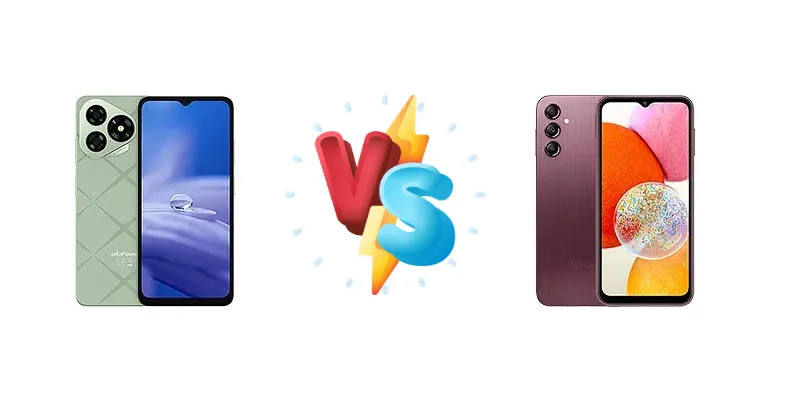
The sub-$200 smartphone market is fiercely competitive. The Ulefone Note 19 prioritizes exceptional battery life, while the Samsung Galaxy A14 offers a more versatile chipset with two distinct versions. This comparison dissects the core differences to determine which device delivers the best value for your needs.
🏆 Quick Verdict
For users prioritizing all-day (and multi-day) battery life, the Ulefone Note 19 is the clear winner, boasting a remarkable 45:51h endurance. However, the Samsung Galaxy A14, particularly the Helio G80 version, provides a smoother, more responsive experience for everyday tasks and light gaming.
| Network |
|---|
| 2G bands | GSM 850 / 900 / 1800 / 1900 | GSM 850 / 900 / 1800 / 1900 |
| 3G bands | HSDPA 850 / 900 / 2100 | HSDPA 850 / 900 / 2100 |
| 4G bands | 1, 2, 3, 4, 5, 7, 8, 12, 17, 19, 20, 26, 28, 38, 40, 41, 66 - International | 1, 3, 5, 7, 8, 20, 28, 38, 40, 41 |
| Speed | HSPA, LTE | HSPA, LTE |
| Technology | GSM / HSPA / LTE | GSM / HSPA / LTE |
| Launch |
|---|
| Announced | 2024, September | 2023, February 28 |
| Status | Available. Released 2024, September | Available. Released 2023, March 27 |
| Body |
|---|
| Build | - | Glass front, plastic back, plastic frame |
| Dimensions | 163.2 x 75.2 x 8.8 mm (6.43 x 2.96 x 0.35 in) | 167.7 x 78 x 9.1 mm (6.60 x 3.07 x 0.36 in) |
| SIM | Nano-SIM + Nano-SIM | · Nano-SIM· Nano-SIM + Nano-SIM |
| Weight | 192 g (6.77 oz) | 201 g (7.09 oz) |
| Display |
|---|
| Protection | Mohs level 4 | - |
| Resolution | 720 x 1612 pixels, 20:9 ratio (~269 ppi density) | 1080 x 2408 pixels, 20:9 ratio (~400 ppi density) |
| Size | 6.56 inches, 103.4 cm2 (~84.2% screen-to-body ratio) | 6.6 inches, 104.9 cm2 (~80.2% screen-to-body ratio) |
| Type | IPS LCD | PLS LCD |
| Platform |
|---|
| CPU | Octa-core 8x1.6 GHz Cortex-A55 | Octa-core (2x2.0 GHz Cortex-A75 & 6x1.8 GHz Cortex-A55) - Version AOcta-core (4x2.0 GHz Cortex-A55 & 4x2.0 GHz Cortex-A55) - Version B |
| Chipset | Unisoc T603 (22 nm) | Mediatek MT6769 Helio G80 (12 nm) - Version AExynos 850 (8 nm) - Version B |
| GPU | PowerVR GE8322 | Mali-G52 MC2 |
| OS | Android 14 (Go edition) | Android 13, upgradable to Android 15, One UI 7 |
| Memory |
|---|
| Card slot | No | microSDXC (dedicated slot) |
| Internal | 32GB 3GB RAM | 64GB 4GB RAM, 128GB 4GB RAM, 128GB 6GB RAM |
| Main Camera |
|---|
| Features | LED flash, HDR, panorama | LED flash, panorama, HDR |
| Single | 8 MP, f/2.0, (wide), 1.12µm | 13 MP, f/2.0, (wide) |
| Triple | - | 50 MP, f/1.8, 26mm (wide), 1/2.75", 0.64µm, PDAF
5 MP, f/2.2, 17mm (ultrawide), 1/5.0", 1.12µm
2 MP (macro) |
| Video | 1440p@30fps, 1080p@30fps | 1080p@30fps |
| Selfie camera |
|---|
| Single | 5 MP, f/2.0, (wide), 1.12µm | 13 MP, f/2.0, 26mm (wide), 1/3.1", 1.12µm |
| Video | Yes | 1080p@30fps |
| Sound |
|---|
| 3.5mm jack | - | Yes |
| 35mm jack | Yes | Yes |
| Loudspeaker | Yes | Yes |
| Comms |
|---|
| Bluetooth | 4.2, A2DP | 5.1 or 5.3, A2DP, LE |
| Infrared port | Yes | - |
| NFC | No | Yes (market/region dependent) |
| Positioning | GPS, GLONASS, GALILEO, BDS | GPS, GALILEO, GLONASS, BDS, QZSS |
| Radio | Stereo FM radio, RDS, recording | Unspecified |
| USB | USB Type-C 2.0 | USB Type-C 2.0 |
| WLAN | Wi-Fi 802.11 b/g/n | Wi-Fi 802.11 a/b/g/n/ac, dual-band, Wi-Fi Direct |
| Features |
|---|
| Sensors | Accelerometer, proximity | Fingerprint (side-mounted), accelerometer, proximity, compass |
| Battery |
|---|
| Charging | 10W wired | 15W wired |
| Type | Li-Po 5000 mAh | Li-Po 5000 mAh |
| Misc |
|---|
| Colors | Black, Green | Black, Dark Red, Silver, Green |
| Models | - | SM-A145F, SM-A145F/DSN, SM-A145M, SM-A145M/DS, SM-A145P, SM-A145R |
| Price | About 80 EUR | € 85.76 / $ 147.60 / £ 79.95 |
| SAR EU | - | 0.46 W/kg (head) 1.37 W/kg (body) |
| EU LABEL |
|---|
| Battery | 45:51h endurance, 1000 cycles | - |
| Energy | Class B | - |
| Free fall | Class C (124 falls) | - |
| Repairability | Class B | - |
Ulefone Note 19
- Exceptional battery life (45:51h endurance)
- Potentially lower price point
- Reliable for basic tasks
- Weak performance compared to the Galaxy A14
- Limited gaming capabilities
- Camera quality likely to be average
Samsung Galaxy A14
- Better performance with Helio G80 or Exynos 850
- Smoother multitasking and app experience
- Samsung brand recognition and software support
- Significantly shorter battery life than the Ulefone Note 19
- Potentially higher price
- 15W charging isn't particularly fast
Display Comparison
Neither device boasts a standout display. Both likely utilize LCD panels, common in this price bracket. The focus here isn't on visual fidelity. The Ulefone Note 19's display specs are not provided, but we can assume it's a standard 720p+ resolution. The Galaxy A14's display is also likely 720p+, but Samsung's display expertise may yield slightly better color accuracy. Neither phone is expected to have high brightness levels, making outdoor visibility a challenge.
Camera Comparison
Camera performance is likely to be similar, leaning towards acceptable for casual snapshots. Both phones likely feature a primary camera around 13MP, but the Ulefone Note 19's camera specs are not provided. The Galaxy A14's camera system is likely to benefit from Samsung's image processing algorithms, potentially delivering more vibrant and detailed photos. The inclusion of a 2MP macro camera on the Galaxy A14 is largely a marketing gimmick, offering limited practical benefit. Sensor size and aperture are critical factors not provided, but will heavily influence low-light performance.
Performance
The performance gap is significant. The Samsung Galaxy A14 offers two chipset options: the Mediatek Helio G80 (12nm) and the Exynos 850 (8nm). The Helio G80, with its Cortex-A75 performance cores, provides a noticeable boost over the Ulefone Note 19’s Unisoc T603 (22nm) and its all Cortex-A55 cores. The Exynos 850, built on a smaller 8nm process, further improves efficiency and sustained performance. The Unisoc T603 is adequate for basic tasks, but will struggle with multitasking and demanding applications. The G80 and Exynos 850 offer a smoother experience for social media, video streaming, and light gaming. The 12nm process of the Helio G80 will likely result in more heat generation than the 8nm Exynos 850.
Battery Life
Battery life is where the Ulefone Note 19 truly shines. Its 45:51h endurance is exceptional for a smartphone, thanks to the power-efficient Unisoc T603 chipset and likely a large battery capacity (though not specified). The Samsung Galaxy A14, while offering a respectable battery life, cannot compete with this level of endurance. The Galaxy A14 supports 15W wired charging, a slight advantage over the Ulefone Note 19’s 10W charging, but the difference in charging speed is unlikely to be dramatic. The Ulefone's longevity offsets the slower charging.
Buying Guide
Buy the Ulefone Note 19 if you need a phone that can reliably last through two full days of moderate use, and aren't demanding gamers. It's ideal for travelers, field workers, or anyone who frequently finds themselves away from a charger. Buy the Samsung Galaxy A14 if you prefer a more balanced experience with better performance for social media, streaming, and casual gaming, and appreciate the Samsung brand ecosystem and software support.
Frequently Asked Questions
❓ Does the Exynos 850 version of the Galaxy A14 noticeably overheat during prolonged gaming sessions?
The Exynos 850, built on an 8nm process, is generally more efficient than the Helio G80. While it can still get warm during extended gaming, it's less prone to significant throttling compared to the Helio G80 version or the Ulefone Note 19 under load. However, don't expect flagship-level thermal performance.
❓ Is the 10W charging on the Ulefone Note 19 a significant drawback, considering its large battery?
While 10W charging is slow by modern standards, the Ulefone Note 19's exceptional battery life mitigates this issue. You're less likely to need to charge it frequently. Overnight charging is perfectly viable, and the long endurance means you can easily go a day and a half or more between charges.
❓ How does the Unisoc T603 handle multitasking compared to the Mediatek Helio G80?
The Unisoc T603, with its all Cortex-A55 cores, struggles with heavy multitasking. Switching between apps will be noticeably slower, and running multiple demanding applications simultaneously will lead to lag. The Helio G80, with its Cortex-A75 performance cores, offers a significantly smoother multitasking experience.