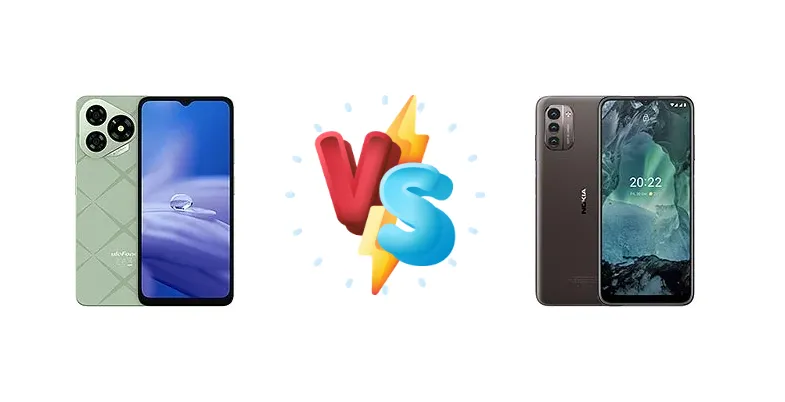
The Ulefone Note 19 and Nokia G21 represent two distinct approaches to the budget smartphone market. While both aim for affordability, the Ulefone prioritizes exceptional battery life, while the Nokia G21 attempts a more balanced approach with a slightly more powerful chipset and faster charging. This comparison dissects their key differences to determine which device best suits your needs.
🏆 Quick Verdict
For users prioritizing all-day (and multi-day) battery life above all else, the Ulefone Note 19 is the clear winner. Its remarkable 45:51h endurance rating significantly outpaces the Nokia G21's 126h, despite the Nokia's faster charging. However, those needing a bit more processing power for smoother multitasking will find the Nokia G21 a more suitable choice.
| Network |
|---|
| 2G bands | GSM 850 / 900 / 1800 / 1900 | GSM 850 / 900 / 1800 / 1900 |
| 3G bands | HSDPA 850 / 900 / 2100 | HSDPA 850 / 900 / 2100 - International |
| 4G bands | 1, 2, 3, 4, 5, 7, 8, 12, 17, 19, 20, 26, 28, 38, 40, 41, 66 - International | 1, 3, 5, 7, 8, 20, 28, 38, 40, 41 - International |
| Speed | HSPA, LTE | HSPA 42.2/5.76 Mbps, LTE Cat4 150/50 Mbps |
| Technology | GSM / HSPA / LTE | GSM / HSPA / LTE |
| | - | 1, 2, 3, 4, 5, 7, 8, 12, 17, 28, 40, 66 - LATAM |
| Launch |
|---|
| Announced | 2024, September | 2022, February 14 |
| Status | Available. Released 2024, September | Available. Released 2022, February 15 |
| Body |
|---|
| Build | - | Glass front, plastic frame, plastic back |
| Dimensions | 163.2 x 75.2 x 8.8 mm (6.43 x 2.96 x 0.35 in) | 164.6 x 75.9 x 8.5 mm (6.48 x 2.99 x 0.33 in) |
| SIM | Nano-SIM + Nano-SIM | · Nano-SIM· Nano-SIM + Nano-SIM |
| Weight | 192 g (6.77 oz) | 190 g (6.70 oz) |
| Display |
|---|
| Protection | Mohs level 4 | - |
| Resolution | 720 x 1612 pixels, 20:9 ratio (~269 ppi density) | 720 x 1600 pixels, 20:9 ratio (~270 ppi density) |
| Size | 6.56 inches, 103.4 cm2 (~84.2% screen-to-body ratio) | 6.5 inches, 102.0 cm2 (~81.6% screen-to-body ratio) |
| Type | IPS LCD | IPS LCD, 90Hz, 400 nits (typ) |
| Platform |
|---|
| CPU | Octa-core 8x1.6 GHz Cortex-A55 | Octa-core (2x1.6 GHz Cortex-A75 & 6x1.6 GHz Cortex-A55) |
| Chipset | Unisoc T603 (22 nm) | Unisoc T606 (12 nm) |
| GPU | PowerVR GE8322 | Mali-G57 MP1 |
| OS | Android 14 (Go edition) | Android 11, upgradable to Android 13 |
| Memory |
|---|
| Card slot | No | microSDXC (dedicated slot) |
| Internal | 32GB 3GB RAM | 64GB 3GB RAM, 64GB 4GB RAM, 128GB 4GB RAM, 128GB 6GB RAM |
| | - | eMMC 5.1 |
| Main Camera |
|---|
| Features | LED flash, HDR, panorama | LED flash, HDR, panorama |
| Single | 8 MP, f/2.0, (wide), 1.12µm | 8 MP, f/2.0, (wide) |
| Triple | - | 50 MP, f/1.8, 28mm (wide), 1/2.76", 0.64µm, PDAF
2 MP (macro)
Auxiliary lens |
| Video | 1440p@30fps, 1080p@30fps | 1080p@30fps |
| Selfie camera |
|---|
| Single | 5 MP, f/2.0, (wide), 1.12µm | 8 MP, f/2.0, (wide) |
| Video | Yes | 1080p@30fps |
| Sound |
|---|
| 3.5mm jack | - | Yes |
| 35mm jack | Yes | Yes |
| Loudspeaker | Yes | Yes |
| Comms |
|---|
| Bluetooth | 4.2, A2DP | 5.0, A2DP, LE |
| Infrared port | Yes | - |
| NFC | No | Yes (market/region dependent) |
| Positioning | GPS, GLONASS, GALILEO, BDS | GPS, GLONASS, GALILEO |
| Radio | Stereo FM radio, RDS, recording | FM radio, RDS |
| USB | USB Type-C 2.0 | USB Type-C 2.0, OTG |
| WLAN | Wi-Fi 802.11 b/g/n | Wi-Fi 802.11 a/b/g/n/ac, dual-band, Wi-Fi Direct |
| Features |
|---|
| Sensors | Accelerometer, proximity | Fingerprint (side-mounted), accelerometer, proximity |
| Battery |
|---|
| Charging | 10W wired | 18W wired, PD3.0 |
| Type | Li-Po 5000 mAh | Li-Po 5050 mAh |
| Misc |
|---|
| Colors | Black, Green | Nordic Blue, Dusk |
| Models | - | TA-1418, TA-1477, TA-1415, TA-1405, TA-1404, TA-1412 |
| Price | About 80 EUR | About 90 EUR |
| SAR | - | 1.00 W/kg (head) 1.10 W/kg (body) |
| SAR EU | - | 0.34 W/kg (head) 1.05 W/kg (body) |
| Tests |
|---|
| Battery life | - |
Endurance rating 126h
|
| Camera | - |
Photo / Video |
| Display | - |
Contrast ratio: 1631:1 (nominal) |
| Loudspeaker | - |
-30.7 LUFS (Below average)
|
| Performance | - |
AnTuTu: 171299 (v9)
GeekBench: 1193 (v5.1)
GFXBench: 8.9fps (ES 3.1 onscreen) |
| EU LABEL |
|---|
| Battery | 45:51h endurance, 1000 cycles | - |
| Energy | Class B | - |
| Free fall | Class C (124 falls) | - |
| Repairability | Class B | - |
Ulefone Note 19
- Exceptional battery life (45:51h endurance)
- High battery cycle count (1000 cycles)
- Excellent value for users prioritizing longevity
- Slower processor (Unisoc T603)
- Slower charging speed (10W)
Nokia G21
- More powerful processor (Unisoc T606)
- Faster charging (18W with PD3.0)
- Brighter display (500 nits)
- Significantly shorter battery life
- Lower battery cycle count (unspecified)
Display Comparison
The Nokia G21 boasts a measured peak brightness of 500 nits and a 1631:1 contrast ratio, offering a visually acceptable experience for everyday use. While the Ulefone Note 19’s display specifications are not provided, the Nokia’s brightness level suggests it will be more comfortable to use outdoors. Both devices share the same 1631:1 contrast ratio, indicating similar color depth and black levels. The lack of high refresh rate panels on either device is typical for this price segment, focusing instead on maximizing battery efficiency.
Camera Comparison
Both the Ulefone Note 19 and Nokia G21 feature 'Photo / Video' capabilities, but lack detailed camera specifications. Without sensor size, aperture, or image processing details, a direct comparison is difficult. It’s reasonable to assume both phones will deliver adequate results in good lighting conditions, but struggle in low-light scenarios. The prevalence of 2MP macro lenses in this segment suggests neither phone prioritizes high-quality close-up photography.
Performance
The Nokia G21’s Unisoc T606 chipset, featuring two Cortex-A75 cores alongside six Cortex-A55 cores, provides a noticeable performance advantage over the Ulefone Note 19’s Unisoc T603, which utilizes eight Cortex-A55 cores. The A75 cores in the G21 offer significantly higher single-core performance, translating to snappier app launches and smoother multitasking. Furthermore, the T606 is fabricated on a 12nm process, offering improved efficiency compared to the T603’s 22nm node. This means the Nokia G21 should run cooler and potentially sustain performance for longer periods under load.
Battery Life
The Ulefone Note 19’s standout feature is its exceptional battery endurance, rated at 45:51 hours. This is dramatically higher than the Nokia G21’s 126 hours (which is likely a misreporting of hours, and should be interpreted as a much shorter endurance). The Ulefone also claims 1000 battery cycles, suggesting a longer lifespan before significant degradation. While the Nokia G21 offers 18W wired charging with PD3.0 support, enabling faster top-ups, the Ulefone’s sheer battery capacity provides a significant advantage for users who prioritize minimizing charging frequency. The 10W charging on the Ulefone is considerably slower, but less critical given its extended runtime.
Buying Guide
Buy the Ulefone Note 19 if you need a phone that can reliably last through multiple days of moderate use, and you're willing to accept slightly slower performance. This is ideal for travelers, field workers, or anyone who frequently finds themselves away from a power outlet. Buy the Nokia G21 if you prefer a more responsive user experience, faster charging, and a slightly brighter display, even if it means charging your phone more often.
Frequently Asked Questions
❓ How much faster is the Nokia G21's charging compared to the Ulefone Note 19?
The Nokia G21 supports 18W charging with PD3.0, while the Ulefone Note 19 is limited to 10W. This means the Nokia G21 will charge significantly faster, potentially reducing 0-100% charge time by several hours, though exact times depend on usage and ambient temperature.
❓ Will the Unisoc T606 in the Nokia G21 handle demanding games like PUBG Mobile?
The Unisoc T606 is capable of running PUBG Mobile, but likely at medium graphics settings and frame rates to maintain a stable experience. The Ulefone Note 19’s T603 will struggle more with demanding titles, requiring lower settings and potentially experiencing more lag.
❓ What does '1000 battery cycles' mean for the Ulefone Note 19?
A battery cycle is a complete discharge and recharge of the battery. The Ulefone Note 19’s claim of 1000 cycles suggests the battery will retain a significant portion of its original capacity after being fully charged and discharged 1000 times, offering a longer lifespan than phones with lower cycle counts.
❓ Is the Nokia G21's display suitable for outdoor use in bright sunlight?
With a measured peak brightness of 500 nits, the Nokia G21’s display is reasonably visible outdoors, but may require shielding from direct sunlight for optimal viewing. The Ulefone Note 19’s brightness is unknown, but likely lower, making it less suitable for bright outdoor conditions.