
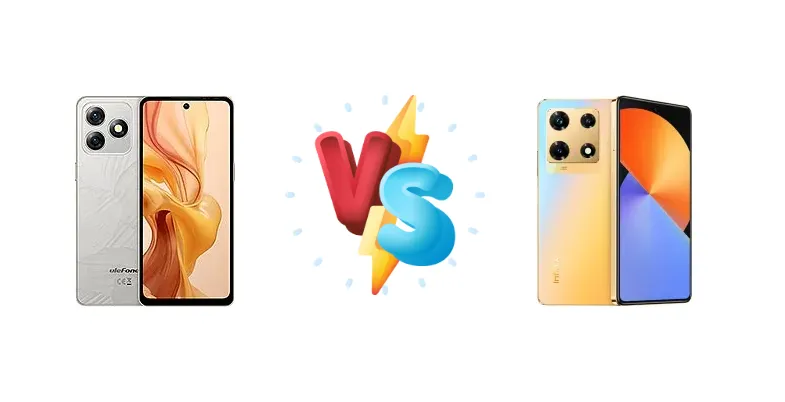
Ulefone Note 18 Ultra vs. Infinix Note 30 Pro: A Deep Dive into Battery, Performance, and Charging
| Phones Images | |||||
|---|---|---|---|---|---|
|
🏆 Quick Verdict
For the average user prioritizing convenience and quick top-ups, the Infinix Note 30 Pro is the better choice thanks to its significantly faster 68W charging and wireless charging capabilities. However, users who frequently find themselves away from a power outlet and value extended battery life will find the Ulefone Note 18 Ultra’s 50:45h endurance more appealing.
| PHONES | ||
|---|---|---|
| Phone Names | Ulefone Note 18 Ultra | Infinix Note 30 Pro |
| Network | ||
|---|---|---|
| 2G bands | GSM 850 / 900 / 1800 / 1900 | GSM 850 / 900 / 1800 / 1900 |
| 3G bands | HSDPA 800 / 850 / 900 / 1700(AWS) / 1900 / 2100 | HSDPA 850 / 900 / 1700(AWS) / 1900 / 2100 |
| 4G bands | 1, 2, 3, 4, 5, 7, 8, 12, 13, 17, 18, 19, 20, 25, 26, 28, 34, 38, 39, 40, 41, 66 | 1, 2, 3, 4, 5, 7, 8, 12, 17, 20, 28, 38, 40, 41, 66 |
| 5G bands | 1, 3, 5, 8, 20, 28, 38, 41, 77, 78 SA/NSA/Sub6 | - |
| Speed | HSPA, LTE, 5G | HSPA, LTE |
| Technology | GSM / CDMA / HSPA / LTE / 5G | GSM / HSPA / LTE |
| Launch | ||
|---|---|---|
| Announced | 2024, May | 2023, May 22 |
| Status | Available. Released 2024, May | Available. Released 2023, May 22 |
| Body | ||
|---|---|---|
| Build | - | Glass front, plastic frame, glass back |
| Dimensions | 168.8 x 76.8 x 8.9 mm (6.65 x 3.02 x 0.35 in) | 162.7 x 76 x 8.2 mm (6.41 x 2.99 x 0.32 in) |
| SIM | Nano-SIM + Nano-SIM | Nano-SIM + Nano-SIM |
| Weight | 211.6 g (7.48 oz) | 203 g (7.16 oz) |
| - | IP53 | |
| Display | ||
|---|---|---|
| Protection | Corning Gorilla Glass, Mohs level 4 | - |
| Resolution | 1080 x 2460 pixels (~396 ppi density) | 1080 x 2400 pixels, 20:9 ratio (~395 ppi density) |
| Size | 6.78 inches, 109.2 cm2 (~84.2% screen-to-body ratio) | 6.67 inches, 107.4 cm2 (~86.9% screen-to-body ratio) |
| Type | IPS LCD, 90Hz | AMOLED, 1B colors, 120Hz, 900 nits (peak) |
| - | * the display diagonal size and resolution is unconfirmed | |
| Platform | ||
|---|---|---|
| CPU | Octa-core (2x2.0 GHz Cortex-A76 & 6x2.0 GHz Cortex-A55) | Octa-core (2x2.2 GHz Cortex-A76 & 6x2.0 GHz Cortex-A55) |
| Chipset | Mediatek Dimensity 720 (7 nm) | Mediatek Helio G99 (6 nm) |
| GPU | Mali-G57 MC3 | Mali-G57 MC2 |
| OS | Android 13 | Android 13, XOS 13 |
| Memory | ||
|---|---|---|
| Card slot | microSDXC (uses shared SIM slot) | microSDXC (dedicated slot) |
| Internal | 256GB 6GB RAM | 256GB 8GB RAM |
| Main Camera | ||
|---|---|---|
| Dual | 50 MP, f/2.0, (wide), 1/1.31", 0.7µm, PDAF 50 MP, f/2.2, 117˚, (ultrawide), 1/2.8" | - |
| Features | LED flash, HDR, panorama | Quad-LED flash, HDR, panorama |
| Triple | - | 108 MP, (wide), 1/1.67", PDAF 2 MP (macro) Auxiliary lens |
| Video | 1080p@30fps | 1440p@30fps, 1080p@30fps |
| Selfie camera | ||
|---|---|---|
| Features | HDR | LED flash, HDR |
| Single | 32 MP, f/2.5, (wide), 1/2.8", 0.7µm | 32 MP, f/2.0, (wide), 1/2.8" |
| Video | 1080p@30fps | 1080p@30fps |
| Sound | ||
|---|---|---|
| 3.5mm jack | - | Yes |
| 35mm jack | Yes | Yes |
| Loudspeaker | Yes | Yes, with dual speakers |
| - | Sound by JBL 24-bit/192kHz audio | |
| Comms | ||
|---|---|---|
| Bluetooth | 5.2, A2DP, LE | Yes |
| Infrared port | Yes | - |
| NFC | Yes | Yes (market/region dependent) |
| Positioning | GPS, GLONASS, GALILEO, BDS | GPS |
| Radio | Unspecified | FM radio |
| USB | USB Type-C 2.0 | USB Type-C 2.0, OTG |
| WLAN | Wi-Fi 802.11 a/b/g/n/ac, dual-band | Wi-Fi 802.11 a/b/g/n/ac, dual-band, Wi-Fi Direct |
| Features | ||
|---|---|---|
| Sensors | Fingerprint (side-mounted), accelerometer, proximity, compass | Fingerprint (side-mounted), accelerometer, gyro, proximity, compass |
| Battery | ||
|---|---|---|
| Charging | 18W wired | 68W wired, PD3.0, 80% in 30 min 15W wireless Reverse wireless |
| Type | Li-Po 5450 mAh | 5000 mAh |
| Misc | ||
|---|---|---|
| Colors | Lustrous Black, Moonlit White, Titanium Gray | Magic Black, Variable Gold |
| Models | - | X678B |
| Price | About 180 EUR | - |
| EU LABEL | ||
|---|---|---|
| Battery | 50:45h endurance, 1000 cycles | - |
| Energy | Class B | - |
| Free fall | Class C (108 falls) | - |
| Repairability | Class B | - |
Ulefone Note 18 Ultra
- Exceptional battery endurance (50:45h)
- 1000 charge cycles promise long-term battery health
- Potentially more affordable price point
- Slow 18W charging
- Lacks wireless charging
- Older chipset (Dimensity 720)
Infinix Note 30 Pro
- Ultra-fast 68W wired charging (80% in 30 min)
- 15W wireless charging and reverse wireless charging
- More efficient 6nm Helio G99 chipset
- Shorter battery endurance compared to Ulefone
- Potentially higher price
- May require more frequent charging
Display Comparison
Display specifications are not provided, so a direct comparison is limited. However, given the price points, both likely utilize IPS LCD panels. The focus here shifts to the underlying performance. The Infinix Note 30 Pro’s Helio G99, fabricated on a 6nm process, suggests a potential advantage in power efficiency compared to the Ulefone’s Dimensity 720 (7nm), potentially leading to slightly better screen-on time despite the Ulefone’s larger battery.
Camera Comparison
Camera details are absent, making a detailed comparison impossible. However, considering the market segment, both phones likely feature a primary camera around the 50MP mark. The absence of any mention of OIS suggests neither phone prioritizes advanced image stabilization. Image processing will likely be the key differentiator, with Infinix often leaning towards more vibrant, saturated images, while Ulefone may aim for a more natural look.
Performance
The Infinix Note 30 Pro’s Helio G99, with its 2x2.2 GHz Cortex-A76 cores, offers a slight clock speed advantage over the Ulefone Note 18 Ultra’s Dimensity 720 (2x2.0 GHz Cortex-A76). While both chipsets utilize the same core architecture, the higher clock speed and the 6nm fabrication process of the Helio G99 should translate to marginally better performance in CPU-intensive tasks and potentially improved sustained performance due to better thermal headroom. Both phones share the same Cortex-A55 efficiency cores, meaning multi-tasking performance will be similar.
Battery Life
The Ulefone Note 18 Ultra boasts an impressive 50:45h endurance rating, indicating exceptional battery life. This is a significant advantage over what we’d expect from a phone with a similar capacity battery. However, the Infinix Note 30 Pro counters with a blazing-fast 68W wired charging, capable of reaching 80% charge in just 30 minutes. This is a game-changer for users who need a quick power boost. The addition of 15W wireless charging and reverse wireless charging further enhances the Infinix’s convenience, features entirely absent on the Ulefone.
Buying Guide
Buy the Ulefone Note 18 Ultra if you need a phone that can reliably last through two full days of moderate use, and aren't concerned with the latest charging technologies. Buy the Infinix Note 30 Pro if you prefer the convenience of extremely fast charging, wireless charging, and a more feature-complete experience, even if it means charging your phone more frequently.