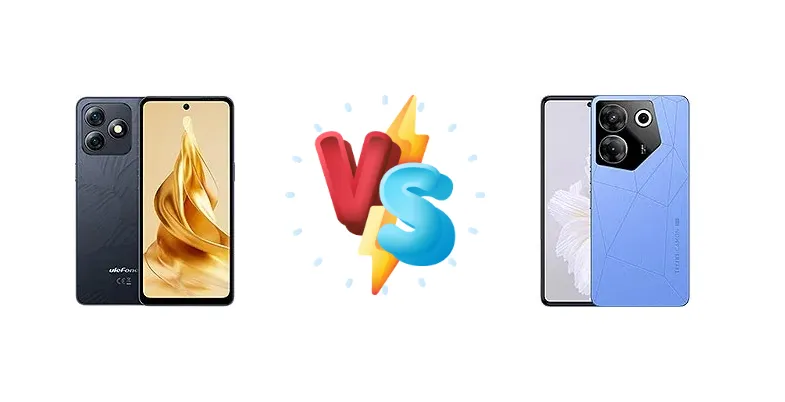
The Ulefone Note 18 Pro and Tecno Camon 20 Pro 5G represent distinct approaches to the budget-to-midrange smartphone market. The Ulefone prioritizes long-term battery endurance and affordability, while the Tecno aims for a more powerful experience with 5G connectivity and faster charging. This comparison dissects their key differences to determine which device best suits your needs.
🏆 Quick Verdict
For the average user prioritizing performance and future-proofing, the Tecno Camon 20 Pro 5G is the clear winner. Its Dimensity 8050 chipset delivers a substantial performance leap over the Ulefone Note 18 Pro’s Helio G91, making it better suited for demanding tasks and 5G networks. However, the Ulefone offers exceptional battery life for those who value longevity above all else.
| Network |
|---|
| 2G bands | GSM 850 / 900 / 1800 / 1900 | GSM 850 / 900 / 1800 / 1900 |
| 3G bands | HSDPA 800 / 850 / 900 / 1700(AWS) / 1900 / 2100 | HSDPA 850 / 900 / 1700(AWS) / 1900 / 2100 |
| 4G bands | 1, 2, 3, 4, 5, 7, 8, 12, 13, 17, 18, 19, 20, 25, 26, 28, 34, 38, 39, 40, 41, 66 | LTE |
| 5G bands | - | SA/NSA |
| Speed | HSPA, LTE | HSPA, LTE, 5G |
| Technology | GSM / CDMA / HSPA / LTE | GSM / HSPA / LTE / 5G |
| Launch |
|---|
| Announced | 2024, November | 2023, May 09 |
| Status | Available. Released 2024, November | Available. Released 2023, May 09 |
| Body |
|---|
| Dimensions | 168.8 x 76.8 x 8.9 mm (6.65 x 3.02 x 0.35 in) | 162.7 x 75.9 x 7.8 mm (6.41 x 2.99 x 0.31 in) |
| SIM | Nano-SIM + Nano-SIM | Nano-SIM + Nano-SIM |
| Weight | 211.6 g (7.48 oz) | - |
| Display |
|---|
| Protection | Corning Gorilla Glass, Mohs level 4 | - |
| Resolution | 720 x 1640 pixels (~264 ppi density) | 1080 x 2400 pixels, 20:9 ratio (~395 ppi density) |
| Size | 6.78 inches, 109.2 cm2 (~84.2% screen-to-body ratio) | 6.67 inches, 107.4 cm2 (~87.0% screen-to-body ratio) |
| Type | IPS LCD, 90Hz | AMOLED, 120Hz |
| | - | Always-on display |
| Platform |
|---|
| CPU | Octa-core (2x2.0 GHz Cortex-A75 & 6x1.8 GHz Cortex-A55) | Octa-core (1x3.0 GHz Cortex-A78 & 3x2.6 GHz Cortex-A78 & 4x2.0 GHz Cortex-A55) |
| Chipset | Mediatek Helio G91 (12 nm) | Mediatek Dimensity 8050 (6 nm) |
| GPU | Mali-G57 MC2 | Mali-G77 MC9 |
| OS | Android 14 | Android 13, HIOS 13 |
| Memory |
|---|
| Card slot | microSDXC (uses shared SIM slot) | microSDXC (dedicated slot) |
| Internal | 256GB 6GB RAM | 256GB 8GB RAM |
| Main Camera |
|---|
| Dual | 64 MP, f/1.9, (wide), 1/1.73", 0.64µm, PDAF
50 MP, f/2.2, 117˚, (ultrawide), 1/2.8" | - |
| Features | LED flash, HDR, panorama | Ring-LED flash, panorama, HDR |
| Triple | - | 64 MP, f/1.7, (wide), 1/1.7", 0.8µm, PDAF, OIS
2 MP (macro)
Auxiliary lens |
| Video | 1080p@30fps | 4K@30fps, 1080p@30fps, HDR |
| Selfie camera |
|---|
| Features | HDR | Dual-LED flash |
| Single | 32 MP, f/2.5, (wide), 1/2.8", 0.8µm | 32 MP, f/2.5, 24mm (wide), 1/2.8", 0.8µm |
| Video | 1080p@30fps | 1080p@30fps |
| Sound |
|---|
| 3.5mm jack | - | Yes |
| 35mm jack | Yes | Yes |
| Loudspeaker | Yes | Yes, with stereo speakers |
| | - | 24-bit/192kHz audio |
| Comms |
|---|
| Bluetooth | 5.1, A2DP, LE | 5.2, A2DP, LE |
| Infrared port | Yes | - |
| NFC | Yes | Yes |
| Positioning | GPS, GLONASS, GALILEO, BDS | GPS |
| Radio | FM radio, RDS, recording | FM radio |
| USB | USB Type-C 2.0, OTG | USB Type-C 2.0, OTG |
| WLAN | Wi-Fi 802.11 a/b/g/n/ac, dual-band | Wi-Fi 802.11 a/b/g/n/ac, dual-band |
| Features |
|---|
| Sensors | Accelerometer, proximity, compass | Fingerprint (under display, optical), accelerometer, gyro, proximity, compass |
| Battery |
|---|
| Charging | 18W wired | 33W wired |
| Type | Li-Po 5450 mAh | 5000 mAh |
| Misc |
|---|
| Colors | Lustrous Black, Moonlit White, Titanium Gray | Dark Welkin, Serenity Blue |
| Models | - | CK8n |
| Price | - | About 270 EUR |
| EU LABEL |
|---|
| Battery | 52:36h endurance, 1000 cycles | - |
| Energy | Class B | - |
| Free fall | Class C (103 falls) | - |
| Repairability | Class B | - |
Ulefone Note 18 Pro
- Exceptional battery endurance (52:36h)
- Long-term battery health (1000 charge cycles)
- More affordable price point (likely)
- Significantly slower processor
- Slower charging speed (18W)
- Limited 5G connectivity
Tecno Camon 20 Pro 5G
- Powerful Dimensity 8050 chipset
- Faster 33W charging
- 5G connectivity for faster data speeds
- Potentially shorter battery life
- Higher price point (likely)
- May experience more thermal throttling under heavy load
Display Comparison
While display specifications are absent, the chipset difference suggests a disparity in graphics processing power impacting visual experiences. The Tecno, with its Dimensity 8050, will likely handle higher refresh rates and more demanding games with greater fluidity. The Ulefone’s Helio G91, while capable, is less powerful. Expect the Tecno to offer a more responsive and visually rich experience, assuming comparable panel quality.
Camera Comparison
Without detailed camera specs, it’s difficult to make a definitive judgment. However, the Tecno’s more powerful chipset allows for more sophisticated image processing, potentially leading to better dynamic range and noise reduction. The Ulefone’s Helio G91 may struggle with complex computational photography tasks. The absence of information on sensor sizes and OIS makes a direct comparison impossible, but the Tecno’s processing advantage is a likely win.
Performance
The core difference lies in the chipsets. The Tecno Camon 20 Pro 5G’s Mediatek Dimensity 8050 (6nm) is a significant upgrade over the Ulefone Note 18 Pro’s Helio G91 (12nm). The Dimensity 8050 features a 1x3.0 GHz Cortex-A78 core alongside 3x2.6 GHz Cortex-A78 cores, and 4x2.0 GHz Cortex-A55 cores, offering substantially higher peak performance and improved multi-core capabilities compared to the Ulefone’s 2x2.0 GHz Cortex-A75 & 6x1.8 GHz Cortex-A55 configuration. The 6nm process node of the Dimensity 8050 also translates to better power efficiency and potentially less thermal throttling during sustained workloads. This benefits gamers and users running resource-intensive applications.
Battery Life
The Ulefone Note 18 Pro boasts a remarkable 52:36h endurance rating, suggesting exceptional battery life. While the Tecno’s battery capacity is unknown, its 33W charging significantly outpaces the Ulefone’s 18W charging. This means the Tecno can replenish its battery much faster, even if its capacity is slightly lower. The Ulefone’s 1000 charge cycles promise long-term battery health, but the Tecno’s faster charging offers convenience for users who frequently need to top up their device.
Buying Guide
Buy the Ulefone Note 18 Pro if you need a phone that can reliably last through two full days of moderate use and prioritize a lower upfront cost. Buy the Tecno Camon 20 Pro 5G if you prefer a smoother, faster experience for gaming, streaming, and multitasking, and want the benefits of 5G connectivity, even if it means more frequent charging.
Frequently Asked Questions
❓ Will the Dimensity 8050 in the Tecno Camon 20 Pro 5G overheat during prolonged gaming sessions?
While the Dimensity 8050 is a powerful chip, the 6nm process node and likely thermal management solutions in the Tecno Camon 20 Pro 5G should mitigate overheating. However, some throttling is possible during extended, graphically demanding games. The Ulefone Note 18 Pro’s Helio G91 will likely throttle sooner due to its less efficient 12nm process.
❓ How long will it take to fully charge the Ulefone Note 18 Pro with its 18W charging?
Given the likely larger battery capacity needed to achieve 52:36h endurance, a full charge on the Ulefone Note 18 Pro with its 18W charger will likely take over 2.5 to 3 hours. The Tecno Camon 20 Pro 5G’s 33W charging will significantly reduce this time, potentially to around 1.5 to 2 hours.
❓ Is the 5G connectivity on the Tecno Camon 20 Pro 5G worth the extra cost if I don't have 5G coverage in my area?
If 5G coverage is unavailable, the immediate benefit of 5G is minimal. However, purchasing the Tecno Camon 20 Pro 5G future-proofs your device for when 5G networks become more widespread. The more powerful processor also offers benefits even on 4G networks.