
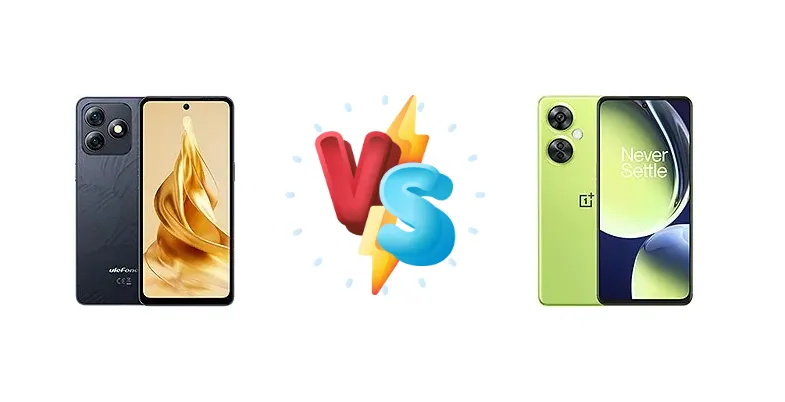
Ulefone Note 18 Pro vs. OnePlus Nord CE 3 Lite: A Deep Dive into Battery, Performance, and Value
| Phones Images | |||||
|---|---|---|---|---|---|
|
🏆 Quick Verdict
For the average user prioritizing longevity and minimizing charging frequency, the Ulefone Note 18 Pro emerges as the winner. Its remarkable 52:36h battery endurance significantly outweighs the OnePlus Nord CE 3 Lite’s faster charging, especially for those away from power outlets for extended periods.
| PHONES | ||
|---|---|---|
| Phone Names | Ulefone Note 18 Pro | OnePlus Nord CE 3 Lite |
| Network | ||
|---|---|---|
| 2G bands | GSM 850 / 900 / 1800 / 1900 | GSM 850 / 900 / 1800 / 1900 |
| 3G bands | HSDPA 800 / 850 / 900 / 1700(AWS) / 1900 / 2100 | HSDPA 800 / 850 / 900 / 1700(AWS) / 1900 / 2100 - International |
| 4G bands | 1, 2, 3, 4, 5, 7, 8, 12, 13, 17, 18, 19, 20, 25, 26, 28, 34, 38, 39, 40, 41, 66 | 1, 2, 3, 4, 5, 7, 8, 12, 13, 17, 18, 19, 20, 26, 28, 32, 38, 39, 40, 41, 66 - International |
| 5G bands | - | 1, 3, 5, 7, 8, 20, 28, 38, 40, 41, 66, 77, 78 SA/NSA - International |
| Speed | HSPA, LTE | HSPA, LTE, 5G |
| Technology | GSM / CDMA / HSPA / LTE | GSM / HSPA / LTE / 5G |
| - | 1, 3, 5, 8, 28, 40, 41, 77, 78 SA/NSA - India | |
| Launch | ||
|---|---|---|
| Announced | 2024, November | 2023, April 04 |
| Status | Available. Released 2024, November | Available. Released 2023, April 11 |
| Body | ||
|---|---|---|
| Build | - | Glass front, plastic frame, plastic back |
| Dimensions | 168.8 x 76.8 x 8.9 mm (6.65 x 3.02 x 0.35 in) | 165.5 x 76 x 8.3 mm (6.52 x 2.99 x 0.33 in) |
| SIM | Nano-SIM + Nano-SIM | Nano-SIM + Nano-SIM |
| Weight | 211.6 g (7.48 oz) | 195 g (6.88 oz) |
| Display | ||
|---|---|---|
| Protection | Corning Gorilla Glass, Mohs level 4 | Corning Gorilla Glass |
| Resolution | 720 x 1640 pixels (~264 ppi density) | 1080 x 2400 pixels, 20:9 ratio (~391 ppi density) |
| Size | 6.78 inches, 109.2 cm2 (~84.2% screen-to-body ratio) | 6.72 inches, 109.6 cm2 (~87.1% screen-to-body ratio) |
| Type | IPS LCD, 90Hz | IPS LCD, 120Hz, 550 nits (typ), 680 nits (peak) |
| Platform | ||
|---|---|---|
| CPU | Octa-core (2x2.0 GHz Cortex-A75 & 6x1.8 GHz Cortex-A55) | Octa-core (2x2.2 GHz Kryo 660 Gold & 6x1.7 GHz Kryo 660 Silver) |
| Chipset | Mediatek Helio G91 (12 nm) | Qualcomm SM6375 Snapdragon 695 5G (6 nm) |
| GPU | Mali-G57 MC2 | Adreno 619 |
| OS | Android 14 | Android 13, OxygenOS 13.1 |
| Memory | ||
|---|---|---|
| Card slot | microSDXC (uses shared SIM slot) | microSDXC (uses shared SIM slot) |
| Internal | 256GB 6GB RAM | 128GB 8GB RAM, 256GB 8GB RAM |
| - | UFS 2.2 | |
| Main Camera | ||
|---|---|---|
| Dual | 64 MP, f/1.9, (wide), 1/1.73", 0.64µm, PDAF 50 MP, f/2.2, 117˚, (ultrawide), 1/2.8" | - |
| Features | LED flash, HDR, panorama | LED flash, HDR, panorama |
| Triple | - | 108 MP, f/1.8, (wide), 1/1.67", 0.64µm, PDAF 2 MP (macro) Auxiliary lens |
| Video | 1080p@30fps | 1080p@30fps |
| Selfie camera | ||
|---|---|---|
| Features | HDR | HDR, panorama |
| Single | 32 MP, f/2.5, (wide), 1/2.8", 0.8µm | 16 MP, f/2.4, (wide), 1.0µm |
| Video | 1080p@30fps | 1080p@30fps |
| Sound | ||
|---|---|---|
| 3.5mm jack | - | Yes |
| 35mm jack | Yes | Yes |
| Loudspeaker | Yes | Yes, with stereo speakers |
| Comms | ||
|---|---|---|
| Bluetooth | 5.1, A2DP, LE | 5.1, A2DP, LE, aptX HD |
| Infrared port | Yes | - |
| NFC | Yes | Yes (market/region dependent) |
| Positioning | GPS, GLONASS, GALILEO, BDS | GPS, GALILEO, GLONASS, BDS, QZSS |
| Radio | FM radio, RDS, recording | No |
| USB | USB Type-C 2.0, OTG | USB Type-C 2.0, OTG |
| WLAN | Wi-Fi 802.11 a/b/g/n/ac, dual-band | Wi-Fi 802.11 a/b/g/n/ac, dual-band |
| Features | ||
|---|---|---|
| Sensors | Accelerometer, proximity, compass | Fingerprint (side-mounted), accelerometer, gyro, proximity, compass |
| Battery | ||
|---|---|---|
| Charging | 18W wired | 67W wired, 80% in 30 min |
| Type | Li-Po 5450 mAh | Li-Po 5000 mAh |
| Misc | ||
|---|---|---|
| Colors | Lustrous Black, Moonlit White, Titanium Gray | Pastel Lime, Chromatic Gray |
| Models | - | CPH2467, CPH2465 |
| Price | - | £ 169.98 / € 209.99 |
| SAR | - | 1.17 W/kg (head) 0.70 W/kg (body) |
| Tests | ||
|---|---|---|
| Performance | - | AnTuTu: 412006 (v9) GeekBench: 2052 (v5) GFXBench: 17fps (ES 3.1 onscreen) |
| EU LABEL | ||
|---|---|---|
| Battery | 52:36h endurance, 1000 cycles | - |
| Energy | Class B | - |
| Free fall | Class C (103 falls) | - |
| Repairability | Class B | - |
Ulefone Note 18 Pro
- Exceptional battery life (52:36h endurance)
- Long battery lifespan (1000 cycles)
- Potentially lower price point
- Older, less efficient chipset (Helio G91)
- Slower charging speed (18W)
OnePlus Nord CE 3 Lite
- Faster and more efficient chipset (Snapdragon 695)
- Ultra-fast charging (67W, 80% in 30 min)
- More responsive user experience
- Likely shorter battery life
- May require more frequent charging
Display Comparison
Display specifications are not provided, but given the price points, both devices likely feature LCD panels. However, the focus here isn't display quality, but rather the impact of the chipsets on driving the display efficiently. The Snapdragon 695's 6nm process should offer slightly better power efficiency when rendering graphics, potentially leading to marginally longer screen-on time despite the Ulefone's overall battery advantage.
Camera Comparison
Camera details are limited, but the chipset difference hints at superior image processing capabilities on the OnePlus. The Snapdragon 695 includes a more advanced ISP (Image Signal Processor) than the Helio G91. This means better noise reduction, dynamic range, and overall image quality, particularly in challenging lighting conditions. While both phones likely feature a primary camera, the OnePlus’s ISP will extract more detail and produce more visually appealing photos. The absence of details on sensor size makes a definitive comparison impossible, but the chipset advantage favors the OnePlus.
Performance
The OnePlus Nord CE 3 Lite’s Qualcomm Snapdragon 695 (6nm) holds a clear architectural advantage over the Ulefone Note 18 Pro’s MediaTek Helio G91 (12nm). The 6nm process allows for higher transistor density and improved power efficiency. While both are octa-core CPUs, the Snapdragon 695’s Kryo 660 Gold cores, clocked at 2.2 GHz, offer a performance edge over the Helio G91’s 2.0 GHz Cortex-A75 cores. This translates to snappier app launches, smoother multitasking, and a more responsive gaming experience on the OnePlus. The Ulefone will handle everyday tasks adequately, but the OnePlus is the better choice for demanding users.
Battery Life
The Ulefone Note 18 Pro’s standout feature is its exceptional battery endurance – a remarkable 52:36 hours. This is significantly longer than what most smartphones offer. While the OnePlus Nord CE 3 Lite’s battery capacity is not specified, its 67W charging capability is a major draw, promising an 80% charge in just 30 minutes. However, faster charging doesn’t negate the need to charge frequently. The Ulefone’s longevity means fewer trips to the charger, making it ideal for users who prioritize convenience and extended usage between charges. The 1000 cycle rating on the Ulefone also suggests a longer lifespan for the battery itself.
Buying Guide
Buy the Ulefone Note 18 Pro if you need a phone that can reliably last through two full days of moderate use, or if you frequently travel and have limited access to charging. Buy the OnePlus Nord CE 3 Lite if you prioritize quick top-ups and a more responsive user experience thanks to its newer Snapdragon 695 chipset, and don't mind charging more frequently.