
Infinix Note 30 Pro vs Ulefone Note 18 Pro: A Detailed Comparison
| Phones Images | |||||
|---|---|---|---|---|---|
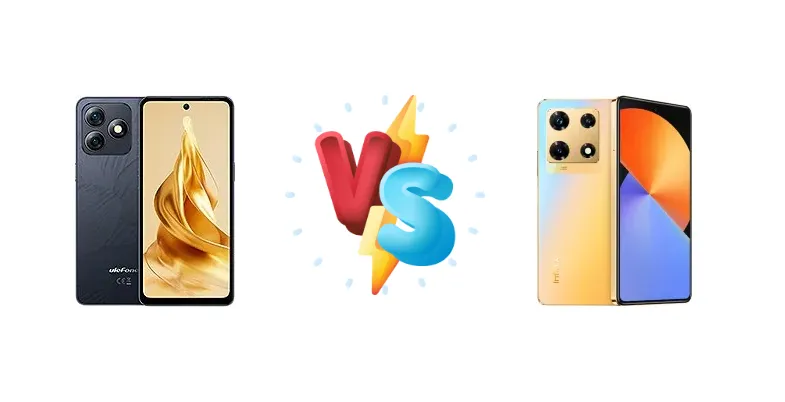
|
🏆 Quick Verdict
For the average user prioritizing convenience and responsiveness, the Infinix Note 30 Pro is the clear winner. Its Helio G99 chipset and 68W charging significantly outperform the Ulefone Note 18 Pro’s Helio G91 and 18W charging, despite the Ulefone offering impressive battery endurance figures.
| PHONES | ||
|---|---|---|
| Phone Names | Ulefone Note 18 Pro | Infinix Note 30 Pro |
| Network | ||
|---|---|---|
| 2G bands | GSM 850 / 900 / 1800 / 1900 | GSM 850 / 900 / 1800 / 1900 |
| 3G bands | HSDPA 800 / 850 / 900 / 1700(AWS) / 1900 / 2100 | HSDPA 850 / 900 / 1700(AWS) / 1900 / 2100 |
| 4G bands | 1, 2, 3, 4, 5, 7, 8, 12, 13, 17, 18, 19, 20, 25, 26, 28, 34, 38, 39, 40, 41, 66 | 1, 2, 3, 4, 5, 7, 8, 12, 17, 20, 28, 38, 40, 41, 66 |
| Speed | HSPA, LTE | HSPA, LTE |
| Technology | GSM / CDMA / HSPA / LTE | GSM / HSPA / LTE |
| Launch | ||
|---|---|---|
| Announced | 2024, November | 2023, May 22 |
| Status | Available. Released 2024, November | Available. Released 2023, May 22 |
| Body | ||
|---|---|---|
| Build | - | Glass front, plastic frame, glass back |
| Dimensions | 168.8 x 76.8 x 8.9 mm (6.65 x 3.02 x 0.35 in) | 162.7 x 76 x 8.2 mm (6.41 x 2.99 x 0.32 in) |
| SIM | Nano-SIM + Nano-SIM | Nano-SIM + Nano-SIM |
| Weight | 211.6 g (7.48 oz) | 203 g (7.16 oz) |
| - | IP53 | |
| Display | ||
|---|---|---|
| Protection | Corning Gorilla Glass, Mohs level 4 | - |
| Resolution | 720 x 1640 pixels (~264 ppi density) | 1080 x 2400 pixels, 20:9 ratio (~395 ppi density) |
| Size | 6.78 inches, 109.2 cm2 (~84.2% screen-to-body ratio) | 6.67 inches, 107.4 cm2 (~86.9% screen-to-body ratio) |
| Type | IPS LCD, 90Hz | AMOLED, 1B colors, 120Hz, 900 nits (peak) |
| - | * the display diagonal size and resolution is unconfirmed | |
| Platform | ||
|---|---|---|
| CPU | Octa-core (2x2.0 GHz Cortex-A75 & 6x1.8 GHz Cortex-A55) | Octa-core (2x2.2 GHz Cortex-A76 & 6x2.0 GHz Cortex-A55) |
| Chipset | Mediatek Helio G91 (12 nm) | Mediatek Helio G99 (6 nm) |
| GPU | Mali-G57 MC2 | Mali-G57 MC2 |
| OS | Android 14 | Android 13, XOS 13 |
| Memory | ||
|---|---|---|
| Card slot | microSDXC (uses shared SIM slot) | microSDXC (dedicated slot) |
| Internal | 256GB 6GB RAM | 256GB 8GB RAM |
| Main Camera | ||
|---|---|---|
| Dual | 64 MP, f/1.9, (wide), 1/1.73", 0.64µm, PDAF 50 MP, f/2.2, 117˚, (ultrawide), 1/2.8" | - |
| Features | LED flash, HDR, panorama | Quad-LED flash, HDR, panorama |
| Triple | - | 108 MP, (wide), 1/1.67", PDAF 2 MP (macro) Auxiliary lens |
| Video | 1080p@30fps | 1440p@30fps, 1080p@30fps |
| Selfie camera | ||
|---|---|---|
| Features | HDR | LED flash, HDR |
| Single | 32 MP, f/2.5, (wide), 1/2.8", 0.8µm | 32 MP, f/2.0, (wide), 1/2.8" |
| Video | 1080p@30fps | 1080p@30fps |
| Sound | ||
|---|---|---|
| 3.5mm jack | - | Yes |
| 35mm jack | Yes | Yes |
| Loudspeaker | Yes | Yes, with dual speakers |
| - | Sound by JBL 24-bit/192kHz audio | |
| Comms | ||
|---|---|---|
| Bluetooth | 5.1, A2DP, LE | Yes |
| Infrared port | Yes | - |
| NFC | Yes | Yes (market/region dependent) |
| Positioning | GPS, GLONASS, GALILEO, BDS | GPS |
| Radio | FM radio, RDS, recording | FM radio |
| USB | USB Type-C 2.0, OTG | USB Type-C 2.0, OTG |
| WLAN | Wi-Fi 802.11 a/b/g/n/ac, dual-band | Wi-Fi 802.11 a/b/g/n/ac, dual-band, Wi-Fi Direct |
| Features | ||
|---|---|---|
| Sensors | Accelerometer, proximity, compass | Fingerprint (side-mounted), accelerometer, gyro, proximity, compass |
| Battery | ||
|---|---|---|
| Charging | 18W wired | 68W wired, PD3.0, 80% in 30 min 15W wireless Reverse wireless |
| Type | Li-Po 5450 mAh | 5000 mAh |
| Misc | ||
|---|---|---|
| Colors | Lustrous Black, Moonlit White, Titanium Gray | Magic Black, Variable Gold |
| Models | - | X678B |
| EU LABEL | ||
|---|---|---|
| Battery | 52:36h endurance, 1000 cycles | - |
| Energy | Class B | - |
| Free fall | Class C (103 falls) | - |
| Repairability | Class B | - |
Ulefone Note 18 Pro
- Exceptional battery endurance (52:36h)
- High charge cycle count (1000 cycles)
- Potentially lower price point
- Slow 18W charging
- Older Helio G91 chipset
- Likely less responsive performance
Infinix Note 30 Pro
- Faster Helio G99 chipset (6nm)
- Ultra-fast 68W wired charging
- Wireless and reverse wireless charging
- Potentially shorter battery life compared to Ulefone
- May be more expensive
- Battery cycle life not specified
Display Comparison
Neither device’s display specifications are provided, so a direct comparison is limited. However, given the market positioning, we can infer both likely utilize LCD panels. The focus here shifts to internal performance. The absence of high refresh rate or AMOLED technology suggests neither phone prioritizes a premium visual experience.
Camera Comparison
Without detailed camera specifications, a comprehensive comparison is impossible. However, it’s reasonable to assume both phones feature multi-camera setups geared towards general photography. The absence of information regarding sensor size or optical image stabilization (OIS) suggests neither phone will excel in low-light conditions. Image processing will likely be the differentiating factor, and Infinix’s software optimization may provide a slight edge.
Performance
The Infinix Note 30 Pro’s Mediatek Helio G99 (6nm) represents a significant architectural leap over the Ulefone Note 18 Pro’s Helio G91 (12nm). The 6nm process inherently offers better power efficiency, translating to less heat generation and potentially sustained performance during demanding tasks. Furthermore, the G99 utilizes Cortex-A76 cores clocked at 2.2 GHz, compared to the G91’s Cortex-A75 cores at 2.0 GHz – a clear advantage in CPU-intensive workloads. This means the Infinix will likely handle multitasking, gaming, and app loading times more smoothly. The G99’s improved GPU will also provide a better gaming experience.
Battery Life
The Ulefone Note 18 Pro boasts impressive battery endurance of 52:36h, coupled with a claimed 1000 charge cycles, indicating a focus on long-term battery health. However, its 18W wired charging is comparatively slow. The Infinix Note 30 Pro, while potentially having slightly lower endurance (data not provided), compensates with a blazing-fast 68W wired charging capability, achieving 80% charge in just 30 minutes. It also adds the convenience of 15W wireless charging and reverse wireless charging, features absent on the Ulefone. This makes the Infinix far more practical for users who need to quickly top up their battery.
Buying Guide
Buy the Ulefone Note 18 Pro if you absolutely need maximum battery life and are willing to sacrifice charging speed and processing power. This phone is ideal for users who frequently find themselves away from power outlets for extended periods. Buy the Infinix Note 30 Pro if you value faster performance, quicker charging, and a more feature-rich experience, even if it means slightly less overall battery endurance. This is the better choice for gamers and those who frequently multitask.