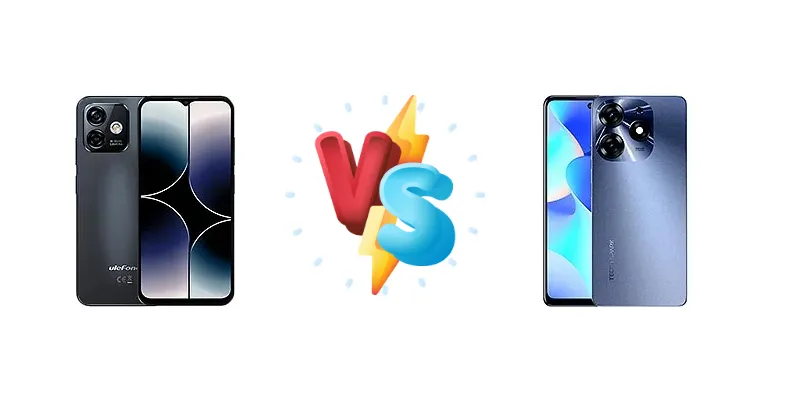
The Ulefone Note 16 Pro and Tecno Spark 10 Pro represent compelling options in the crowded budget smartphone market. While both aim to deliver essential features at accessible price points, they diverge significantly in their core strengths – namely, battery endurance and processing power. This comparison dissects these differences to help you determine which device best suits your needs.
🏆 Quick Verdict
For users prioritizing all-day (and multi-day) battery life, the Ulefone Note 16 Pro is the clear winner, boasting a remarkable 40:15h endurance rating. However, the Tecno Spark 10 Pro offers a brighter display and a slightly more powerful processor, making it a better choice for media consumption and light gaming.
| Network |
|---|
| 2G bands | GSM 850 / 900 / 1800 / 1900 | GSM 850 / 900 / 1800 / 1900 |
| 3G bands | HSDPA 850 / 900 / 1700(AWS) / 1900 / 2100 | HSDPA 850 / 900 / 2100 |
| 4G bands | 1, 2, 3, 4, 5, 7, 8, 12, 17, 19, 20, 28, 34, 38, 39, 40, 41, 66 | LTE |
| Speed | HSPA, LTE | HSPA, LTE |
| Technology | GSM / HSPA / LTE | GSM / HSPA / LTE |
| Launch |
|---|
| Announced | 2023, May 30 | 2023, March 06 |
| Status | Available. Released 2023, May 30 | Available. Released 2023, March 22 |
| Body |
|---|
| Build | - | Glass front, plastic frame, glass back |
| Dimensions | 165 x 76.4 x 8.7 mm (6.50 x 3.01 x 0.34 in) | 168.4 x 76.2 x 8.4 mm (6.63 x 3.00 x 0.33 in) |
| SIM | Nano-SIM + Nano-SIM | Nano-SIM + Nano-SIM |
| Weight | 184 g (6.49 oz) | 208 g (7.34 oz) |
| Display |
|---|
| Protection | Mohs level 4 | - |
| Resolution | 720 x 1600 pixels, 20:9 ratio (~269 ppi density) | 1080 x 2460 pixels (~396 ppi density) |
| Size | 6.52 inches, 102.6 cm2 (~81.4% screen-to-body ratio) | 6.8 inches, 109.3 cm2 (~85.1% screen-to-body ratio) |
| Type | IPS LCD | IPS LCD, 90Hz |
| Platform |
|---|
| CPU | Octa-core (2x1.6 GHz Cortex-A75 & 6x1.6 GHz Cortex-A55) | Octa-core (2x2.0 GHz Cortex-A75 & 6x1.8 GHz Cortex-A55) |
| Chipset | Unisoc T606 (12 nm) | Mediatek MT6769H Helio G88 (12 nm) |
| GPU | Mali-G57 MP1 | Mali-G52 MC2 |
| OS | Android 13 | Android 13, HIOS 12.6 |
| Memory |
|---|
| Card slot | microSDXC (uses shared SIM slot) | microSDXC (dedicated slot) |
| Internal | 128GB 4GB RAM, 256GB 8GB RAM | 128GB 4GB RAM, 128GB 8GB RAM, 256GB 8GB RAM |
| Main Camera |
|---|
| Dual | 50 MP, f/1.8, (wide), 0.64µm, PDAF
2 MP (macro) | 50 MP, f/1.6, (wide), PDAF
0.08 MP, (depth) |
| Features | LED flash, HDR, panorama | Dual-LED flash, HDR, panorama |
| Single | - | 50 MP, f/1.6, (wide), PDAF
Auxiliary lens |
| Triple | - | 50 MP, f/1.6, (wide), PDAF
other unspecified cameras |
| Video | 1080p@30fps | 1440p@30fps, 1080p@30fps |
| Selfie camera |
|---|
| Features | - | Dual-LED flash |
| Single | 8 MP, f/2.0, (wide), 1.12µm | 32 MP, (wide) |
| Video | 1080p@30fps | 1440p@30fps, 1080p@30fps |
| Sound |
|---|
| 3.5mm jack | - | Yes |
| 35mm jack | Yes | Yes |
| Loudspeaker | Yes | Yes |
| Comms |
|---|
| Bluetooth | 5.0, A2DP, LE | 5.3, A2DP, LE |
| NFC | No | Yes |
| Positioning | GPS, GLONASS, GALILEO, BDS | GPS |
| Radio | Stereo FM radio, RDS, recording | FM radio |
| USB | USB Type-C 2.0 | USB Type-C 2.0, OTG |
| WLAN | Wi-Fi 802.11 a/b/g/n/ac, dual-band | Wi-Fi 802.11 b/g/n |
| Features |
|---|
| Sensors | Fingerprint (side-mounted), accelerometer, proximity, compass | Fingerprint (side-mounted), accelerometer, proximity, compass |
| Battery |
|---|
| Charging | 10W | 18W wired |
| Type | Li-Po 4400 mAh | 5000 mAh |
| Misc |
|---|
| Colors | Midnight Violet, Serenity Blue, Meteorite Black | Starry Black, Pearl White |
| Models | - | KI7 |
| Price | - | £ 245.74 |
| Tests |
|---|
| Battery life | - |
Endurance rating 131h
|
| Camera | - |
Photo / Video |
| Display | - |
Contrast ratio: 1991:1 (nominal) |
| Loudspeaker | - |
-29.2 LUFS (Average)
|
| Performance | - |
AnTuTu: 249938 (v9)
GeekBench: 1358 (v5.1), 1376 (v6)
GFXBench: 8.1fps (ES 3.1 onscreen) |
| EU LABEL |
|---|
| Battery | 40:15h endurance, 1000 cycles | - |
| Energy | Class B | - |
| Free fall | Class C (98 falls) | - |
| Repairability | Class C | - |
Ulefone Note 16 Pro
- Exceptional battery life (40:15h endurance)
- Long battery lifespan (1000 charge cycles)
- Potentially better long-term value due to battery longevity
- Slower charging speed (10W)
- Less powerful processor compared to Tecno
Tecno Spark 10 Pro
- Brighter display (521 nits)
- Slightly faster processor (Helio G88)
- Faster charging (18W)
- Significantly shorter battery life (131h endurance)
- Potentially shorter battery lifespan
Display Comparison
The Tecno Spark 10 Pro boasts a brighter display, reaching a measured 521 nits compared to an unstated value for the Ulefone. Both share a 1991:1 contrast ratio, suggesting similar dynamic range. However, brightness is crucial for outdoor visibility, giving the Tecno an edge. While neither manufacturer specifies panel technology (IPS vs. VA), the contrast ratio suggests IPS, which typically offers wider viewing angles. Bezels are not specified, making it difficult to assess the overall immersive experience.
Camera Comparison
Both devices list 'Photo / Video' capabilities, offering minimal insight. Without sensor size or aperture details, a direct comparison is impossible. The absence of specific camera specs suggests both phones rely on software processing to enhance image quality. It's safe to assume both feature a primary camera and potentially depth/macro sensors, but the quality of these secondary sensors is likely to be limited. Focusing on the main sensor's capabilities would be key for discerning image quality.
Performance
The Tecno Spark 10 Pro’s MediaTek Helio G88 (2x2.0 GHz Cortex-A75 & 6x1.8 GHz Cortex-A55) offers a slight CPU clock speed advantage over the Ulefone Note 16 Pro’s Unisoc T606 (2x1.6 GHz Cortex-A75 & 6x1.6 GHz Cortex-A55). This translates to marginally faster app loading and smoother multitasking. Both chipsets are built on a 12nm process, indicating similar power efficiency. However, the Ulefone’s focus on endurance suggests software optimizations prioritize battery conservation over sustained peak performance.
Battery Life
The Ulefone Note 16 Pro’s 40:15h endurance rating is the standout feature, dwarfing the Tecno Spark 10 Pro’s 131h rating. This translates to significantly longer usage between charges. While the Tecno Spark 10 Pro offers 18W charging, the Ulefone is limited to 10W. However, the Ulefone’s massive endurance mitigates the slower charging speed, as users will likely need to charge less frequently. The Ulefone also claims 1000 charge cycles, suggesting a longer lifespan for the battery itself.
Buying Guide
Buy the Ulefone Note 16 Pro if you need exceptional battery life and prioritize longevity over raw performance. This phone is ideal for travelers, field workers, or anyone who frequently finds themselves away from a power outlet. Buy the Tecno Spark 10 Pro if you prefer a more responsive user experience, enjoy watching videos on a brighter screen, and don't mind charging your phone more frequently.
Frequently Asked Questions
❓ How much faster is the Tecno Spark 10 Pro in real-world usage compared to the Ulefone Note 16 Pro?
While the Helio G88 in the Tecno Spark 10 Pro is clocked slightly higher, the difference in everyday tasks like browsing, social media, and messaging will be minimal. The Ulefone Note 16 Pro’s software optimizations may prioritize smoothness over raw speed, potentially mitigating the performance gap. The Tecno will show more benefit in graphically intensive tasks.
❓ Is the 10W charging on the Ulefone Note 16 Pro a significant drawback, given its large battery?
While 10W is slower than the Tecno’s 18W, the Ulefone’s exceptional battery life means you’ll likely need to charge it less often. A full charge will take longer, but the extended usage time between charges compensates for this. The 1000 charge cycle claim also suggests the battery will maintain capacity for a longer period.
❓ What type of user would benefit most from the Ulefone Note 16 Pro's long battery life?
The Ulefone Note 16 Pro is ideal for users who are frequently on the go, travel extensively, or work in environments where access to power outlets is limited. It's also a great choice for those who simply prefer the convenience of not having to worry about charging their phone multiple times a day.