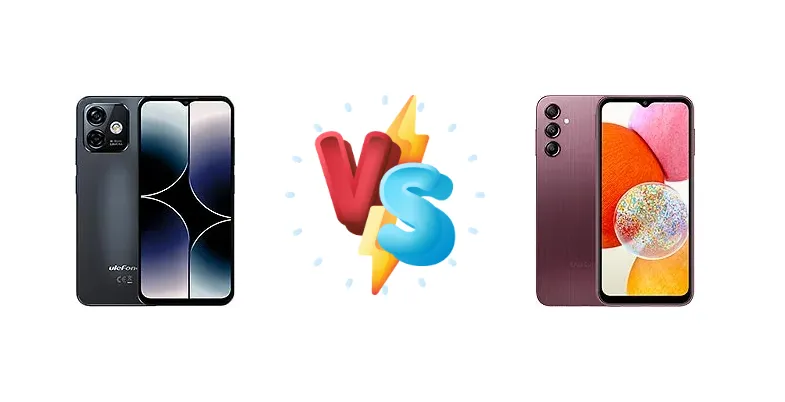
The sub-$200 smartphone market is fiercely competitive. The Ulefone Note 16 Pro and Samsung Galaxy A14 represent compelling options, but cater to different priorities. The Ulefone prioritizes exceptional battery life, while the Samsung offers a more recognizable brand and a choice of chipsets, presenting a trade-off between raw power and efficiency.
🏆 Quick Verdict
For users prioritizing all-day (and then some) battery life, the Ulefone Note 16 Pro is the clear winner, offering a remarkable 40:15h endurance. However, the Samsung Galaxy A14, particularly the Exynos 850 variant, provides a more refined software experience and potentially better sustained performance for demanding tasks.
| Network |
|---|
| 2G bands | GSM 850 / 900 / 1800 / 1900 | GSM 850 / 900 / 1800 / 1900 |
| 3G bands | HSDPA 850 / 900 / 1700(AWS) / 1900 / 2100 | HSDPA 850 / 900 / 2100 |
| 4G bands | 1, 2, 3, 4, 5, 7, 8, 12, 17, 19, 20, 28, 34, 38, 39, 40, 41, 66 | 1, 3, 5, 7, 8, 20, 28, 38, 40, 41 |
| Speed | HSPA, LTE | HSPA, LTE |
| Technology | GSM / HSPA / LTE | GSM / HSPA / LTE |
| Launch |
|---|
| Announced | 2023, May 30 | 2023, February 28 |
| Status | Available. Released 2023, May 30 | Available. Released 2023, March 27 |
| Body |
|---|
| Build | - | Glass front, plastic back, plastic frame |
| Dimensions | 165 x 76.4 x 8.7 mm (6.50 x 3.01 x 0.34 in) | 167.7 x 78 x 9.1 mm (6.60 x 3.07 x 0.36 in) |
| SIM | Nano-SIM + Nano-SIM | · Nano-SIM· Nano-SIM + Nano-SIM |
| Weight | 184 g (6.49 oz) | 201 g (7.09 oz) |
| Display |
|---|
| Protection | Mohs level 4 | - |
| Resolution | 720 x 1600 pixels, 20:9 ratio (~269 ppi density) | 1080 x 2408 pixels, 20:9 ratio (~400 ppi density) |
| Size | 6.52 inches, 102.6 cm2 (~81.4% screen-to-body ratio) | 6.6 inches, 104.9 cm2 (~80.2% screen-to-body ratio) |
| Type | IPS LCD | PLS LCD |
| Platform |
|---|
| CPU | Octa-core (2x1.6 GHz Cortex-A75 & 6x1.6 GHz Cortex-A55) | Octa-core (2x2.0 GHz Cortex-A75 & 6x1.8 GHz Cortex-A55) - Version AOcta-core (4x2.0 GHz Cortex-A55 & 4x2.0 GHz Cortex-A55) - Version B |
| Chipset | Unisoc T606 (12 nm) | Mediatek MT6769 Helio G80 (12 nm) - Version AExynos 850 (8 nm) - Version B |
| GPU | Mali-G57 MP1 | Mali-G52 MC2 |
| OS | Android 13 | Android 13, upgradable to Android 15, One UI 7 |
| Memory |
|---|
| Card slot | microSDXC (uses shared SIM slot) | microSDXC (dedicated slot) |
| Internal | 128GB 4GB RAM, 256GB 8GB RAM | 64GB 4GB RAM, 128GB 4GB RAM, 128GB 6GB RAM |
| Main Camera |
|---|
| Dual | 50 MP, f/1.8, (wide), 0.64µm, PDAF
2 MP (macro) | - |
| Features | LED flash, HDR, panorama | LED flash, panorama, HDR |
| Single | - | 13 MP, f/2.0, (wide) |
| Triple | - | 50 MP, f/1.8, 26mm (wide), 1/2.75", 0.64µm, PDAF
5 MP, f/2.2, 17mm (ultrawide), 1/5.0", 1.12µm
2 MP (macro) |
| Video | 1080p@30fps | 1080p@30fps |
| Selfie camera |
|---|
| Single | 8 MP, f/2.0, (wide), 1.12µm | 13 MP, f/2.0, 26mm (wide), 1/3.1", 1.12µm |
| Video | 1080p@30fps | 1080p@30fps |
| Sound |
|---|
| 3.5mm jack | - | Yes |
| 35mm jack | Yes | Yes |
| Loudspeaker | Yes | Yes |
| Comms |
|---|
| Bluetooth | 5.0, A2DP, LE | 5.1 or 5.3, A2DP, LE |
| NFC | No | Yes (market/region dependent) |
| Positioning | GPS, GLONASS, GALILEO, BDS | GPS, GALILEO, GLONASS, BDS, QZSS |
| Radio | Stereo FM radio, RDS, recording | Unspecified |
| USB | USB Type-C 2.0 | USB Type-C 2.0 |
| WLAN | Wi-Fi 802.11 a/b/g/n/ac, dual-band | Wi-Fi 802.11 a/b/g/n/ac, dual-band, Wi-Fi Direct |
| Features |
|---|
| Sensors | Fingerprint (side-mounted), accelerometer, proximity, compass | Fingerprint (side-mounted), accelerometer, proximity, compass |
| Battery |
|---|
| Charging | 10W | 15W wired |
| Type | Li-Po 4400 mAh | Li-Po 5000 mAh |
| Misc |
|---|
| Colors | Midnight Violet, Serenity Blue, Meteorite Black | Black, Dark Red, Silver, Green |
| Models | - | SM-A145F, SM-A145F/DSN, SM-A145M, SM-A145M/DS, SM-A145P, SM-A145R |
| Price | - | € 85.76 / $ 147.60 / £ 79.95 |
| SAR EU | - | 0.46 W/kg (head) 1.37 W/kg (body) |
| EU LABEL |
|---|
| Battery | 40:15h endurance, 1000 cycles | - |
| Energy | Class B | - |
| Free fall | Class C (98 falls) | - |
| Repairability | Class C | - |
Ulefone Note 16 Pro
- Exceptional battery life (40:15h endurance)
- Potentially more consistent performance due to efficient chipset
- Competitive price point
- Slower charging speed (10W)
- Less recognizable brand
- Potentially less refined software experience
Samsung Galaxy A14
- Well-known brand (Samsung)
- Faster charging (15W)
- Choice of chipsets (Helio G80 or Exynos 850)
- Significantly lower battery life
- Performance varies depending on chipset version
- May experience more throttling under sustained load
Display Comparison
Neither device boasts a standout display. Both utilize 12nm chipsets, suggesting similar power constraints impacting display capabilities. While specific display specs (resolution, brightness) are missing for the Ulefone, the A14's display is likely a standard LCD panel. The focus here isn't on visual fidelity, but rather on functional usability. The A14's larger screen size (typically 6.6 inches vs. the Note 16 Pro's likely similar size) may be preferable for media consumption, but without detailed specs, a definitive comparison is impossible.
Camera Comparison
Camera performance is likely to be similar across both devices, leaning towards basic functionality. Both phones likely feature a primary camera accompanied by several low-resolution sensors (often 2MP macro/depth). Without specific sensor details, it’s safe to assume image quality will be adequate for social media sharing but won’t compete with higher-end smartphones. The A14 may benefit from Samsung’s image processing algorithms, potentially offering slightly more refined results, but the difference will likely be marginal. The absence of OIS on either device suggests low-light performance will be limited.
Performance
The performance landscape is more nuanced. The Ulefone Note 16 Pro’s Unisoc T606, while a 12nm chip, features a Cortex-A75 based CPU configuration. The Samsung Galaxy A14 presents a split: the Helio G80 (also 12nm) and the Exynos 850 (8nm). The Exynos 850, built on a smaller 8nm process, theoretically offers better power efficiency and thermal headroom. The A75 cores in both the Ulefone and the A14 (Helio G80/Exynos 850) provide a performance boost over the A55 cores, but the Exynos 850’s architecture is more modern. The A14’s CPU clock speeds (2.0 GHz Cortex-A75) are slightly higher than the Ulefone’s (1.6 GHz Cortex-A75), suggesting a potential edge in single-core performance. However, the Ulefone’s focus on efficiency may translate to more consistent performance under sustained load.
Battery Life
This is where the Ulefone Note 16 Pro truly shines. Its 40:15h endurance rating is exceptional for a budget smartphone. The Samsung Galaxy A14, with its 15W charging, offers a faster charging speed than the Ulefone’s 10W, but this is offset by the significantly lower endurance. The A14’s battery capacity is not specified, but a typical capacity for this class of device is around 5000mAh. While 5000mAh is respectable, it doesn’t come close to the Ulefone’s demonstrated endurance. The Ulefone’s Unisoc T606 chipset, despite being less powerful, appears to be significantly more power-efficient, allowing for extended usage on a single charge.
Buying Guide
Buy the Ulefone Note 16 Pro if you need a phone that can reliably last through two full days of moderate use, and aren't heavily reliant on graphically intensive games. Buy the Samsung Galaxy A14 if you prefer a well-known brand, a potentially smoother user experience (depending on the chipset version), and are willing to compromise on ultimate battery endurance for potentially better app responsiveness.
Frequently Asked Questions
❓ Does the Exynos 850 chip in the Samsung Galaxy A14 overheat during prolonged gaming sessions?
The Exynos 850, while more efficient than the Helio G80, is still a budget chipset. While it's unlikely to experience severe overheating, sustained gaming at high settings may lead to thermal throttling, reducing performance over time. The Ulefone Note 16 Pro, with its less powerful but more efficient Unisoc T606, may offer more consistent performance during extended gaming, albeit at lower graphical settings.
❓ Is the 2MP macro camera on either phone actually useful for taking detailed close-up photos?
Generally, 2MP macro cameras on budget smartphones are of limited utility. The low resolution results in images lacking detail and sharpness. They are often included as a marketing feature rather than a genuinely useful photographic tool. Expect soft, grainy images from both devices when using the macro camera.
❓ Can the Samsung Galaxy A14 handle demanding games like PUBG Mobile at 60fps?
The Samsung Galaxy A14, particularly the Exynos 850 variant, *may* be able to run PUBG Mobile at 60fps with graphics settings lowered to medium or low. However, performance will vary depending on the specific game version and background processes. The Helio G80 version will likely struggle to maintain a stable 60fps even at lower settings. The Ulefone Note 16 Pro is less suited for demanding games like PUBG Mobile due to its less powerful GPU.