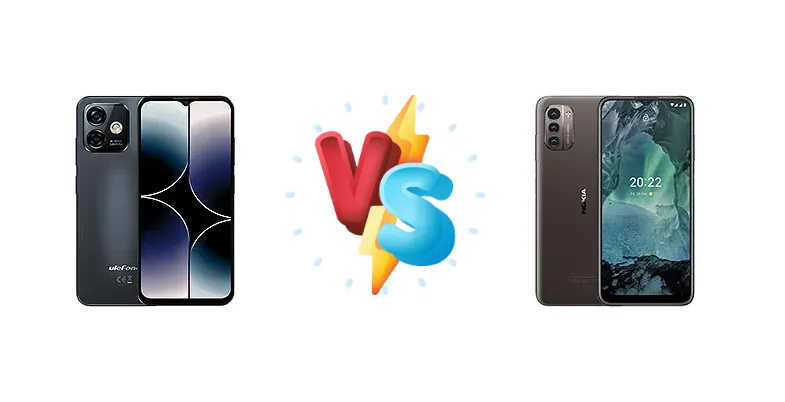
The Ulefone Note 16 Pro and Nokia G21 both target the budget-conscious smartphone user, but they take different approaches. The Ulefone prioritizes exceptional battery endurance, while the Nokia G21 focuses on faster charging and a more polished software experience. This comparison dissects their key specifications to determine which device delivers the best overall package.
🏆 Quick Verdict
For users prioritizing maximum uptime and longevity, the Ulefone Note 16 Pro is the clear winner. Its astounding 40:15h endurance rating significantly outpaces the Nokia G21’s 126h, making it ideal for travelers or those away from power outlets. However, the Nokia G21’s 18W charging offers a convenience the Ulefone lacks.
| Network |
|---|
| 2G bands | GSM 850 / 900 / 1800 / 1900 | GSM 850 / 900 / 1800 / 1900 |
| 3G bands | HSDPA 850 / 900 / 1700(AWS) / 1900 / 2100 | HSDPA 850 / 900 / 2100 - International |
| 4G bands | 1, 2, 3, 4, 5, 7, 8, 12, 17, 19, 20, 28, 34, 38, 39, 40, 41, 66 | 1, 3, 5, 7, 8, 20, 28, 38, 40, 41 - International |
| Speed | HSPA, LTE | HSPA 42.2/5.76 Mbps, LTE Cat4 150/50 Mbps |
| Technology | GSM / HSPA / LTE | GSM / HSPA / LTE |
| | - | 1, 2, 3, 4, 5, 7, 8, 12, 17, 28, 40, 66 - LATAM |
| Launch |
|---|
| Announced | 2023, May 30 | 2022, February 14 |
| Status | Available. Released 2023, May 30 | Available. Released 2022, February 15 |
| Body |
|---|
| Build | - | Glass front, plastic frame, plastic back |
| Dimensions | 165 x 76.4 x 8.7 mm (6.50 x 3.01 x 0.34 in) | 164.6 x 75.9 x 8.5 mm (6.48 x 2.99 x 0.33 in) |
| SIM | Nano-SIM + Nano-SIM | · Nano-SIM· Nano-SIM + Nano-SIM |
| Weight | 184 g (6.49 oz) | 190 g (6.70 oz) |
| Display |
|---|
| Protection | Mohs level 4 | - |
| Resolution | 720 x 1600 pixels, 20:9 ratio (~269 ppi density) | 720 x 1600 pixels, 20:9 ratio (~270 ppi density) |
| Size | 6.52 inches, 102.6 cm2 (~81.4% screen-to-body ratio) | 6.5 inches, 102.0 cm2 (~81.6% screen-to-body ratio) |
| Type | IPS LCD | IPS LCD, 90Hz, 400 nits (typ) |
| Platform |
|---|
| CPU | Octa-core (2x1.6 GHz Cortex-A75 & 6x1.6 GHz Cortex-A55) | Octa-core (2x1.6 GHz Cortex-A75 & 6x1.6 GHz Cortex-A55) |
| Chipset | Unisoc T606 (12 nm) | Unisoc T606 (12 nm) |
| GPU | Mali-G57 MP1 | Mali-G57 MP1 |
| OS | Android 13 | Android 11, upgradable to Android 13 |
| Memory |
|---|
| Card slot | microSDXC (uses shared SIM slot) | microSDXC (dedicated slot) |
| Internal | 128GB 4GB RAM, 256GB 8GB RAM | 64GB 3GB RAM, 64GB 4GB RAM, 128GB 4GB RAM, 128GB 6GB RAM |
| | - | eMMC 5.1 |
| Main Camera |
|---|
| Dual | 50 MP, f/1.8, (wide), 0.64µm, PDAF
2 MP (macro) | - |
| Features | LED flash, HDR, panorama | LED flash, HDR, panorama |
| Single | - | 8 MP, f/2.0, (wide) |
| Triple | - | 50 MP, f/1.8, 28mm (wide), 1/2.76", 0.64µm, PDAF
2 MP (macro)
Auxiliary lens |
| Video | 1080p@30fps | 1080p@30fps |
| Selfie camera |
|---|
| Single | 8 MP, f/2.0, (wide), 1.12µm | 8 MP, f/2.0, (wide) |
| Video | 1080p@30fps | 1080p@30fps |
| Sound |
|---|
| 3.5mm jack | - | Yes |
| 35mm jack | Yes | Yes |
| Loudspeaker | Yes | Yes |
| Comms |
|---|
| Bluetooth | 5.0, A2DP, LE | 5.0, A2DP, LE |
| NFC | No | Yes (market/region dependent) |
| Positioning | GPS, GLONASS, GALILEO, BDS | GPS, GLONASS, GALILEO |
| Radio | Stereo FM radio, RDS, recording | FM radio, RDS |
| USB | USB Type-C 2.0 | USB Type-C 2.0, OTG |
| WLAN | Wi-Fi 802.11 a/b/g/n/ac, dual-band | Wi-Fi 802.11 a/b/g/n/ac, dual-band, Wi-Fi Direct |
| Features |
|---|
| Sensors | Fingerprint (side-mounted), accelerometer, proximity, compass | Fingerprint (side-mounted), accelerometer, proximity |
| Battery |
|---|
| Charging | 10W | 18W wired, PD3.0 |
| Type | Li-Po 4400 mAh | Li-Po 5050 mAh |
| Misc |
|---|
| Colors | Midnight Violet, Serenity Blue, Meteorite Black | Nordic Blue, Dusk |
| Models | - | TA-1418, TA-1477, TA-1415, TA-1405, TA-1404, TA-1412 |
| Price | - | About 90 EUR |
| SAR | - | 1.00 W/kg (head) 1.10 W/kg (body) |
| SAR EU | - | 0.34 W/kg (head) 1.05 W/kg (body) |
| Tests |
|---|
| Battery life | - |
Endurance rating 126h
|
| Camera | - |
Photo / Video |
| Display | - |
Contrast ratio: 1631:1 (nominal) |
| Loudspeaker | - |
-30.7 LUFS (Below average)
|
| Performance | - |
AnTuTu: 171299 (v9)
GeekBench: 1193 (v5.1)
GFXBench: 8.9fps (ES 3.1 onscreen) |
| EU LABEL |
|---|
| Battery | 40:15h endurance, 1000 cycles | - |
| Energy | Class B | - |
| Free fall | Class C (98 falls) | - |
| Repairability | Class C | - |
Ulefone Note 16 Pro
- Exceptional battery endurance (40:15h)
- Potentially longer battery lifespan (1000 cycles)
- Competitive price point (implied)
- Slow 10W charging
- Limited display specifications
- Basic camera system (implied)
Nokia G21
- Faster 18W charging with PD3.0
- Brighter display (500 nits)
- More established brand reputation
- Significantly shorter battery endurance (126h)
- No specified battery cycle lifespan
- Basic camera system (implied)
Display Comparison
Both devices share a similar contrast ratio of 1631:1, suggesting comparable visual depth. However, the Nokia G21 boasts a measured peak brightness of 500 nits, which will provide a noticeably more vibrant and readable experience in direct sunlight compared to the Ulefone Note 16 Pro, whose brightness is not specified. The lack of detailed display specs for the Ulefone makes a direct comparison difficult, but the Nokia G21’s brightness advantage is a clear benefit for outdoor use.
Camera Comparison
Both phones list 'Photo / Video' capabilities, but lack specific details regarding sensor size, aperture, or image processing. This suggests a focus on basic photography rather than high-quality imaging. The lack of detail makes a meaningful comparison impossible; it’s safe to assume both will perform adequately in good lighting conditions but struggle in low light. The inclusion of a 2MP macro camera on either device is likely a marketing tactic, as such low-resolution sensors rarely produce usable images.
Performance
Both the Ulefone Note 16 Pro and Nokia G21 are powered by the Unisoc T606 chipset with an identical CPU configuration – an octa-core setup featuring 2x1.6 GHz Cortex-A75 and 6x1.6 GHz Cortex-A55 cores. This means performance will be largely similar for everyday tasks like browsing, social media, and light gaming. Neither device is positioned as a performance powerhouse, and demanding games will likely require reduced settings. The absence of RAM specifications for both devices makes it difficult to assess multitasking capabilities, but the chipset itself is the primary performance bottleneck.
Battery Life
The Ulefone Note 16 Pro’s 40:15h endurance rating is the standout feature, dwarfing the Nokia G21’s 126h. This translates to significantly longer usage between charges, potentially lasting multiple days for moderate users. While the Nokia G21 offers 18W wired charging with PD3.0 support, enabling faster top-ups, the Ulefone is limited to 10W charging. The Ulefone also claims 1000 battery cycles, suggesting a longer lifespan before significant capacity degradation, a factor the Nokia G21’s specifications do not address.
Buying Guide
Buy the Ulefone Note 16 Pro if you absolutely need the longest possible battery life and are willing to sacrifice charging speed. This phone is perfect for users who frequently travel, work outdoors, or simply dislike the hassle of daily charging. Buy the Nokia G21 if you value faster charging and a slightly more refined user experience, even if it means compromising on overall battery endurance. It’s a better fit for users who prefer to top up their phone throughout the day.
Frequently Asked Questions
❓ How long will the Ulefone Note 16 Pro realistically last on a single charge with moderate use?
With moderate use (a few hours of browsing, social media, and calls), the Ulefone Note 16 Pro should easily last two full days, and potentially three, thanks to its 40:15h endurance rating. This makes it ideal for weekend trips or situations where access to a charger is limited.
❓ Does the Nokia G21’s 18W charging significantly reduce charging time compared to the Ulefone Note 16 Pro?
Yes, the Nokia G21’s 18W charging with PD3.0 will charge the device considerably faster than the Ulefone Note 16 Pro’s 10W charging. While exact 0-100% times aren’t specified, you can expect a noticeable difference, potentially shaving off several hours of charging time.
❓ Are the cameras on either phone suitable for taking high-quality photos in low-light conditions?
Given the lack of detailed camera specifications, it’s unlikely that either phone will excel in low-light photography. Expect images to be noisy and lack detail in challenging lighting situations. Both are likely best suited for casual snapshots in good lighting.
❓ What does '1000 battery cycles' mean for the Ulefone Note 16 Pro?
A battery cycle is a complete discharge and recharge of the battery. The Ulefone Note 16 Pro’s claim of 1000 cycles suggests the battery should retain a significant portion of its original capacity after being fully charged and discharged 1000 times, potentially extending its usable lifespan.