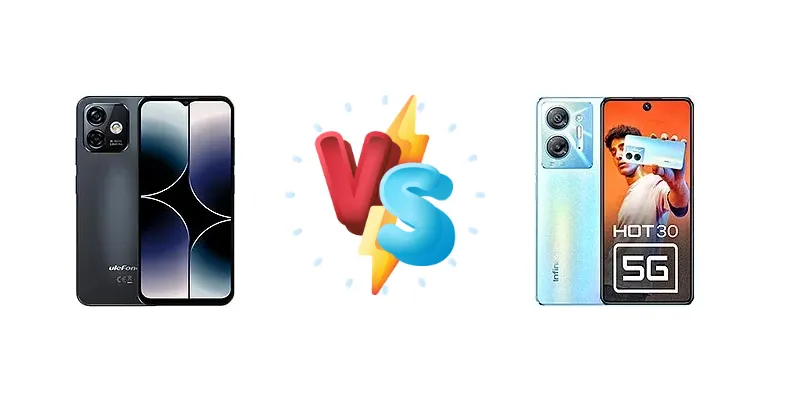
The sub-$200 smartphone market is fiercely competitive, and the Ulefone Note 16 Pro and Infinix Hot 30 5G represent compelling options for users prioritizing affordability and 5G connectivity. However, they take different approaches: Ulefone focuses on maximizing battery endurance, while Infinix prioritizes processing power with a newer chipset and faster charging. This comparison dissects their key differences to help you choose the right device.
🏆 Quick Verdict
For the average user, the Infinix Hot 30 5G emerges as the stronger choice. Its Mediatek Dimensity 6020 chipset delivers noticeably better performance than the Ulefone's Unisoc T606, and the 18W charging significantly reduces downtime. While the Ulefone boasts impressive battery endurance, the performance gap is too significant to ignore.
| Network |
|---|
| 2G bands | GSM 850 / 900 / 1800 / 1900 | GSM 850 / 900 / 1800 / 1900 |
| 3G bands | HSDPA 850 / 900 / 1700(AWS) / 1900 / 2100 | HSDPA 850 / 900 / 1700(AWS) / 1900 / 2100 |
| 4G bands | 1, 2, 3, 4, 5, 7, 8, 12, 17, 19, 20, 28, 34, 38, 39, 40, 41, 66 | LTE |
| 5G bands | - | 1, 3, 5, 8, 28, 38, 40, 41, 77, 78 SA/NSA |
| Speed | HSPA, LTE | HSPA, LTE, 5G |
| Technology | GSM / HSPA / LTE | GSM / HSPA / LTE / 5G |
| Launch |
|---|
| Announced | 2023, May 30 | 2023, July 14 |
| Status | Available. Released 2023, May 30 | Available. Released 2023, July 18 |
| Body |
|---|
| Build | - | Glass front, plastic frame, plastic back |
| Dimensions | 165 x 76.4 x 8.7 mm (6.50 x 3.01 x 0.34 in) | 168.5 x 76.5 x 9.2 mm (6.63 x 3.01 x 0.36 in) |
| SIM | Nano-SIM + Nano-SIM | Nano-SIM + Nano-SIM |
| Weight | 184 g (6.49 oz) | 215 g (7.58 oz) |
| Display |
|---|
| Protection | Mohs level 4 | - |
| Resolution | 720 x 1600 pixels, 20:9 ratio (~269 ppi density) | 1080 x 2460 pixels (~396 ppi density) |
| Size | 6.52 inches, 102.6 cm2 (~81.4% screen-to-body ratio) | 6.78 inches, 109.2 cm2 (~84.7% screen-to-body ratio) |
| Type | IPS LCD | IPS LCD, 120Hz, 580 nits (peak) |
| Platform |
|---|
| CPU | Octa-core (2x1.6 GHz Cortex-A75 & 6x1.6 GHz Cortex-A55) | Octa-core (2x2.2 GHz Cortex-A76 & 6x2.0 GHz Cortex-A55) |
| Chipset | Unisoc T606 (12 nm) | Mediatek Dimensity 6020 (7 nm) |
| GPU | Mali-G57 MP1 | Mali-G57 MC2 |
| OS | Android 13 | Android 13, XOS 13 |
| Memory |
|---|
| Card slot | microSDXC (uses shared SIM slot) | microSDXC (dedicated slot) |
| Internal | 128GB 4GB RAM, 256GB 8GB RAM | 128GB 4GB RAM, 128GB 8GB RAM |
| Main Camera |
|---|
| Dual | 50 MP, f/1.8, (wide), 0.64µm, PDAF
2 MP (macro) | - |
| Features | LED flash, HDR, panorama | Quad-LED flash, HDR, panorama |
| Single | - | 50 MP, f/1.6, (wide), 1/2.55", AF
Auxiliary lens |
| Video | 1080p@30fps | 1440p@30fps, 1080p@30fps |
| Selfie camera |
|---|
| Features | - | Dual-LED flash |
| Single | 8 MP, f/2.0, (wide), 1.12µm | 8 MP, f/2.0, (wide) |
| Video | 1080p@30fps | 1080p@30fps |
| Sound |
|---|
| 35mm jack | Yes | Yes |
| Loudspeaker | Yes | Yes, with stereo speakers |
| Comms |
|---|
| Bluetooth | 5.0, A2DP, LE | 5.1, A2DP, LE |
| NFC | No | No |
| Positioning | GPS, GLONASS, GALILEO, BDS | GPS, GLONASS, GALILEO, BDS |
| Radio | Stereo FM radio, RDS, recording | FM radio |
| USB | USB Type-C 2.0 | USB Type-C 2.0 |
| WLAN | Wi-Fi 802.11 a/b/g/n/ac, dual-band | Wi-Fi 802.11 a/b/g/n/ac, dual-band |
| Features |
|---|
| Sensors | Fingerprint (side-mounted), accelerometer, proximity, compass | Fingerprint (side-mounted), accelerometer, proximity, compass |
| Battery |
|---|
| Charging | 10W | 18W wired |
| Type | Li-Po 4400 mAh | 5000 mAh |
| Misc |
|---|
| Colors | Midnight Violet, Serenity Blue, Meteorite Black | Knight Black, Aurora Blue |
| Models | - | X6832 |
| Price | - | About 140 EUR |
| EU LABEL |
|---|
| Battery | 40:15h endurance, 1000 cycles | - |
| Energy | Class B | - |
| Free fall | Class C (98 falls) | - |
| Repairability | Class C | - |
Ulefone Note 16 Pro
- Exceptional battery endurance (40:15h)
- Long-term battery health (1000 cycles)
- Potentially lower price point
- Slow 10W charging
- Less powerful Unisoc T606 chipset
- Likely limited gaming performance
Infinix Hot 30 5G
- Faster and more efficient Mediatek Dimensity 6020 chipset
- Faster 18W charging
- Improved overall performance and responsiveness
- Potentially shorter battery life compared to Ulefone
- May be slightly more expensive
- Battery cycle life not specified
Display Comparison
Neither device boasts a standout display. Both likely utilize LCD panels, common in this price bracket. The key difference lies under the hood. We lack specific display specs, but the focus here is on processing power, not visual fidelity. Expect adequate, but not exceptional, viewing experiences on both.
Camera Comparison
Without detailed camera specifications, a direct comparison is difficult. However, given the price point, both phones likely feature primary sensors around the 13-50MP range. The Ulefone Note 16 Pro’s camera system is likely optimized for basic photography, while the Infinix Hot 30 5G may benefit from the Dimensity 6020’s improved image signal processor (ISP) for faster processing and potentially better image quality. We can assume both will include lower-resolution auxiliary lenses (depth, macro) of limited utility.
Performance
The Infinix Hot 30 5G’s Mediatek Dimensity 6020 (7nm) represents a significant architectural leap over the Ulefone Note 16 Pro’s Unisoc T606 (12nm). The Dimensity 6020 features newer Cortex-A76 cores clocked at 2.2 GHz, compared to the T606’s Cortex-A75 cores at 1.6 GHz. This translates to a substantial performance advantage in CPU-intensive tasks and gaming. The 7nm process node also contributes to better thermal efficiency, potentially reducing throttling during sustained workloads. While both are octa-core CPUs, the architectural improvements in the Dimensity 6020 are crucial.
Battery Life
The Ulefone Note 16 Pro claims an impressive 40:15h endurance, suggesting exceptional battery life. However, its 10W charging is a major drawback. The Infinix Hot 30 5G, with 18W charging, will replenish its battery much faster, even if its overall endurance is slightly lower. The Ulefone’s 1000 cycle battery claim is a positive, indicating long-term battery health, but the slow charging speed is a significant inconvenience for users who need quick top-ups.
Buying Guide
Buy the Ulefone Note 16 Pro if you absolutely need the longest possible battery life and are willing to compromise on processing speed. This phone is ideal for users who primarily browse, message, and make calls, and rarely engage in demanding tasks. Buy the Infinix Hot 30 5G if you prioritize a smoother user experience, faster app loading times, and the ability to handle moderate gaming or multitasking. It's the better option for users who want a more responsive and versatile device.
Frequently Asked Questions
❓ Will the Dimensity 6020 in the Infinix Hot 30 5G struggle with demanding games like PUBG Mobile?
While the Dimensity 6020 isn't a flagship chipset, it's capable of running PUBG Mobile at medium settings with reasonable frame rates. Expect some occasional frame drops during intense firefights, but it's a playable experience. The Ulefone Note 16 Pro's Unisoc T606 will likely struggle to maintain stable frame rates even at lower settings.
❓ How long will it realistically take to fully charge the Ulefone Note 16 Pro with its 10W charging?
With 10W charging, a full charge from 0% on the Ulefone Note 16 Pro will likely take over 3 hours, potentially closer to 4. This is a significant drawback compared to the Infinix Hot 30 5G's 18W charging, which can achieve a full charge in around 2 hours.
❓ Does the Infinix Hot 30 5G support carrier aggregation for faster 5G speeds?
While not explicitly stated, the Dimensity 6020 chipset generally supports carrier aggregation, which can significantly improve 5G download and upload speeds. However, actual speeds will depend on your carrier and network conditions.
❓ Is the 1000 charge cycle claim for the Ulefone Note 16 Pro battery realistic?
1000 charge cycles is an optimistic claim, but it suggests the battery is designed for longevity. However, battery degradation will still occur over time, even with fewer cycles. The actual capacity will diminish after prolonged use, regardless of the cycle count.