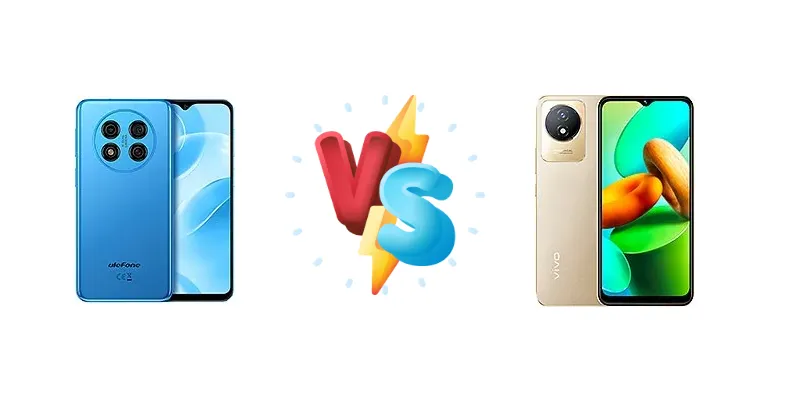
The Ulefone Note 15 and vivo Y02t represent the extreme end of the smartphone price spectrum. Both aim to deliver essential functionality at a minimal cost, but they take different approaches to achieving this. This comparison dissects their core components to determine which device offers the most compelling value for users prioritizing affordability.
🏆 Quick Verdict
For the average user seeking a slightly more responsive experience, the vivo Y02t emerges as the better choice. Its Helio P35 chipset, built on a more efficient 12nm process, provides a noticeable performance uplift over the Ulefone Note 15’s MT6580A, despite both being entry-level options. However, the Ulefone may appeal to those prioritizing absolute lowest cost.
| Network |
|---|
| 2G bands | GSM 850 / 900 / 1800 / 1900 | GSM 850 / 900 / 1800 / 1900 |
| 3G bands | HSDPA 850 / 900 / 1900 / 2100 | HSDPA 850 / 900 / 2100 |
| 4G bands | - | 1, 3, 5, 7, 8, 20, 28, 38, 40, 41 |
| Speed | HSPA | HSPA, LTE |
| Technology | GSM / HSPA | GSM / HSPA / LTE |
| Launch |
|---|
| Announced | 2023, June 18 | 2023, July 12 |
| Status | Available. Released 2023, June 18 | Available. Released 2023, July 22 |
| Body |
|---|
| Build | - | Glass front, plastic back, plastic frame |
| Dimensions | 157.2 x 75.3 x 8.9 mm (6.19 x 2.96 x 0.35 in) | 164 x 75.6 x 8.5 mm (6.46 x 2.98 x 0.33 in) |
| SIM | Nano-SIM + Nano-SIM | Nano-SIM + Nano-SIM |
| Weight | 179 g (6.31 oz) | 186 g (6.56 oz) |
| Display |
|---|
| Resolution | 720 x 1600 pixels, 20:9 ratio (~282 ppi density) | 720 x 1600 pixels, 20:9 ratio (~270 ppi density) |
| Size | 6.22 inches, 93.4 cm2 (~78.9% screen-to-body ratio) | 6.51 inches, 102.3 cm2 (~82.5% screen-to-body ratio) |
| Type | IPS LCD | IPS LCD |
| Platform |
|---|
| CPU | Quad-core 1.3 GHz Cortex-A7 | Octa-core (4x2.35 GHz Cortex-A53 & 4x1.8 GHz Cortex-A53) |
| Chipset | Mediatek MT6580A/WVP (28 nm) | Mediatek MT6765 Helio P35 (12 nm) |
| GPU | Mali-400 | PowerVR GE8320 |
| OS | Android 12 (Go edition) | Android 13, Funtouch 13 |
| Memory |
|---|
| Card slot | microSDXC (dedicated slot) | microSDXC (dedicated slot) |
| Internal | 32GB 2GB RAM | 64GB 4GB RAM, 128GB 4GB RAM |
| Main Camera |
|---|
| Dual | 8 MP, (wide)
Auxiliary lens | - |
| Features | LED flash, HDR, panorama | LED flash |
| Single | - | 8 MP, f/2.0 |
| Video | 720p@30fps | 1080p@30fps |
| Selfie camera |
|---|
| Single | 5 MP | 5 MP, f/2.2 |
| Video | 720p@30fps | Yes |
| Sound |
|---|
| 35mm jack | Yes | Yes |
| Loudspeaker | Yes | Yes |
| Comms |
|---|
| Bluetooth | 4.0, A2DP | 5.0, A2DP, LE |
| NFC | No | No |
| Positioning | GPS | GPS, GLONASS, GALILEO, BDS, QZSS |
| Radio | Stereo FM radio, RDS, recording | FM radio |
| USB | USB Type-C 2.0 | microUSB 2.0, OTG |
| WLAN | Wi-Fi 802.11 b/g/n | Wi-Fi 802.11 a/b/g/n/ac, dual-band |
| Features |
|---|
| Sensors | Accelerometer, proximity | Accelerometer, gyro, proximity, compass (market/region dependent) |
| Battery |
|---|
| Charging | - | 10W wired
5W reverse wired |
| Type | Li-Po 4000 mAh | 5000 mAh |
| Misc |
|---|
| Colors | Sunset Purple, Diamond Blue, Twilight Black | Orchid Blue, Cosmic Grey, Sunset Gold |
| Models | - | V2254, V2252 |
| Price | About 80 EUR | - |
Ulefone Note 15
- Potentially lower price point
- Functional for basic tasks
- Likely durable build quality (Ulefone's reputation)
- Significantly slower performance
- Older chipset architecture
- Likely inferior camera quality
vivo Y02t
- Faster and more responsive performance
- More efficient chipset (12nm)
- 5W reverse wired charging
- Slower 10W charging
- Basic camera system
- May be slightly more expensive
Display Comparison
Neither device boasts a standout display. Specifications are unavailable for the Ulefone Note 15’s panel, suggesting a basic LCD. The vivo Y02t also utilizes an LCD, likely with a 720p+ resolution. The absence of features like high refresh rates or even full HD resolution is standard at this price point. The focus here is purely on functionality, not visual fidelity. Bezels are expected to be substantial on both devices, maximizing screen real estate within a compact form factor.
Camera Comparison
Camera performance is likely to be similar on both devices, meaning limited in low-light conditions. Details regarding sensor sizes and apertures are unavailable for either phone, but given the price point, expect basic 5MP or 8MP main sensors. The inclusion of a 2MP macro camera on the vivo Y02t is largely a marketing gimmick, offering minimal practical benefit due to its low resolution and fixed focus. Image processing will be basic on both, relying heavily on software algorithms to enhance image quality.
Performance
The core difference lies in the chipsets. The Ulefone Note 15’s Mediatek MT6580A, fabricated on a 28nm process, features a quad-core Cortex-A7 CPU clocked at 1.3 GHz. This is a significantly older architecture. Conversely, the vivo Y02t’s Helio P35 (MT6765) is built on a more modern 12nm process and boasts an octa-core configuration (4x2.35 GHz Cortex-A53 & 4x1.8 GHz Cortex-A53). This translates to a substantial performance advantage for the Y02t in multi-tasking and app loading times. While neither is a gaming powerhouse, the Y02t will handle less demanding titles with greater fluidity. The Ulefone will struggle with even moderately demanding applications.
Battery Life
Battery capacity is not specified for the Ulefone Note 15, but it's likely around 4000-5000mAh, typical for this segment. The vivo Y02t packs a 5000mAh battery and supports 10W wired charging, with an added benefit of 5W reverse wired charging. While 10W charging is slow by modern standards, it’s adequate for overnight charging. The reverse charging feature, though limited, allows the Y02t to act as a power bank for other small devices, a unique advantage over the Ulefone.
Buying Guide
Buy the Ulefone Note 15 if you need a functional smartphone for basic tasks like calls, texts, and light web browsing, and your budget is extremely limited. Buy the vivo Y02t if you prefer a smoother, more responsive user experience for everyday tasks, occasional social media use, and are willing to spend a little more for improved performance and reverse charging capabilities.
Frequently Asked Questions
❓ Will the vivo Y02t be able to run popular social media apps like Facebook and Instagram smoothly?
Yes, the Helio P35 chipset in the vivo Y02t is capable of running social media apps like Facebook and Instagram without significant lag. While it won't offer a high-end experience, it will provide a usable and reasonably smooth experience for casual browsing and interaction.
❓ Is the Ulefone Note 15 a good option for someone who primarily uses their phone for calls and texts?
Yes, the Ulefone Note 15 is a perfectly adequate option for users who primarily need a phone for calls and texts. Its basic functionality and potentially lower price point make it suitable for this limited use case. However, be prepared for slower performance if you attempt to use more demanding apps.
❓ How long will it take to fully charge the vivo Y02t from 0% to 100%?
With its 10W charging, the vivo Y02t will likely take around 3-4 hours to fully charge from 0% to 100%. This is a relatively slow charging speed compared to modern smartphones, but it's typical for devices in this price range. Overnight charging is recommended.
❓ Can the vivo Y02t be used to charge other devices wirelessly?
No, the vivo Y02t only supports 5W *wired* reverse charging. This means you can connect another device to it using a USB cable to provide a small amount of power, but it does not support wireless charging for other devices.