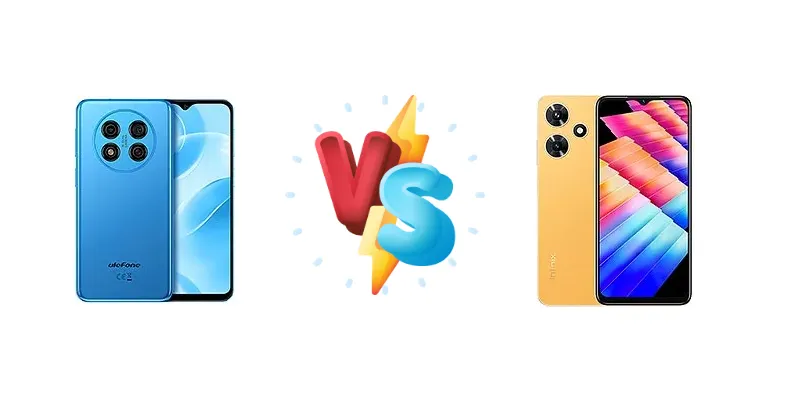
The Ulefone Note 15 and Infinix Hot 30i represent two distinct approaches to the ultra-budget smartphone market. The Ulefone relies on a tried-and-true, albeit older, Mediatek chipset, while the Infinix opts for the newer Unisoc T606. This comparison dissects these choices, revealing which phone offers the best experience for everyday tasks and light use.
🏆 Quick Verdict
For the average user prioritizing responsiveness and future-proofing, the Infinix Hot 30i is the clear winner. Its Unisoc T606 chipset, built on a more efficient 12nm process, delivers significantly better performance than the Ulefone Note 15’s aging Mediatek MT6580A. While the Ulefone may offer a slightly lower price point, the performance gap justifies the small premium for the Infinix.
| Network |
|---|
| 2G bands | GSM 850 / 900 / 1800 / 1900 | GSM 850 / 900 / 1800 / 1900 |
| 3G bands | HSDPA 850 / 900 / 1900 / 2100 | HSDPA 850 / 900 / 1700(AWS) / 1900 / 2100 |
| 4G bands | - | 1, 2, 3, 4, 5, 7, 8, 20, 28, 38, 40, 41 |
| Speed | HSPA | HSPA, LTE |
| Technology | GSM / HSPA | GSM / HSPA / LTE |
| Launch |
|---|
| Announced | 2023, June 18 | 2023, March 31 |
| Status | Available. Released 2023, June 18 | Available. Released 2023, March 31 |
| Body |
|---|
| Build | - | Glass front, plastic frame, plastic back |
| Dimensions | 157.2 x 75.3 x 8.9 mm (6.19 x 2.96 x 0.35 in) | 164 x 75.8 x 8.4 mm (6.46 x 2.98 x 0.33 in) |
| SIM | Nano-SIM + Nano-SIM | Nano-SIM + Nano-SIM |
| Weight | 179 g (6.31 oz) | 191 g (6.74 oz) |
| Display |
|---|
| Resolution | 720 x 1600 pixels, 20:9 ratio (~282 ppi density) | 720 x 1612 pixels, 20:9 ratio (~269 ppi density) |
| Size | 6.22 inches, 93.4 cm2 (~78.9% screen-to-body ratio) | 6.56 inches, 103.4 cm2 (~83.2% screen-to-body ratio) |
| Type | IPS LCD | IPS LCD, 90Hz, 500 nits (peak) |
| Platform |
|---|
| CPU | Quad-core 1.3 GHz Cortex-A7 | Octa-core (2x1.6 GHz Cortex-A75 & 6x1.6 GHz Cortex-A55) |
| Chipset | Mediatek MT6580A/WVP (28 nm) | Unisoc T606 (12 nm) |
| GPU | Mali-400 | Mali-G57 MP1 |
| OS | Android 12 (Go edition) | Android 12, XOS 10.6 |
| Memory |
|---|
| Card slot | microSDXC (dedicated slot) | microSDXC (dedicated slot) |
| Internal | 32GB 2GB RAM | 64GB 4GB RAM, 128GB 4GB RAM, 128GB 8GB RAM |
| | - | UFS 2.2 |
| Main Camera |
|---|
| Dual | 8 MP, (wide)
Auxiliary lens | 13 MP, f/1.9, (wide), AF
0.08 MP, (depth) |
| Features | LED flash, HDR, panorama | Dual-LED flash, HDR, panorama |
| Single | - | 13 MP, f/1.9, (wide), 1/3.07", AF
Auxiliary lens |
| Video | 720p@30fps | 1080p@30fps |
| Selfie camera |
|---|
| Features | - | Dual-LED flash |
| Single | 5 MP | 8 MP, f/2.0, (wide), 1/3.94" |
| Video | 720p@30fps | 1080p@30fps |
| Sound |
|---|
| 3.5mm jack | - | Yes |
| 35mm jack | Yes | Yes |
| Loudspeaker | Yes | Yes |
| Comms |
|---|
| Bluetooth | 4.0, A2DP | Yes |
| NFC | No | Yes (Hot 30i NFC only) |
| Positioning | GPS | GPS |
| Radio | Stereo FM radio, RDS, recording | FM radio |
| USB | USB Type-C 2.0 | USB Type-C 2.0, OTG |
| WLAN | Wi-Fi 802.11 b/g/n | Wi-Fi 802.11 a/b/g/n/ac, dual-band |
| Features |
|---|
| Sensors | Accelerometer, proximity | Fingerprint (side-mounted), accelerometer, proximity, compass |
| Battery |
|---|
| Charging | - | 18W wired |
| Type | Li-Po 4000 mAh | 5000 mAh |
| Misc |
|---|
| Colors | Sunset Purple, Diamond Blue, Twilight Black | Mirror Black, Glacier Blue, Diamond White, Marigold |
| Models | - | X669, X669D |
| Price | About 80 EUR | - |
Ulefone Note 15
- Potentially lower price point
- Simple and straightforward user experience
- May have longer standby time due to less powerful processor
- Significantly slower performance
- Outdated chipset architecture
- Likely slower charging speeds
Infinix Hot 30i
- Faster and more responsive performance
- More efficient chipset (Unisoc T606)
- 18W fast charging support
- Slightly higher price
- May have slightly shorter battery life under heavy load
- Unisoc chipset may have less software optimization
Display Comparison
Neither device boasts a standout display. Both are likely to feature LCD panels, common in this price bracket. However, the absence of detailed display specs for the Ulefone Note 15 suggests a more basic implementation. The Infinix Hot 30i, while not specifying resolution or brightness, benefits from a more modern chipset potentially allowing for better image processing and color reproduction. Bezels are expected to be substantial on both devices, reflecting their budget nature.
Camera Comparison
Detailed camera specifications are lacking for both devices. However, given the price point, expectations should be tempered. Both are likely to feature a primary camera alongside basic auxiliary lenses (potentially a 2MP macro). The Infinix Hot 30i may benefit from the image signal processor (ISP) within the Unisoc T606, potentially offering slightly better image processing capabilities. Without sensor size or aperture information, a definitive camera comparison is impossible, but the more modern chipset gives the Infinix a slight edge.
Performance
The core difference lies in the chipsets. The Ulefone Note 15’s Mediatek MT6580A, fabricated on a 28nm process, features a quad-core Cortex-A7 CPU. This is a significantly older architecture. Conversely, the Infinix Hot 30i’s Unisoc T606, built on a 12nm process, utilizes an octa-core configuration with a mix of Cortex-A75 and A55 cores. The A75 cores provide a substantial performance boost for demanding tasks, while the A55 cores offer improved efficiency. This translates to faster app loading times, smoother multitasking, and a more responsive overall experience on the Infinix. The 12nm process also contributes to better thermal management, reducing the likelihood of throttling under sustained load.
Battery Life
Battery capacity is not specified for the Ulefone Note 15, but it's likely to be in the 4000-5000mAh range, typical for this segment. The Infinix Hot 30i offers 18W wired charging, a significant advantage over the Ulefone, which likely supports only 5W or 10W charging. This means the Infinix can be charged much faster, reducing downtime. While a larger battery capacity on the Ulefone could offset the slower charging, the efficiency gains of the Unisoc T606 in the Infinix Hot 30i likely result in comparable real-world battery life.
Buying Guide
Buy the Ulefone Note 15 if you absolutely need the lowest possible price and your smartphone usage is limited to basic calling, texting, and very light web browsing. Buy the Infinix Hot 30i if you value a smoother user experience, occasional multitasking, and the ability to run more demanding apps without significant lag. The Hot 30i is also the better choice for users who appreciate faster charging speeds.
Frequently Asked Questions
❓ Will the Unisoc T606 in the Infinix Hot 30i handle popular social media apps like TikTok and Instagram smoothly?
Yes, the Unisoc T606 is more than capable of handling social media apps like TikTok and Instagram. Its octa-core architecture and Cortex-A75 cores provide sufficient processing power for smooth scrolling, video playback, and basic editing within these applications. The Ulefone Note 15’s older chipset may struggle with these tasks, resulting in noticeable lag.
❓ Is the lack of detailed camera specs a concern for both phones?
Yes, the limited camera information is a significant drawback. Both phones likely feature basic camera setups suitable for casual snapshots in good lighting conditions. Don't expect high-quality images in low light or advanced features like optical image stabilization. The Infinix Hot 30i may have a slight advantage due to its more modern chipset's image processing capabilities, but overall camera performance will be modest.
❓ How much of a difference will the 12nm vs 28nm process make in real-world battery life?
The 12nm process of the Unisoc T606 is significantly more efficient than the 28nm process of the Mediatek MT6580A. This means the Infinix Hot 30i will consume less power for the same tasks, resulting in longer battery life, especially during demanding activities like gaming or video streaming. While the Ulefone Note 15 might have a slightly larger battery capacity, the efficiency advantage of the Infinix will likely translate to comparable or even better real-world usage.