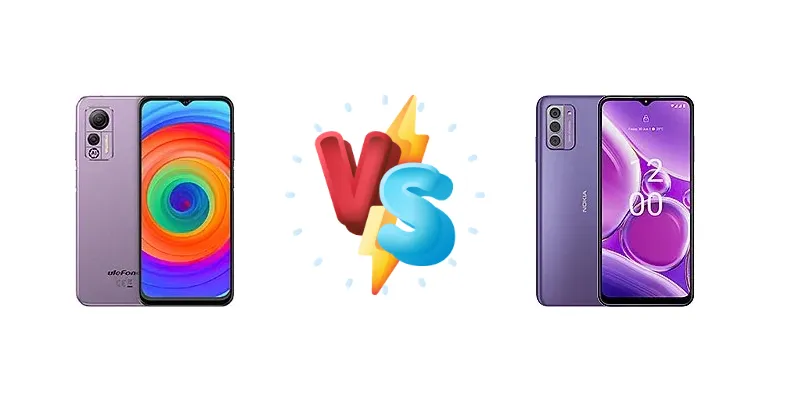
The Ulefone Note 14 and Nokia G42 represent two distinct approaches to the budget smartphone market. The Ulefone prioritizes extreme affordability, while the Nokia G42 aims for a more balanced experience with 5G connectivity and a focus on software support. This comparison dissects their core components to determine which device delivers the best value for your money.
🏆 Quick Verdict
For the average user prioritizing future-proofing and smoother performance, the Nokia G42 is the clear winner. Its Snapdragon 480+ chipset offers a significant performance uplift over the Ulefone Note 14’s Helio A22, alongside 5G connectivity and faster charging, justifying the price difference.
| Network |
|---|
| 2G bands | GSM 850 / 900 / 1800 / 1900 | GSM 850 / 900 / 1800 / 1900 |
| 3G bands | HSDPA 850 / 900 / 1700(AWS) / 1900 / 2100 | HSDPA 850 / 900 / 1700(AWS) / 1900 / 2100 |
| 4G bands | 1, 2, 3, 4, 5, 7, 8, 12, 17, 19, 20, 28 | 1, 2, 3, 4, 5, 7, 8, 12, 17, 13, 20, 28, 38, 39, 40, 41, 66 |
| 5G bands | - | 1, 2, 3, 5, 7, 8, 28, 40, 41, 66, 77, 78 SA/NSA |
| Speed | HSPA, LTE | HSPA, LTE, 5G |
| Technology | GSM / HSPA / LTE | GSM / HSPA / LTE / 5G |
| | eMMC 5.1 | - |
| Launch |
|---|
| Announced | 2022, September 29 | 2023, June 28 |
| Status | Available. Released 2022, September 29 | Available. Released 2023, June 28 |
| Body |
|---|
| Build | - | Glass front, plastic back, plastic frame |
| Dimensions | 164.8 x 76 x 9 mm (6.49 x 2.99 x 0.35 in) | 165 x 75.8 x 8.6 mm (6.50 x 2.98 x 0.34 in) |
| SIM | Nano-SIM + Nano-SIM | · Nano-SIM· Nano-SIM + Nano-SIM |
| Weight | 189 g (6.67 oz) | 193.8 g (6.84 oz) |
| Display |
|---|
| Protection | - | Corning Gorilla Glass 3 |
| Resolution | 720 x 1600 pixels, 20:9 ratio (~269 ppi density) | 720 x 1612 pixels, 20:9 ratio (~269 ppi density) |
| Size | 6.52 inches, 102.6 cm2 (~81.9% screen-to-body ratio) | 6.56 inches, 103.4 cm2 (~82.7% screen-to-body ratio) |
| Type | IPS LCD | IPS LCD, 90Hz, 450 nits (typ), 560 nits (peak) |
| Platform |
|---|
| CPU | Quad-core 2.0 GHz Cortex-A53 | Octa-core (2x2.2 GHz Kryo 460 & 6x1.8 GHz Kryo 460) |
| Chipset | Mediatek MT6761 Helio A22 (12 nm) | Qualcomm SM4350-AC Snapdragon 480+ 5G (8 nm) |
| GPU | PowerVR GE8300 | Adreno 619 |
| OS | Android 12 | Android 13, upgradable to Android 14 |
| Memory |
|---|
| Card slot | microSDXC (dedicated slot) | microSDXC |
| Internal | 16GB 3GB RAM, 64GB 4GB RAM | 128GB 4GB RAM, 128GB 6GB RAM, 256GB 8GB RAM |
| Main Camera |
|---|
| Dual | 13 MP, f/2.0, (wide), 1.12µm, AF (64/4 model)
8 MP, f/1.8, (wide), 1.12µm, AF (16/3 model)
Depth camera | - |
| Features | LED flash, HDR, panorama | LED flash, HDR, panorama |
| Single | 5 MP, f/2.0, (wide) | - |
| Triple | - | 50 MP, f/1.8, (wide), AF
2 MP (macro)
Auxiliary lens |
| Video | 1080p@30fps | 1080p@30fps |
| Selfie camera |
|---|
| Single | 5 MP, f/2.0, (wide) | 8 MP |
| Video | 1080p@30fps | Yes |
| Sound |
|---|
| 3.5mm jack | Yes | - |
| 35mm jack | Yes | Yes |
| Loudspeaker | Yes | Yes |
| Comms |
|---|
| Bluetooth | 5.0, A2DP, LE | 5.1, A2DP, LE |
| NFC | No | Yes (market/region dependent) |
| Positioning | GPS, GLONASS, GALILEO, BDS | GPS, GLONASS, GALILEO, BDS |
| Radio | Stereo FM radio, RDS, recording | FM radio |
| USB | USB Type-C 2.0 | USB Type-C 2.0, OTG |
| WLAN | Wi-Fi 802.11 a/b/g/n/ac, dual-band | Wi-Fi 802.11 a/b/g/n/ac/6, dual-band |
| Features |
|---|
| Sensors | Fingerprint (side-mounted), accelerometer, proximity | Fingerprint (side-mounted), accelerometer, proximity, compass |
| Battery |
|---|
| Charging | - | 20W wired, PD3.0, QC3 |
| Type | Li-Po 4500 mAh | Li-Po 5000 mAh |
| Misc |
|---|
| Colors | Midnight Black, Mint Green, Lavender Purple | Gray, Purple, Red |
| Price | About 100 EUR | $ 545.00 / £ 124.99 |
Ulefone Note 14
- Extremely affordable price point
- Functional for basic smartphone tasks
- Potentially longer battery life due to less powerful processor
- Significantly slower performance
- Lacks 5G connectivity
- Slow charging speeds (likely)
Nokia G42
- 5G connectivity for faster data speeds
- More powerful Snapdragon 480+ processor
- Faster 20W charging with PD3.0/QC3
- Higher price compared to Ulefone Note 14
- Potentially shorter battery life due to more powerful processor
- Software updates may be limited
Display Comparison
Neither device boasts a standout display. Given the context data lacks display specifics, we can infer both likely utilize LCD panels common in this price bracket. The Nokia G42’s inclusion of 20W charging with PD3.0/QC3 suggests a more modern design, potentially leading to slightly slimmer bezels. However, without knowing the resolution or refresh rate, a definitive display winner is impossible to declare. Color accuracy is likely similar, leaning towards the standard sRGB coverage found in budget phones.
Camera Comparison
Without detailed camera specifications, a direct comparison is challenging. However, the Nokia G42’s likely more advanced image signal processor (ISP) within the Snapdragon 480+ chipset will offer superior image processing capabilities compared to the Helio A22’s ISP. This means better dynamic range, noise reduction, and overall image quality, even with similar sensor sizes. The prevalence of 2MP macro lenses on both devices suggests they are largely marketing features and offer limited practical benefit. The Nokia G42’s potential for better software optimization will likely yield more consistent results.
Performance
The performance disparity is the most significant difference. The Nokia G42’s Qualcomm Snapdragon 480+ 5G, built on an 8nm process, is a substantial upgrade over the Ulefone Note 14’s MediaTek Helio A22 (12nm). The Snapdragon’s octa-core configuration (2x2.2 GHz Kryo 460 & 6x1.8 GHz Kryo 460) provides significantly more processing power than the Helio A22’s quad-core 2.0 GHz Cortex-A53. This translates to faster app loading times, smoother multitasking, and a more responsive user interface on the Nokia G42. The 8nm process also contributes to better thermal efficiency, reducing the likelihood of throttling during sustained use. Gamers will find the Snapdragon 480+ capable of handling less demanding titles at medium settings, while the Helio A22 will struggle even with basic games.
Battery Life
The Nokia G42’s 20W wired charging with PD3.0 and QC3 is a clear advantage. While the Ulefone Note 14’s charging speed is not specified, it’s likely significantly slower. This means the Nokia G42 can replenish its battery much faster, reducing downtime. Although battery capacity isn’t provided for either device, the Snapdragon 480+’s improved power efficiency could offset a potentially smaller battery size, resulting in comparable real-world battery life. The faster charging speed, however, remains a key benefit for the Nokia G42.
Buying Guide
Buy the Ulefone Note 14 if you need a functional smartphone for basic tasks like calls, texts, and light social media, and your budget is extremely limited. Buy the Nokia G42 if you prioritize 5G connectivity for faster data speeds, smoother multitasking, and a more responsive user experience, even if it means spending a bit more.
Frequently Asked Questions
❓ Will the Snapdragon 480+ in the Nokia G42 handle demanding games like PUBG Mobile?
While the Snapdragon 480+ isn't a gaming powerhouse, it can run PUBG Mobile at lower to medium settings with acceptable frame rates. Expect some occasional stuttering, especially in intense firefights. The Ulefone Note 14’s Helio A22 will struggle significantly with PUBG Mobile, likely resulting in a poor gaming experience.
❓ How much faster is 5G on the Nokia G42 compared to 4G on the Ulefone Note 14?
5G speeds on the Nokia G42 can be significantly faster than 4G on the Ulefone Note 14, potentially offering download speeds 10-100 times faster depending on network conditions and carrier support. This translates to quicker app downloads, smoother streaming, and faster web browsing.
❓ Does the Nokia G42 support software updates and security patches for an extended period?
Nokia generally provides a reasonable level of software support for its devices, typically including at least two major Android updates and three years of security patches. While not on par with flagship devices, this is a significant advantage over many other budget brands, including Ulefone, which often have limited software support.
❓ Is the difference in processor speed between the Helio A22 and Snapdragon 480+ noticeable in everyday tasks?
Yes, the difference is very noticeable. The Snapdragon 480+ offers a much smoother and more responsive experience when multitasking, opening apps, and browsing the web. The Helio A22 can feel sluggish and unresponsive, especially when running multiple apps simultaneously.