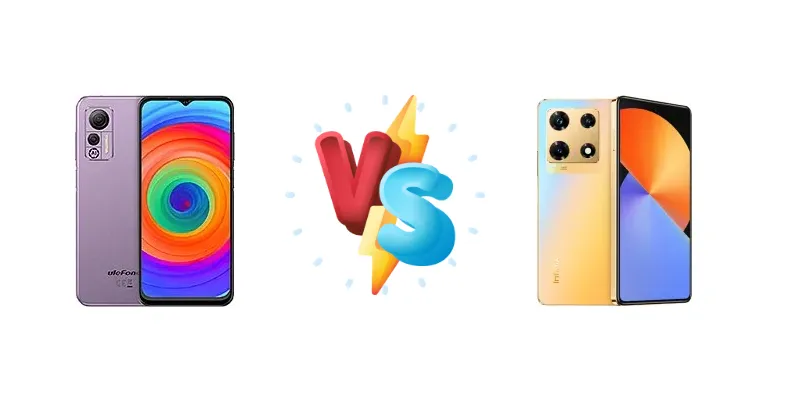
The Ulefone Note 14 and Infinix Note 30 Pro represent distinct approaches to the budget smartphone market. The Ulefone aims for affordability, while the Infinix attempts to pack in more features and performance. This comparison dissects their core components to determine which device offers the best value for your money.
🏆 Quick Verdict
For the average user prioritizing performance and convenience, the Infinix Note 30 Pro is the clear winner. Its Helio G99 chipset and 68W fast charging significantly outperform the Ulefone Note 14’s Helio A22 and standard charging, justifying the likely price difference.
| Network |
|---|
| 2G bands | GSM 850 / 900 / 1800 / 1900 | GSM 850 / 900 / 1800 / 1900 |
| 3G bands | HSDPA 850 / 900 / 1700(AWS) / 1900 / 2100 | HSDPA 850 / 900 / 1700(AWS) / 1900 / 2100 |
| 4G bands | 1, 2, 3, 4, 5, 7, 8, 12, 17, 19, 20, 28 | 1, 2, 3, 4, 5, 7, 8, 12, 17, 20, 28, 38, 40, 41, 66 |
| Speed | HSPA, LTE | HSPA, LTE |
| Technology | GSM / HSPA / LTE | GSM / HSPA / LTE |
| | eMMC 5.1 | - |
| Launch |
|---|
| Announced | 2022, September 29 | 2023, May 22 |
| Status | Available. Released 2022, September 29 | Available. Released 2023, May 22 |
| Body |
|---|
| Build | - | Glass front, plastic frame, glass back |
| Dimensions | 164.8 x 76 x 9 mm (6.49 x 2.99 x 0.35 in) | 162.7 x 76 x 8.2 mm (6.41 x 2.99 x 0.32 in) |
| SIM | Nano-SIM + Nano-SIM | Nano-SIM + Nano-SIM |
| Weight | 189 g (6.67 oz) | 203 g (7.16 oz) |
| | - | IP53 |
| Display |
|---|
| Resolution | 720 x 1600 pixels, 20:9 ratio (~269 ppi density) | 1080 x 2400 pixels, 20:9 ratio (~395 ppi density) |
| Size | 6.52 inches, 102.6 cm2 (~81.9% screen-to-body ratio) | 6.67 inches, 107.4 cm2 (~86.9% screen-to-body ratio) |
| Type | IPS LCD | AMOLED, 1B colors, 120Hz, 900 nits (peak) |
| | - | * the display diagonal size and resolution is unconfirmed |
| Platform |
|---|
| CPU | Quad-core 2.0 GHz Cortex-A53 | Octa-core (2x2.2 GHz Cortex-A76 & 6x2.0 GHz Cortex-A55) |
| Chipset | Mediatek MT6761 Helio A22 (12 nm) | Mediatek Helio G99 (6 nm) |
| GPU | PowerVR GE8300 | Mali-G57 MC2 |
| OS | Android 12 | Android 13, XOS 13 |
| Memory |
|---|
| Card slot | microSDXC (dedicated slot) | microSDXC (dedicated slot) |
| Internal | 16GB 3GB RAM, 64GB 4GB RAM | 256GB 8GB RAM |
| Main Camera |
|---|
| Dual | 13 MP, f/2.0, (wide), 1.12µm, AF (64/4 model)
8 MP, f/1.8, (wide), 1.12µm, AF (16/3 model)
Depth camera | - |
| Features | LED flash, HDR, panorama | Quad-LED flash, HDR, panorama |
| Single | 5 MP, f/2.0, (wide) | - |
| Triple | - | 108 MP, (wide), 1/1.67", PDAF
2 MP (macro)
Auxiliary lens |
| Video | 1080p@30fps | 1440p@30fps, 1080p@30fps |
| Selfie camera |
|---|
| Features | - | LED flash, HDR |
| Single | 5 MP, f/2.0, (wide) | 32 MP, f/2.0, (wide), 1/2.8" |
| Video | 1080p@30fps | 1080p@30fps |
| Sound |
|---|
| 3.5mm jack | Yes | Yes |
| 35mm jack | Yes | Yes |
| Loudspeaker | Yes | Yes, with dual speakers |
| | - | Sound by JBL
24-bit/192kHz audio |
| Comms |
|---|
| Bluetooth | 5.0, A2DP, LE | Yes |
| NFC | No | Yes (market/region dependent) |
| Positioning | GPS, GLONASS, GALILEO, BDS | GPS |
| Radio | Stereo FM radio, RDS, recording | FM radio |
| USB | USB Type-C 2.0 | USB Type-C 2.0, OTG |
| WLAN | Wi-Fi 802.11 a/b/g/n/ac, dual-band | Wi-Fi 802.11 a/b/g/n/ac, dual-band, Wi-Fi Direct |
| Features |
|---|
| Sensors | Fingerprint (side-mounted), accelerometer, proximity | Fingerprint (side-mounted), accelerometer, gyro, proximity, compass |
| Battery |
|---|
| Charging | - | 68W wired, PD3.0, 80% in 30 min
15W wireless
Reverse wireless |
| Type | Li-Po 4500 mAh | 5000 mAh |
| Misc |
|---|
| Colors | Midnight Black, Mint Green, Lavender Purple | Magic Black, Variable Gold |
| Models | - | X678B |
| Price | About 100 EUR | - |
Ulefone Note 14
- Extremely affordable price point
- Potentially longer battery life due to less demanding processor
- Simple and easy-to-use interface
- Significantly slower performance
- Outdated processor architecture
- Slow charging speeds
Infinix Note 30 Pro
- Faster and more efficient processor
- 68W fast charging with wireless charging options
- Improved camera capabilities
- Higher price compared to Ulefone Note 14
- Potentially shorter battery life under heavy use
- May include bloatware
Display Comparison
Neither device’s display specifications are provided, so a direct comparison is limited. However, given the market positioning, the Ulefone Note 14 likely features a standard 60Hz LCD panel. The Infinix Note 30 Pro, aiming higher, may include a higher refresh rate (90Hz or 120Hz) and potentially AMOLED technology, resulting in more vibrant colors and deeper blacks. Bezels are also likely to be slimmer on the Infinix, contributing to a more modern aesthetic.
Camera Comparison
Without detailed camera specifications, analysis is limited. However, the Infinix Note 30 Pro is likely to feature a more capable camera system. The Helio G99’s ISP (Image Signal Processor) is more advanced than the A22’s, enabling better image processing and potentially features like improved HDR and night mode. While both phones may include multiple rear cameras, the Ulefone Note 14 likely relies on lower-resolution sensors, while the Infinix may prioritize a higher-resolution main sensor for sharper images. We can expect the Infinix to deliver more detailed and dynamic photos.
Performance
The performance gap between these two devices is substantial. The Ulefone Note 14’s MediaTek Helio A22, a quad-core processor built on a 12nm process, is designed for basic functionality. The Infinix Note 30 Pro’s Helio G99, an octa-core chip fabricated on a more efficient 6nm process, offers a significant leap in processing power. The G99’s Cortex-A76 cores provide a noticeable improvement in CPU performance, while its enhanced GPU will deliver a smoother gaming experience. This translates to faster app launches, more responsive multitasking, and better overall system fluidity for the Infinix.
Battery Life
While battery capacity isn’t specified, the Infinix Note 30 Pro’s 68W wired charging is a game-changer. This allows for an 80% charge in just 30 minutes, a significant advantage over the Ulefone Note 14’s standard charging. The inclusion of 15W wireless charging and reverse wireless charging further enhances the Infinix’s convenience. Even if the Ulefone Note 14 has a slightly larger battery capacity, the Infinix’s faster charging will minimize downtime and provide a more practical user experience.
Buying Guide
Buy the Ulefone Note 14 if you need a basic, extremely affordable smartphone for essential tasks like calls, texts, and light social media use, and battery life is paramount. Buy the Infinix Note 30 Pro if you prefer a smoother user experience, faster app loading times, and the convenience of rapid charging, even if it means spending a bit more.
Frequently Asked Questions
❓ Is the Helio G99 in the Infinix Note 30 Pro capable of handling demanding games like PUBG or Call of Duty?
Yes, the Helio G99 is a capable gaming chipset for its price range. While it won't deliver flagship-level performance, it can comfortably run PUBG and Call of Duty at medium to high settings with playable frame rates. The 6nm process also helps with thermal management during extended gaming sessions.
❓ How long does it realistically take to fully charge the Infinix Note 30 Pro from 0% using the 68W charger?
While Infinix claims 80% in 30 minutes, a full 0-100% charge with the 68W charger will likely take around 45-50 minutes. This is still significantly faster than the Ulefone Note 14, which will take several hours with its standard charger.
❓ Does the Ulefone Note 14 have any notable software features or customizations?
The Ulefone Note 14 likely runs a near-stock version of Android, potentially with some basic customizations. It's unlikely to offer the advanced software features or optimized gaming modes found on the Infinix Note 30 Pro.
❓ Is the reverse wireless charging on the Infinix Note 30 Pro useful for topping up accessories like earbuds?
Yes, the 15W reverse wireless charging is a convenient feature for topping up accessories like wireless earbuds or smartwatches. While it's not as fast as wired charging, it provides a convenient way to share power on the go.