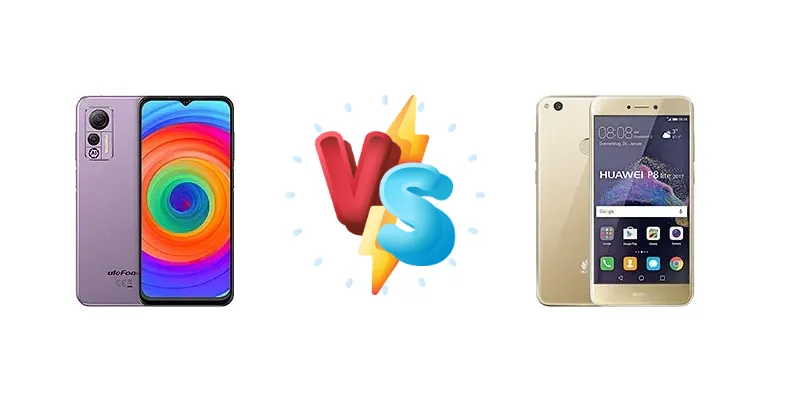
Looking for an affordable Android phone? The Ulefone Note 14 and Huawei P8 Lite (2017) are both contenders, offering a range of features without breaking the bank. But which one delivers the best value for your money? Let's dive into a detailed comparison.
🏆 Quick Verdict
The Huawei P8 Lite (2017) edges out the Ulefone Note 14 thanks to its slightly more powerful Kirin 655 chipset and generally better software support. While the Note 14 offers a modern design, the P8 Lite's performance and established brand give it the advantage.
| Network |
|---|
| 2G bands | GSM 850 / 900 / 1800 / 1900 | GSM 850 / 900 / 1800 / 1900 - SIM 1 & SIM 2 |
| 3G bands | HSDPA 850 / 900 / 1700(AWS) / 1900 / 2100 | HSDPA 850 / 900 / 1900 / 2100 |
| 4G bands | 1, 2, 3, 4, 5, 7, 8, 12, 17, 19, 20, 28 | 1, 3, 7, 8, 20 |
| Speed | HSPA, LTE | HSPA 42.2/5.76 Mbps, LTE Cat4 150/50 Mbps |
| Technology | GSM / HSPA / LTE | GSM / HSPA / LTE |
| | eMMC 5.1 | - |
| Launch |
|---|
| Announced | 2022, September 29 | 2017, January. Released 2017, January |
| Status | Available. Released 2022, September 29 | Discontinued |
| Body |
|---|
| Build | - | Glass front, glass back, aluminum frame |
| Dimensions | 164.8 x 76 x 9 mm (6.49 x 2.99 x 0.35 in) | 147.2 x 72.9 x 7.6 mm (5.80 x 2.87 x 0.30 in) |
| SIM | Nano-SIM + Nano-SIM | Nano-SIM + Nano-SIM |
| Weight | 189 g (6.67 oz) | 147 g (5.19 oz) |
| Display |
|---|
| Resolution | 720 x 1600 pixels, 20:9 ratio (~269 ppi density) | 1080 x 1920 pixels, 16:9 ratio (~424 ppi density) |
| Size | 6.52 inches, 102.6 cm2 (~81.9% screen-to-body ratio) | 5.2 inches, 74.5 cm2 (~69.5% screen-to-body ratio) |
| Type | IPS LCD | IPS LCD |
| Platform |
|---|
| CPU | Quad-core 2.0 GHz Cortex-A53 | Octa-core (4x2.1 GHz Cortex-A53 & 4x1.7 GHz Cortex-A53) |
| Chipset | Mediatek MT6761 Helio A22 (12 nm) | Kirin 655 (16 nm) |
| GPU | PowerVR GE8300 | Mali-T830MP2 |
| OS | Android 12 | Android 7.0 (Nougat), upgradable to Android 8.0 (Oreo), EMUI 9 |
| Memory |
|---|
| Card slot | microSDXC (dedicated slot) | microSDXC (uses shared SIM slot) |
| Internal | 16GB 3GB RAM, 64GB 4GB RAM | 16GB 3GB RAM, 32GB 4GB RAM, 64GB 4GB RAM |
| Main Camera |
|---|
| Dual | 13 MP, f/2.0, (wide), 1.12µm, AF (64/4 model)
8 MP, f/1.8, (wide), 1.12µm, AF (16/3 model)
Depth camera | - |
| Features | LED flash, HDR, panorama | LED flash, panorama, HDR |
| Single | 5 MP, f/2.0, (wide) | 12 MP, AF |
| Video | 1080p@30fps | 1080p@30fps |
| Selfie camera |
|---|
| Single | 5 MP, f/2.0, (wide) | 8 MP, f/2.0 |
| Video | 1080p@30fps | 1080p@30fps |
| Sound |
|---|
| 3.5mm jack | Yes | Yes |
| 35mm jack | Yes | Yes |
| Loudspeaker | Yes | Yes |
| Comms |
|---|
| Bluetooth | 5.0, A2DP, LE | 4.1, A2DP, EDR, LE |
| NFC | No | Yes (market dependent) |
| Positioning | GPS, GLONASS, GALILEO, BDS | GPS, GLONASS |
| Radio | Stereo FM radio, RDS, recording | FM radio |
| USB | USB Type-C 2.0 | microUSB 2.0, OTG |
| WLAN | Wi-Fi 802.11 a/b/g/n/ac, dual-band | Wi-Fi 802.11 b/g/n, Wi-Fi Direct |
| Features |
|---|
| Sensors | Fingerprint (side-mounted), accelerometer, proximity | Fingerprint (rear-mounted), accelerometer, proximity, compass |
| Battery |
|---|
| Type | Li-Po 4500 mAh | Li-Ion 3000 mAh, non-removable |
| Misc |
|---|
| Colors | Midnight Black, Mint Green, Lavender Purple | Black, White, Gold, Blue |
| Models | - | PRA-TL10, PRA-TL20, PRA-LA1, PRA-LX1, PRA-LX2, TAG-L21, PRA-AL00X, TAG-L32, PRA-LX3, PRA-AL00 |
| Price | About 100 EUR | About 170 EUR |
Ulefone Note 14
- Large Battery
- Modern Design
- Large Display
- Affordable Price
- Slower Performance
- Less Refined Software
- Potentially Lower Build Quality
- Limited Brand Recognition
Huawei P8 Lite (2017)
- Better Performance
- More Refined Camera
- Established Brand
- Compact Size
- Smaller Battery
- Older Design
- Software Updates May Be Limited
- Smaller Display
Display Comparison
The Ulefone Note 14 typically features a larger display (around 6.5 inches) with a modern waterdrop notch, offering a more immersive viewing experience. The Huawei P8 Lite (2017) has a smaller 5.2-inch display, which some may find more manageable. Both use IPS LCD panels, offering decent color accuracy and viewing angles.
Camera Comparison
The Huawei P8 Lite (2017) generally has a better camera system. While both phones offer decent image quality in good lighting conditions, the P8 Lite's image processing tends to be more refined, resulting in more vibrant and detailed photos. Low-light performance is also typically better on the P8 Lite. Both have a front-facing camera suitable for selfies.
Performance
The Huawei P8 Lite (2017)'s Kirin 655 chipset, with its octa-core processor, generally outperforms the Ulefone Note 14's Helio A22. The Kirin 655's architecture and slightly higher clock speeds provide a noticeable difference in app loading times and multitasking capabilities. The Note 14 can feel sluggish at times, especially with demanding apps.
Battery Life
The Ulefone Note 14 often boasts a larger battery capacity (typically 5000mAh or more) compared to the Huawei P8 Lite (2017)'s (around 3000mAh). This translates to longer battery life on the Note 14, potentially lasting a full day or more with moderate usage. The P8 Lite will likely require charging before the end of the day for heavier users.
Buying Guide
The Ulefone Note 14 is a good choice for users prioritizing a modern aesthetic and a large battery on a very tight budget. The Huawei P8 Lite (2017) is better suited for those who want a smoother overall experience, slightly better performance, and a more recognizable brand name, even if it's an older device.
Frequently Asked Questions
❓ Is the Ulefone Note 14 good for gaming?
The Ulefone Note 14's processor is not ideal for demanding games. You can play less intensive games, but expect lower graphics settings and potential lag.
❓ Will the Huawei P8 Lite (2017) receive software updates?
Huawei's software update support for older devices like the P8 Lite (2017) is limited. You may not receive the latest Android versions, but security patches may still be available.