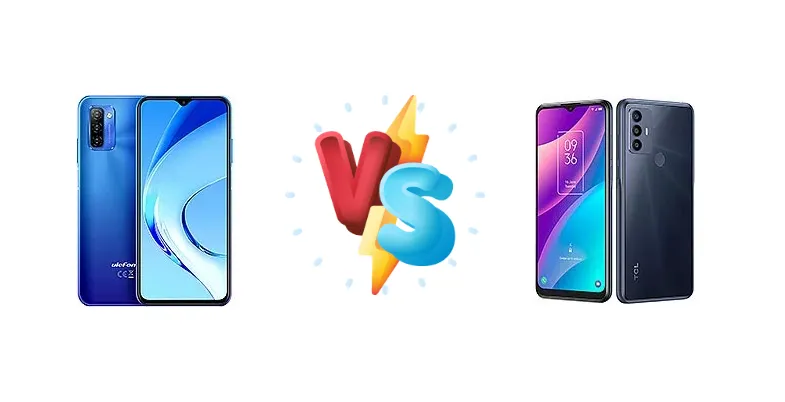
The Ulefone Note 12 and TCL 30 SE represent the fiercely competitive sub-$150 smartphone market. Both aim to deliver essential functionality at an accessible price, but they take different approaches to achieving this. The Ulefone leverages a Unisoc chipset, while the TCL opts for a MediaTek solution. This comparison dives deep into the specifics to determine which device offers the best value.
🏆 Quick Verdict
For the average user prioritizing basic tasks and longer standby times, the TCL 30 SE emerges as the slightly better choice. Its Mediatek Helio G25, with its octa-core configuration, provides a more responsive experience for multitasking, and the 15W charging offers a quicker top-up than the Ulefone's 10W.
| Network |
|---|
| 2G bands | GSM 850 / 900 / 1800 / 1900 | GSM 850 / 900 / 1800 / 1900 |
| 3G bands | HSDPA 850 / 900 / 1700(AWS) / 1900 / 2100 | HSDPA 850 / 900 / 1900 / 2100 - EMEA/APAC |
| 4G bands | 1, 2, 3, 4, 5, 7, 8, 12, 17, 19, 20, 26, 66 | 1, 3, 5, 7, 8, 20, 28, 38, 40, 41 - EMEA |
| Speed | HSPA, LTE | HSPA 42.2/11.5 Mbps, LTE Cat4 150/50 Mbps |
| Technology | GSM / HSPA / LTE | GSM / HSPA / LTE |
| | - | 2, 3, 4, 5, 7, 8, 12, 13, 17, 26, 28, 66 - LATAM |
| Launch |
|---|
| Announced | 2022, July | 2022, February 27 |
| Status | Available. Released 2022, July | Available. Released 2022, April 20 |
| Body |
|---|
| Build | - | Glass front, plastic frame, plastic back |
| Dimensions | 173.6 x 79.1 x 10.2 mm (6.83 x 3.11 x 0.40 in) | 165.2 x 75.5 x 8.9 mm (6.50 x 2.97 x 0.35 in) |
| SIM | Nano-SIM + Nano-SIM | · Nano-SIM· Nano-SIM + Nano-SIM |
| Weight | 237 g (8.36 oz) | 190 g (6.70 oz) |
| Display |
|---|
| Resolution | 720 x 1640 pixels (~263 ppi density) | 720 x 1600 pixels, 20:9 ratio (~269 ppi density) |
| Size | 6.82 inches, 110.5 cm2 (~80.4% screen-to-body ratio) | 6.52 inches, 102.6 cm2 (~82.3% screen-to-body ratio) |
| Type | IPS LCD | IPS LCD, 450 nits (typ) |
| Platform |
|---|
| CPU | Quad-core (1x2.0 GHz Cortex-A75 & 3x1.8 GHz Cortex-A55) | Octa-core (4x2.0 GHz Cortex-A53 & 4x1.5 GHz Cortex-A53) |
| Chipset | Unisoc Tiger T310 (12 nm) | Mediatek MT6762G Helio G25 (12 nm) |
| GPU | PowerVR GE8300 | PowerVR GE8320 |
| OS | Android 11 | Android 12, TCL UI 4.0 |
| Memory |
|---|
| Card slot | microSDXC (dedicated slot) | microSDXC (dedicated slot) |
| Internal | 128GB 4GB RAM | 64GB 4GB RAM, 128GB 4GB RAM |
| | - | eMMC 5.1 |
| Main Camera |
|---|
| Features | LED flash, HDR, panorama | LED flash, HDR, panorama |
| Single | 8 MP | 8 MP, f/2.0, 26mm (wide), 1/4", 1.12µm |
| Triple | 13 MP, (wide), AF
2 MP (macro)
Auxiliary lens | 50 MP, f/1.9, 28mm (wide), 1/2.76", 0.64µm, PDAF
2 MP (macro)
Auxiliary lens |
| Video | 1080p@30fps | 1080p@30fps |
| Selfie camera |
|---|
| Features | HDR | HDR |
| Single | 8 MP | 8 MP, f/2.0, 26mm (wide), 1/4.0", 1.12µm |
| Video | Yes | 1080p@30fps |
| Sound |
|---|
| 3.5mm jack | Yes | Yes |
| 35mm jack | Yes | Yes |
| Loudspeaker | Yes | Yes |
| Comms |
|---|
| Bluetooth | 4.2, A2DP | 5.0, A2DP, LE |
| NFC | No | Yes (6165H/6165H1 only) |
| Positioning | GPS, GLONASS, BDS | GPS, GLONASS, GALILEO, BDS |
| Radio | Stereo FM radio, RDS, recording | Unspecified |
| USB | USB Type-C 2.0 | USB Type-C 2.0 |
| WLAN | Wi-Fi 802.11 b/g/n | Wi-Fi 802.11 b/g/n, Wi-Fi Direct |
| Features |
|---|
| Sensors | Fingerprint (side-mounted), accelerometer, proximity | Fingerprint (rear-mounted), accelerometer, proximity, compass |
| Battery |
|---|
| Charging | 10W wired | 15W wired |
| Type | Li-Po 7700 mAh | Li-Po 5000 mAh |
| Misc |
|---|
| Colors | Black, Red, Blue | Atlantic Blue, Space Gray, Glacial Blue |
| Models | - | 6165H, 6156H1, 6165A, 6165A1, 6165S |
Ulefone Note 12
- Potentially longer standby time due to efficient core design.
- Simpler software experience (likely less bloatware).
- Lower price point (potentially).
- Quad-core processor may struggle with multitasking.
- Slower 10W charging.
- Less responsive user interface.
TCL 30 SE
- Octa-core processor offers better multitasking performance.
- Faster 15W charging.
- More responsive user experience.
- Potentially shorter battery life under heavy use.
- May include more pre-installed bloatware.
- Slightly higher price (potentially).
Display Comparison
Neither device boasts a standout display. Both are likely utilizing LCD panels, common in this price bracket. Without specific display specs, the comparison hinges on processing power to render UI elements smoothly. The TCL 30 SE’s more capable CPU may translate to slightly smoother scrolling and animations, though the difference will likely be subtle. Bezels are expected to be substantial on both, and color accuracy will be basic.
Camera Comparison
Camera performance is likely to be similar on both devices, with both likely featuring a primary sensor paired with basic auxiliary lenses. Without specific sensor details, it’s safe to assume image quality will be adequate in good lighting conditions but struggle in low light. The focus should be on the primary sensor; any 2MP macro or depth sensors are unlikely to deliver meaningful improvements to image quality. Image processing will be basic on both, prioritizing speed over detail.
Performance
The core difference lies in the chipsets. The Ulefone Note 12’s Unisoc Tiger T310 is a quad-core processor featuring one Cortex-A75 core for performance and three Cortex-A55 cores for efficiency. The TCL 30 SE’s MediaTek Helio G25 is an octa-core processor, utilizing four Cortex-A53 cores at 2.0 GHz and another four at 1.5 GHz. While the A75 core in the Ulefone is individually more powerful than the A53 cores in the TCL, the sheer number of cores in the Helio G25 provides a significant advantage in multitasking and handling multiple background processes. This translates to a more fluid user experience for the TCL, especially when switching between apps. Both chipsets are built on a 12nm process, suggesting similar power efficiency.
Battery Life
Battery capacity is not specified for either device, but both will likely fall in the 4000-5000 mAh range, typical for this segment. However, the TCL 30 SE’s 15W wired charging is a clear advantage over the Ulefone Note 12’s 10W charging. This means the TCL will reach a full charge significantly faster, reducing downtime. While a larger battery capacity on the Ulefone could offset the slower charging, the difference in charging speed is likely to be more noticeable in daily use.
Buying Guide
Buy the Ulefone Note 12 if you primarily need a phone for very light use – calls, texts, and occasional browsing – and value simplicity above all else. Its Unisoc chipset is sufficient for these tasks. Buy the TCL 30 SE if you anticipate more frequent app switching, light gaming, or simply prefer a phone that feels a bit snappier in everyday use, and appreciate the faster charging capability.
Frequently Asked Questions
❓ Will the Unisoc Tiger T310 in the Ulefone Note 12 struggle with popular social media apps like Facebook and Instagram?
While the Unisoc Tiger T310 can handle basic social media apps, users may experience occasional lag or slowdowns when scrolling through image-heavy feeds or using multiple apps simultaneously. The TCL 30 SE’s Helio G25 is better equipped to handle these tasks smoothly.
❓ How long will it take to fully charge the TCL 30 SE from 0% using the included 15W charger?
Based on typical 15W charging rates for similar devices, expect the TCL 30 SE to take approximately 2.5 to 3 hours to fully charge from 0%. This is significantly faster than the Ulefone Note 12’s 10W charging, which could take upwards of 4 hours.
❓ Can either of these phones handle basic mobile games like Candy Crush or Subway Surfers?
Both the Ulefone Note 12 and TCL 30 SE can handle casual games like Candy Crush and Subway Surfers. However, the TCL 30 SE will provide a smoother gaming experience with fewer frame drops due to its more powerful processor.
❓ Is the TCL 30 SE likely to overheat during extended use, such as watching videos or playing games?
Neither chipset is known for generating excessive heat. Both are built on a 12nm process, which offers reasonable thermal efficiency. While some warmth is expected during prolonged use, overheating is unlikely to be a significant issue with either device.