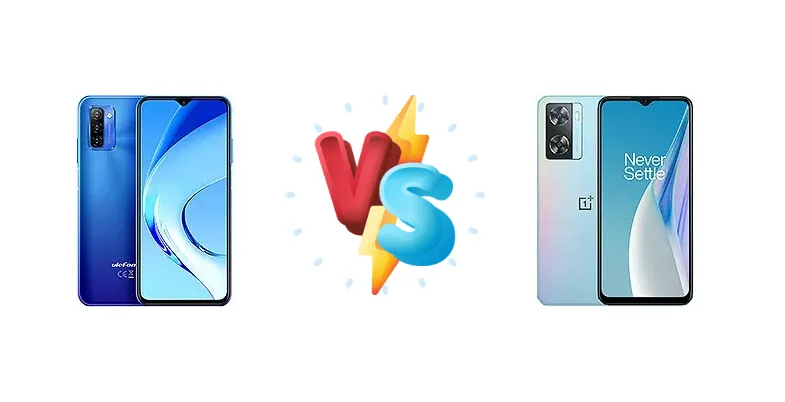
The Ulefone Note 12 and OnePlus Nord N20 SE represent two approaches to the ultra-budget smartphone market. The Ulefone focuses on providing a functional device at the lowest possible price, while the OnePlus Nord N20 SE aims to deliver a more refined experience with faster charging, albeit at a slightly higher cost. This comparison dissects their core components to determine which phone best suits your needs.
🏆 Quick Verdict
For the average user prioritizing quick top-ups and a smoother overall experience, the OnePlus Nord N20 SE is the better choice. Its 33W charging significantly outperforms the Ulefone Note 12’s 10W, and the octa-core Helio G35 offers a performance edge despite using similar architecture.
| Network |
|---|
| 2G bands | GSM 850 / 900 / 1800 / 1900 | GSM 850 / 900 / 1800 / 1900 |
| 3G bands | HSDPA 850 / 900 / 1700(AWS) / 1900 / 2100 | HSDPA 850 / 900 / 2100 - Global |
| 4G bands | 1, 2, 3, 4, 5, 7, 8, 12, 17, 19, 20, 26, 66 | 1, 3, 5, 7, 8, 20, 28, 38, 40, 41 - Global |
| Speed | HSPA, LTE | HSPA, LTE |
| Technology | GSM / HSPA / LTE | GSM / HSPA / LTE |
| | - | 1, 2, 3, 4, 5, 7, 8, 12, 13, 17, 18, 19, 26, 28, 38, 41, 66 - LATAM |
| Launch |
|---|
| Announced | 2022, July | 2022, August 05 |
| Status | Available. Released 2022, July | Available. Released 2022, August 08 |
| Body |
|---|
| Build | - | Glass front, plastic frame, plastic back |
| Dimensions | 173.6 x 79.1 x 10.2 mm (6.83 x 3.11 x 0.40 in) | 163.8 x 75 x 8 mm (6.45 x 2.95 x 0.31 in) |
| SIM | Nano-SIM + Nano-SIM | Nano-SIM + Nano-SIM |
| Weight | 237 g (8.36 oz) | 187 g (6.60 oz) |
| Display |
|---|
| Resolution | 720 x 1640 pixels (~263 ppi density) | 720 x 1612 pixels, 20:9 ratio (~269 ppi density) |
| Size | 6.82 inches, 110.5 cm2 (~80.4% screen-to-body ratio) | 6.56 inches, 103.4 cm2 (~84.2% screen-to-body ratio) |
| Type | IPS LCD | IPS LCD, 480 nits (typ), 600 nits (HBM) |
| Platform |
|---|
| CPU | Quad-core (1x2.0 GHz Cortex-A75 & 3x1.8 GHz Cortex-A55) | Octa-core (4x2.3 GHz Cortex-A53 & 4x1.8 GHz Cortex-A53) |
| Chipset | Unisoc Tiger T310 (12 nm) | Mediatek MT6765G Helio G35 (12 nm) |
| GPU | PowerVR GE8300 | PowerVR GE8320 |
| OS | Android 11 | Android 12, OxygenOS 12.1 |
| Memory |
|---|
| Card slot | microSDXC (dedicated slot) | microSDXC |
| Internal | 128GB 4GB RAM | 64GB 4GB RAM, 128GB 4GB RAM |
| | - | eMMC 5.1 |
| Main Camera |
|---|
| Dual | - | 50 MP, f/1.8, (wide), 1/2.76", 0.64µm, PDAF
Auxiliary lens |
| Features | LED flash, HDR, panorama | LED flash, HDR, panorama |
| Single | 8 MP | 8 MP, f/2.0, 26mm (wide), 1/4", 1.12µm |
| Triple | 13 MP, (wide), AF
2 MP (macro)
Auxiliary lens | - |
| Video | 1080p@30fps | 1080p@30fps |
| Selfie camera |
|---|
| Features | HDR | - |
| Single | 8 MP | 8 MP, f/2.0, 26mm (wide), 1/4.0", 1.12µm |
| Video | Yes | 1080p@30fps |
| Sound |
|---|
| 3.5mm jack | Yes | Yes |
| 35mm jack | Yes | Yes |
| Loudspeaker | Yes | Yes, with dual speakers |
| Comms |
|---|
| Bluetooth | 4.2, A2DP | 5.3, A2DP, LE, aptX HD |
| NFC | No | No |
| Positioning | GPS, GLONASS, BDS | GPS, GLONASS, BDS, GALILEO, QZSS |
| Radio | Stereo FM radio, RDS, recording | No |
| USB | USB Type-C 2.0 | USB Type-C 2.0, OTG |
| WLAN | Wi-Fi 802.11 b/g/n | Wi-Fi 802.11 a/b/g/n/ac, dual-band, Wi-Fi Direct |
| Features |
|---|
| Sensors | Fingerprint (side-mounted), accelerometer, proximity | Fingerprint (side-mounted), accelerometer, proximity, compass |
| Battery |
|---|
| Charging | 10W wired | 33W wired, 50% in 34 min, 100% in 69 min |
| Type | Li-Po 7700 mAh | Li-Po 5000 mAh |
| Misc |
|---|
| Colors | Black, Red, Blue | Blue Oasis, Celestial Black |
| Models | - | CPH2469 |
| Price | - | About 190 EUR |
Ulefone Note 12
- Lowest possible price point
- Functional for basic tasks
- Potentially better single-core performance due to Cortex-A75
- Extremely slow 10W charging
- Quad-core processor may struggle with multitasking
- Likely limited camera capabilities
OnePlus Nord N20 SE
- 33W fast charging significantly reduces downtime
- Octa-core processor offers better multitasking
- OnePlus’s software optimization provides a smoother experience
- Slightly higher price than the Ulefone Note 12
- Cortex-A53 cores are less efficient than A75
- May still struggle with demanding games
Display Comparison
Neither device boasts a standout display. Both utilize 12nm chipsets, suggesting similar power constraints impacting display capabilities. While specific display specs (resolution, panel type) are missing, the focus here is on performance. The absence of high refresh rates on either device indicates a prioritization of battery life over visual fluidity.
Camera Comparison
Without detailed camera specifications, a direct comparison is difficult. However, given the price points, both phones likely feature basic camera setups. The absence of information regarding sensor size or optical image stabilization suggests neither device will excel in low-light photography. Image processing will likely be the differentiating factor, and OnePlus generally offers more refined software algorithms.
Performance
The core difference lies in the chipset architecture. The Ulefone Note 12’s Unisoc Tiger T310 features a quad-core configuration with one Cortex-A75 core for peak performance and three Cortex-A55 cores for efficiency. The OnePlus Nord N20 SE’s MediaTek Helio G35, however, employs an octa-core setup with four Cortex-A53 cores at 2.3 GHz and another four at 1.8 GHz. While the A75 core in the Ulefone is individually more powerful, the Helio G35’s eight cores provide greater multitasking capability and sustained performance. The higher clock speed of the G35’s primary cores also contributes to a snappier experience in everyday tasks. This benefits users who frequently switch between apps or engage in light gaming.
Battery Life
The Ulefone Note 12 is hampered by its slow 10W wired charging. This translates to significantly longer charging times compared to the OnePlus Nord N20 SE’s 33W charging, which can reach 50% in 34 minutes and 100% in 69 minutes. While battery capacity isn’t specified, the faster charging of the Nord N20 SE is a major advantage for users who need to quickly replenish their battery throughout the day. The difference in charging speed is a tangible benefit, reducing downtime and increasing usability.
Buying Guide
Buy the Ulefone Note 12 if you absolutely need the cheapest possible smartphone and are willing to compromise on charging speed and performance. It’s ideal for basic communication and light tasks. Buy the OnePlus Nord N20 SE if you value faster charging, a more responsive user interface, and a slightly better gaming experience, even if it means spending a bit more upfront.
Frequently Asked Questions
❓ Will the Helio G35 in the OnePlus Nord N20 SE handle popular games like PUBG Mobile?
The Helio G35 can run PUBG Mobile, but expect to play at lower graphics settings and frame rates to maintain a stable experience. It’s not a gaming powerhouse, but it’s capable of casual gaming sessions. The Ulefone Note 12’s Tiger T310 will likely struggle more with demanding titles.
❓ How much longer will it take to fully charge the Ulefone Note 12 compared to the OnePlus Nord N20 SE?
The Ulefone Note 12’s 10W charging is significantly slower. While the Nord N20 SE reaches 100% in 69 minutes, the Ulefone Note 12 will likely take well over 3 hours, potentially even 4 or 5, depending on the battery capacity. This is a major inconvenience for users who need a quick charge.
❓ Is the difference in CPU cores (quad-core vs octa-core) noticeable in everyday use?
Yes, the octa-core Helio G35 in the Nord N20 SE will provide a smoother experience when multitasking and switching between apps. The Ulefone Note 12’s quad-core processor may exhibit lag or slowdowns when handling multiple tasks simultaneously.