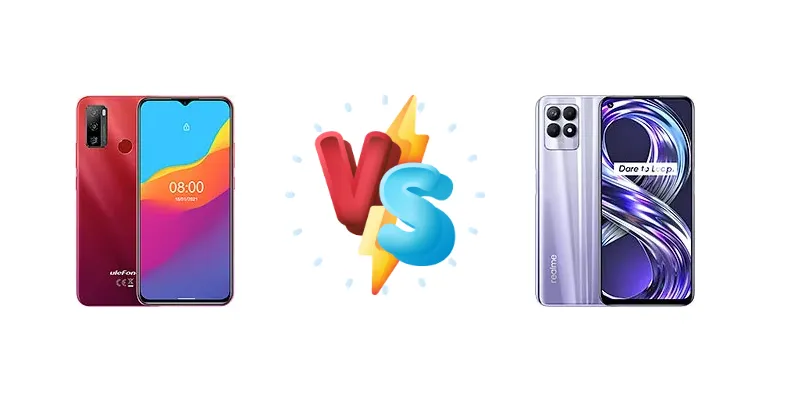
The Ulefone Note 10 and Realme 8i represent two distinct approaches to the budget smartphone market. The Ulefone aims for affordability above all else, while the Realme 8i attempts to deliver a more polished experience with a focus on gaming and faster charging. This comparison dissects their key differences to determine which device offers the best value.
🏆 Quick Verdict
For most users, the Realme 8i is the superior choice. Its significantly more powerful MediaTek Helio G96 chipset, coupled with 18W fast charging, provides a smoother user experience and quicker top-ups. While the Ulefone Note 10 is cheaper, the performance gap is substantial.
| Network |
|---|
| 2G bands | GSM 850 / 900 / 1800 / 1900 | GSM 850 / 900 / 1800 / 1900 |
| 3G bands | HSDPA 850 / 900 / 2100 | HSDPA 850 / 900 / 2100 |
| 4G bands | 1, 3, 5, 7, 8, 20 | 1, 3, 5, 8, 38, 40, 41 |
| Speed | HSPA, LTE | HSPA, LTE |
| Technology | GSM / HSPA / LTE | GSM / HSPA / LTE |
| Launch |
|---|
| Announced | 2021, January 21 | 2021, September 09 |
| Status | Available. Released 2021, January 21 | Available. Released 2021, September 14 |
| Body |
|---|
| Build | Plastic frame, plastic back | Glass front, plastic frame, plastic back |
| Dimensions | 165.2 x 76.7 x 9.7 mm (6.50 x 3.02 x 0.38 in) | 164.1 x 75.5 x 8.5 mm (6.46 x 2.97 x 0.33 in) |
| SIM | Nano-SIM + Micro-SIM | Nano-SIM + Nano-SIM |
| Weight | 203 g (7.16 oz) | 194 g (6.84 oz) |
| Display |
|---|
| Resolution | 720 x 1600 pixels, 20:9 ratio (~269 ppi density) | 1080 x 2412 pixels, 20:9 ratio (~400 ppi density) |
| Size | 6.52 inches, 102.6 cm2 (~81.0% screen-to-body ratio) | 6.6 inches, 104.8 cm2 (~84.6% screen-to-body ratio) |
| Type | IPS LCD | IPS LCD, 120Hz, 600 nits (peak) |
| Platform |
|---|
| CPU | Octa-core (4x1.6 GHz Cortex-A55 & 4x1.2 GHz Cortex-A55) | Octa-core (2x2.05 GHz Cortex-A76 & 6x2.0 GHz Cortex-A55) |
| Chipset | Unisoc SC9863A (28 nm) | Mediatek MT6781 Helio G96 (12 nm) |
| GPU | IMG8322 | Mali-G57 MC2 |
| OS | Android 11 (Go edition) | Android 11, Realme UI 2.0 |
| Memory |
|---|
| Card slot | microSDXC (dedicated slot) | microSDXC (dedicated slot) |
| Internal | 32GB 2GB RAM | 64GB 4GB RAM, 128GB 4GB RAM, 128GB 6GB RAM |
| | eMMC 5.1 | UFS 2.1 |
| Main Camera |
|---|
| Features | LED flash | LED flash, HDR, panorama |
| Single | 8 MP, f/2.0 | 16 MP, f/2.1, (wide), 1/3.0", 1.0µm |
| Triple | 8 MP, f/2.0, AF
5 MP (macro)
Auxiliary lens | 50 MP, f/1.8, 26mm (wide), 1/2.76", 0.64µm, PDAF
2 MP (macro)
Auxiliary lens |
| Video | 1080p@30fps | 1080p@30fps |
| Selfie camera |
|---|
| Features | - | Panorama |
| Single | 8 MP, f/2.0 | 16 MP, f/2.1, (wide), 1/3.0", 1.0µm |
| Video | - | 1080p@30fps |
| Sound |
|---|
| 3.5mm jack | Yes | Yes |
| 35mm jack | Yes | Yes |
| Loudspeaker | Yes | Yes |
| Comms |
|---|
| Bluetooth | 4.2, A2DP | 5.1, A2DP, LE |
| NFC | No | Yes (market/region dependent) |
| Positioning | GPS | GPS, GLONASS, GALILEO, BDS |
| Radio | Unspecified | No |
| USB | microUSB 2.0, OTG | USB Type-C 2.0, OTG |
| WLAN | Wi-Fi 802.11 b/g/n | Wi-Fi 802.11 a/b/g/n/ac, dual-band |
| Features |
|---|
| Sensors | Fingerprint (rear-mounted), accelerometer, proximity | Fingerprint (side-mounted), accelerometer, gyro, proximity, compass |
| Battery |
|---|
| Charging | 10W wired | 18W wired |
| Type | Li-Ion 5500 mAh | 5000 mAh |
| Misc |
|---|
| Colors | Black, Red, Aurora Green | Space Black, Space Purple |
| Models | - | RMX3151 |
| Price | About 120 EUR | About 440 EUR |
| Tests |
|---|
| Battery life | - |
Endurance rating 131h
|
| Camera | - |
Photo / Video |
| Loudspeaker | - |
-28.4 LUFS (Average)
|
Ulefone Note 10
- Extremely affordable price point
- Acceptable battery endurance (131h)
- Functional for basic smartphone tasks
- Weak processor performance
- Slow 10W charging
- Likely low-quality display
Realme 8i
- Significantly faster processor (Helio G96)
- Faster 18W charging
- Brighter and higher contrast display
- Higher price than Ulefone Note 10
- Battery life is similar to Ulefone Note 10
- Camera details are limited
Display Comparison
The Realme 8i boasts a brighter display, measured at 540 nits, compared to the Ulefone Note 10 (brightness unspecified). This translates to better visibility outdoors. While both likely utilize IPS LCD panels, the Realme 8i’s 1244:1 contrast ratio suggests deeper blacks and more vibrant colors. The Ulefone Note 10’s display specifications are minimal, suggesting a more basic viewing experience. Bezels are likely larger on the Ulefone, further diminishing the immersive quality.
Camera Comparison
Both phones feature 'Photo / Video' capabilities, but details are sparse. Without sensor size or aperture information, a direct comparison is difficult. However, the Realme 8i, being a more recent and generally higher-tier device, likely benefits from more sophisticated image processing algorithms. The Ulefone Note 10’s camera is likely to be a basic setup, suitable for casual snapshots. The absence of details suggests a focus on cost reduction rather than photographic quality. We can assume the Realme 8i will deliver more detailed and dynamic images.
Performance
The performance disparity is the most significant difference. The Realme 8i’s MediaTek Helio G96 (12nm) is a substantial upgrade over the Ulefone Note 10’s Unisoc SC9863A (28nm). The Helio G96 features two Cortex-A76 cores clocked at 2.05 GHz, providing a significant boost in single-core performance, crucial for app responsiveness. The Ulefone’s SC9863A relies on slower Cortex-A55 cores, making it struggle with demanding applications. The 12nm process node of the Helio G96 also offers better power efficiency, potentially offsetting the Realme 8i’s slightly larger battery draw. The Realme 8i is the clear winner for gaming and multitasking.
Battery Life
Both devices share an endurance rating of 131 hours, suggesting similar real-world battery life despite the differing chipsets. However, the Realme 8i’s 18W wired charging is a significant advantage over the Ulefone Note 10’s slow 10W charging. This means the Realme 8i can be topped up much faster, minimizing downtime. While the Ulefone Note 10 might last a similar amount of time on a single charge, the convenience of quicker charging makes the Realme 8i more practical for daily use.
Buying Guide
Buy the Ulefone Note 10 if your primary need is an extremely affordable smartphone for basic tasks like calls, texts, and light web browsing, and you're willing to compromise on performance and charging speed. Buy the Realme 8i if you prioritize a responsive user experience, enjoy mobile gaming, and value faster charging capabilities, even at a slightly higher price point.
Frequently Asked Questions
❓ Will the Helio G96 in the Realme 8i handle demanding games like PUBG or Call of Duty?
Yes, the MediaTek Helio G96 is specifically designed for gaming. While it won't deliver flagship-level performance, it can comfortably run PUBG and Call of Duty at medium to high settings with playable frame rates. The Ulefone Note 10's Unisoc SC9863A would struggle significantly with these titles.
❓ How long will it take to fully charge the Realme 8i with the 18W charger?
While a precise time isn't available, the Realme 8i's 18W charging should fully charge the battery in approximately 1 hour and 45 minutes to 2 hours, depending on usage during charging. This is considerably faster than the Ulefone Note 10's 10W charging, which could take over 3 hours.
❓ Is the camera on the Realme 8i good enough for social media photos and videos?
The Realme 8i's camera is likely capable of producing good-quality photos and videos for social media. While specific sensor details are missing, Realme generally offers competent camera performance in this price range. Expect decent detail and color reproduction in good lighting conditions.
❓ Does the Ulefone Note 10 support common video streaming services like YouTube and Netflix?
Yes, the Ulefone Note 10 will support common video streaming services like YouTube and Netflix. However, the lower display brightness and potentially lower resolution may result in a less enjoyable viewing experience compared to the Realme 8i.