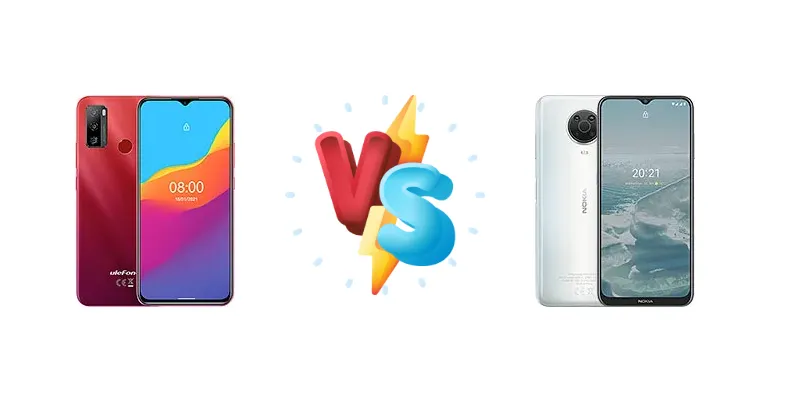
The Ulefone Note 10 and Nokia G20 represent the ultra-budget end of the Android spectrum. Both aim to deliver smartphone functionality at the lowest possible price point, but they take different approaches to achieving this. This comparison dissects their core components to reveal which device offers the best value for users prioritizing performance and longevity.
🏆 Quick Verdict
For the average user, the Nokia G20 is the slightly better choice. While both phones offer basic functionality, the Nokia G20’s Mediatek Helio G35, built on a 12nm process, provides a noticeable performance advantage and improved efficiency over the Ulefone Note 10’s older 28nm Unisoc SC9863A. This translates to a smoother user experience, especially with multitasking.
| Network |
|---|
| 2G bands | GSM 850 / 900 / 1800 / 1900 | GSM 850 / 900 / 1800 / 1900 |
| 3G bands | HSDPA 850 / 900 / 2100 | HSDPA 850 / 900 / 1900 / 2100 - International |
| 4G bands | 1, 3, 5, 7, 8, 20 | 1, 3, 5, 7, 8, 20, 28, 38, 40, 41 - International |
| Speed | HSPA, LTE | HSPA 42.2/5.76 Mbps, LTE Cat4 150/50 Mbps |
| Technology | GSM / HSPA / LTE | GSM / HSPA / LTE |
| | - | 1, 2, 3, 4, 5, 7, 8, 12, 17, 28, 66 - LATAM |
| Launch |
|---|
| Announced | 2021, January 21 | 2021, April 08 |
| Status | Available. Released 2021, January 21 | Available. Released 2021, May 17 |
| Body |
|---|
| Build | Plastic frame, plastic back | - |
| Dimensions | 165.2 x 76.7 x 9.7 mm (6.50 x 3.02 x 0.38 in) | 164.9 x 76 x 9.2 mm (6.49 x 2.99 x 0.36 in) |
| SIM | Nano-SIM + Micro-SIM | · Nano-SIM· Nano-SIM + Nano-SIM |
| Weight | 203 g (7.16 oz) | 197 g (6.95 oz) |
| | - | Splash protection |
| Display |
|---|
| Resolution | 720 x 1600 pixels, 20:9 ratio (~269 ppi density) | 720 x 1600 pixels, 20:9 ratio (~269 ppi density) |
| Size | 6.52 inches, 102.6 cm2 (~81.0% screen-to-body ratio) | 6.52 inches, 102.6 cm2 (~81.9% screen-to-body ratio) |
| Type | IPS LCD | IPS LCD |
| Platform |
|---|
| CPU | Octa-core (4x1.6 GHz Cortex-A55 & 4x1.2 GHz Cortex-A55) | Octa-core (4x2.3 GHz Cortex-A53 & 4x1.8 GHz Cortex-A53) |
| Chipset | Unisoc SC9863A (28 nm) | Mediatek MT6765G Helio G35 (12 nm) |
| GPU | IMG8322 | PowerVR GE8320 |
| OS | Android 11 (Go edition) | Android 11, upgradable to Android 13 |
| Memory |
|---|
| Card slot | microSDXC (dedicated slot) | microSDXC (dedicated slot) |
| Internal | 32GB 2GB RAM | 64GB 4GB RAM, 128GB 4GB RAM |
| | eMMC 5.1 | - |
| Main Camera |
|---|
| Features | LED flash | LED flash, HDR, panorama |
| Quad | - | 48 MP, f/1.8, (wide), PDAF
5 MP, (ultrawide)
2 MP (macro)
Auxiliary lens |
| Single | 8 MP, f/2.0 | 8 MP, (wide) |
| Triple | 8 MP, f/2.0, AF
5 MP (macro)
Auxiliary lens | - |
| Video | 1080p@30fps | 1080p@30fps |
| Selfie camera |
|---|
| Single | 8 MP, f/2.0 | 8 MP, (wide) |
| Video | - | 1080p@30fps |
| Sound |
|---|
| 3.5mm jack | Yes | Yes |
| 35mm jack | Yes | Yes |
| Loudspeaker | Yes | Yes |
| Comms |
|---|
| Bluetooth | 4.2, A2DP | 5.0, A2DP, LE |
| NFC | No | Yes (market/region dependent) |
| Positioning | GPS | GPS, GLONASS, BDS |
| Radio | Unspecified | FM radio |
| USB | microUSB 2.0, OTG | USB Type-C 2.0, OTG |
| WLAN | Wi-Fi 802.11 b/g/n | Wi-Fi 802.11 b/g/n |
| Features |
|---|
| Sensors | Fingerprint (rear-mounted), accelerometer, proximity | Fingerprint (side-mounted), accelerometer, gyro, proximity |
| Battery |
|---|
| Charging | 10W wired | 10W wired |
| Type | Li-Ion 5500 mAh | Li-Po 5050 mAh |
| Misc |
|---|
| Colors | Black, Red, Aurora Green | Glacier, Night |
| Models | - | TA-1336, TA-1343, TA-1347, TA-1372, TA-1365 |
| Price | About 120 EUR | About 90 EUR |
| SAR | - | 1.01 W/kg (head) 1.02 W/kg (body) |
| SAR EU | - | 0.49 W/kg (head) 1.13 W/kg (body) |
Ulefone Note 10
- Potentially lower price point
- Basic smartphone functionality
- May include features not found on the G20 (dependent on specific model variations)
- Older, less efficient chipset
- Likely slower performance
- Potentially shorter battery life
- Limited software support
Nokia G20
- More modern and efficient chipset
- Better performance for multitasking
- Nokia’s software update commitment (albeit limited)
- Potentially longer battery life
- May be slightly more expensive
- Still a budget device with inherent limitations
- 10W charging is slow
Display Comparison
Neither device boasts a standout display. Details regarding panel type (IPS, TFT) and resolution are missing, but both likely feature basic LCD panels. The focus here is on cost reduction, meaning expect limited brightness and color accuracy. The absence of high refresh rates is a given. The real difference lies under the hood, impacting the responsiveness of the UI.
Camera Comparison
Both phones likely feature basic camera setups geared towards casual photography. Without specific sensor details, it’s safe to assume both rely on budget sensors. The presence of a 2MP macro lens on either device is largely marketing fluff; image quality will be limited. The Nokia G20 *may* benefit from slightly better image processing capabilities due to the more powerful chipset, but don't expect flagship-level results from either.
Performance
The core disparity lies in the chipsets. The Nokia G20’s Mediatek Helio G35 (12nm) is a more modern design than the Ulefone Note 10’s Unisoc SC9863A (28nm). The 12nm process allows for greater transistor density and improved power efficiency. While both are octa-core, the CPU architecture differs significantly: the G35 uses Cortex-A53 cores clocked up to 2.3GHz, while the SC9863A utilizes a mix of Cortex-A55 and A55 cores, maxing out at 1.6GHz. This means the G30 will handle multitasking and app launches more efficiently. The older 28nm process of the Unisoc chip will likely result in more heat generation under load, potentially leading to performance throttling.
Battery Life
Both devices are equipped with 10W wired charging, indicating a focus on minimizing cost rather than rapid replenishment. Battery capacity details are missing, but the more efficient Mediatek Helio G35 in the Nokia G20 will likely translate to longer real-world battery life, even with a similar capacity battery to the Ulefone Note 10. The 28nm Unisoc chip will consume more power, reducing overall uptime.
Buying Guide
Buy the Ulefone Note 10 if you absolutely need the lowest possible price and are willing to accept compromises in performance and long-term software support. It's suitable for very basic tasks like calls, texts, and light social media. Buy the Nokia G20 if you prioritize a more responsive user experience, slightly better gaming capabilities, and the assurance of Nokia’s software update commitment, even if it's limited.
Frequently Asked Questions
❓ Will the Unisoc SC9863A in the Ulefone Note 10 struggle with popular apps like Facebook or WhatsApp?
Yes, the Unisoc SC9863A is a very basic chipset. While it can run these apps, expect noticeable lag and slowdowns, especially when multitasking or using the apps for extended periods. The Nokia G20’s Helio G35 will provide a significantly smoother experience.
❓ Does the Nokia G20 support software updates, and for how long?
Nokia typically provides at least two years of security updates for its G-series phones. While major Android version updates are less frequent on this budget tier, you can expect a degree of ongoing software support, which is a significant advantage over the Ulefone Note 10, which likely has limited or no guaranteed updates.
❓ Is the 10W charging on either phone sufficient for daily use?
10W charging is quite slow by modern standards. Expect a full charge to take several hours. Neither phone is designed for quick top-ups; overnight charging is recommended. The Nokia G20's more efficient chipset may mean you need to charge it less frequently, mitigating the slow charging speed somewhat.