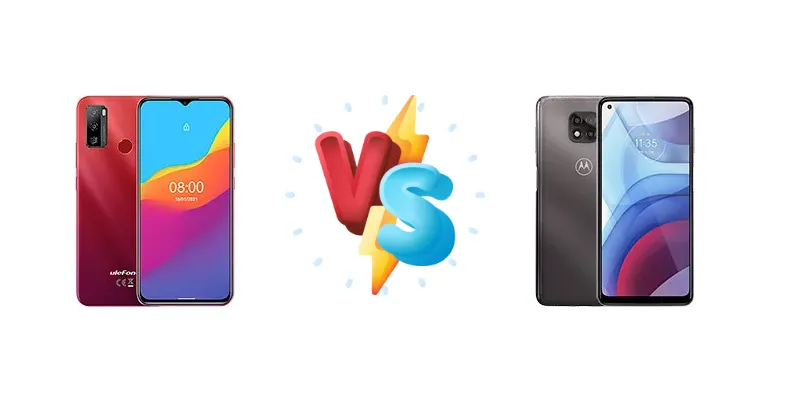
The sub-$200 smartphone market is fiercely competitive. The Ulefone Note 10 and Motorola Moto G Power (2021) both aim to deliver essential features at an accessible price. However, they take different approaches: Ulefone focuses on keeping costs minimal, while Motorola leverages Qualcomm’s Snapdragon platform for a more refined experience. This comparison dissects their key differences to help you choose the right device.
🏆 Quick Verdict
For most users, the Motorola Moto G Power (2021) is the better choice. Its Qualcomm Snapdragon 662 chipset, built on an 11nm process, provides a significantly smoother and more responsive experience than the Ulefone Note 10’s Unisoc SC9863A. While the Ulefone offers a lower entry price, the Moto G Power’s performance advantage justifies the slight premium.
| Network |
|---|
| 2G bands | GSM 850 / 900 / 1800 / 1900 | GSM 850 / 900 / 1800 / 1900 |
| 3G bands | HSDPA 850 / 900 / 2100 | HSDPA 850 / 900 / 1700(AWS) / 1900 / 2100 |
| 4G bands | 1, 3, 5, 7, 8, 20 | 1, 2, 3, 4, 5, 7, 8, 12, 13, 14, 17, 25, 26, 29, 30, 38, 41, 66, 71 |
| Speed | HSPA, LTE | HSPA, LTE |
| Technology | GSM / HSPA / LTE | GSM / CDMA / HSPA / EVDO / LTE |
| | - | CDMA2000 1xEV-DO |
| Launch |
|---|
| Announced | 2021, January 21 | 2021, January 08 |
| Status | Available. Released 2021, January 21 | Available. Released 2021, January 14 |
| Body |
|---|
| Build | Plastic frame, plastic back | Glass front, plastic back, plastic frame |
| Dimensions | 165.2 x 76.7 x 9.7 mm (6.50 x 3.02 x 0.38 in) | 165.3 x 75.9 x 9.5 mm (6.51 x 2.99 x 0.37 in) |
| SIM | Nano-SIM + Micro-SIM | Nano-SIM |
| Weight | 203 g (7.16 oz) | 206.5 g (7.30 oz) |
| | - | Water-repellent coating |
| Display |
|---|
| Resolution | 720 x 1600 pixels, 20:9 ratio (~269 ppi density) | 720 x 1600 pixels, 20:9 ratio (~266 ppi density) |
| Size | 6.52 inches, 102.6 cm2 (~81.0% screen-to-body ratio) | 6.6 inches, 105.2 cm2 (~83.8% screen-to-body ratio) |
| Type | IPS LCD | IPS LCD |
| Platform |
|---|
| CPU | Octa-core (4x1.6 GHz Cortex-A55 & 4x1.2 GHz Cortex-A55) | Octa-core (4x2.0 GHz Kryo 260 Gold & 4x1.8 GHz Kryo 260 Silver) |
| Chipset | Unisoc SC9863A (28 nm) | Qualcomm SM6115 Snapdragon 662 (11 nm) |
| GPU | IMG8322 | Adreno 610 |
| OS | Android 11 (Go edition) | Android 10 |
| Memory |
|---|
| Card slot | microSDXC (dedicated slot) | microSDXC (dedicated slot) |
| Internal | 32GB 2GB RAM | 32GB 3GB RAM, 64GB 4GB RAM |
| | eMMC 5.1 | eMMC 5.1 |
| Main Camera |
|---|
| Features | LED flash | LED flash, HDR, panorama |
| Single | 8 MP, f/2.0 | - |
| Triple | 8 MP, f/2.0, AF
5 MP (macro)
Auxiliary lens | 48 MP, f/1.7, (wide), 1/2.0", 0.8µm, PDAF
2 MP (macro)
Auxiliary lens |
| Video | 1080p@30fps | 1080p@30/60fps, gyro-EIS |
| Selfie camera |
|---|
| Features | - | HDR |
| Single | 8 MP, f/2.0 | 8 MP, f/2.0, 1.12µm |
| Video | - | 1080p@30fps, gyro-EIS |
| Sound |
|---|
| 3.5mm jack | Yes | Yes |
| 35mm jack | Yes | Yes |
| Loudspeaker | Yes | Yes |
| Comms |
|---|
| Bluetooth | 4.2, A2DP | 5.0, A2DP, LE |
| NFC | No | No |
| Positioning | GPS | GPS, GLONASS, GALILEO |
| Radio | Unspecified | FM radio |
| USB | microUSB 2.0, OTG | USB Type-C 2.0 |
| WLAN | Wi-Fi 802.11 b/g/n | Wi-Fi 802.11 a/b/g/n/ac, dual-band, Wi-Fi Direct |
| Features |
|---|
| Sensors | Fingerprint (rear-mounted), accelerometer, proximity | Fingerprint (side-mounted), accelerometer, gyro, proximity, compass, barometer |
| Battery |
|---|
| Charging | 10W wired | 15W wired |
| Type | Li-Ion 5500 mAh | Li-Po 5000 mAh |
| Misc |
|---|
| Colors | Black, Red, Aurora Green | Flash Gray, Polar Silver |
| Price | About 120 EUR | About 60 EUR |
Ulefone Note 10
- Lower price point makes it very accessible.
- May offer slightly longer standby time due to potentially larger battery (unconfirmed).
- Simple and straightforward Android experience.
- Significantly weaker performance due to the Unisoc chipset.
- Slower charging speed (10W).
- Likely inferior camera performance.
Motorola Moto G Power (2021)
- Superior performance thanks to the Snapdragon 662.
- Faster 15W charging.
- Better image processing capabilities.
- Slightly higher price compared to the Ulefone Note 10.
- May not have the absolute longest standby time (trade-off for performance).
- Software updates may be less frequent than higher-end Motorola models.
Display Comparison
Neither device boasts a standout display. Both likely utilize IPS LCD panels, a common choice in this price bracket. However, the core difference lies in the processing power driving them. Display quality details like resolution and refresh rate are not provided, but the chipset's ability to efficiently render graphics will impact perceived smoothness. The Ulefone's weaker GPU will struggle with more demanding visual tasks, making the Moto G Power the better option for video playback and casual gaming.
Camera Comparison
Without detailed sensor information, a direct camera comparison is difficult. However, the Motorola Moto G Power (2021) likely benefits from Qualcomm’s image signal processor (ISP), which generally delivers better image quality and processing speeds. The Ulefone Note 10’s Unisoc chipset lacks the same level of image processing capabilities. It’s reasonable to assume the Moto G Power will produce more detailed and vibrant photos, especially in challenging lighting conditions. The prevalence of low-resolution auxiliary cameras on both devices suggests focusing on the main sensor’s performance is key.
Performance
The Motorola Moto G Power (2021) holds a clear advantage in performance. Its Qualcomm Snapdragon 662, fabricated on an 11nm process, is significantly more efficient and powerful than the Ulefone Note 10’s Unisoc SC9863A (28nm). The Snapdragon 662’s octa-core configuration, with 4x2.0 GHz Kryo 260 Gold cores, provides a noticeable boost in CPU performance compared to the Ulefone’s 4x1.6 GHz Cortex-A55 cores. This translates to faster app loading times, smoother multitasking, and a more responsive overall user experience. The larger process node of the Unisoc chip also suggests higher power consumption for similar tasks.
Battery Life
Both phones prioritize battery life, but approach it differently. The Moto G Power (2021) features 15W wired charging, while the Ulefone Note 10 is limited to 10W. While battery capacity isn’t specified, the faster charging speed of the Motorola will result in quicker top-ups. The more efficient Snapdragon 662 chipset also contributes to better battery life, as it consumes less power during operation. Users who frequently need to recharge throughout the day will benefit from the Moto G Power’s faster charging and improved power efficiency.
Buying Guide
Buy the Ulefone Note 10 if your primary need is an extremely affordable device for basic tasks like calls, texts, and light social media, and you're willing to accept compromises in performance. Buy the Motorola Moto G Power (2021) if you prioritize a smoother user experience, better app responsiveness, and a more reliable chipset for everyday use, even if it means spending a bit more.
Frequently Asked Questions
❓ Will the Ulefone Note 10 struggle with popular apps like TikTok or Facebook?
Yes, the Unisoc SC9863A chipset is likely to exhibit noticeable lag and slowdowns when running demanding apps like TikTok or Facebook, especially with multiple apps open simultaneously. The limited processing power and slower RAM speeds will impact app responsiveness and overall smoothness.
❓ Is the Motorola Moto G Power (2021) a good choice for mobile gaming?
The Moto G Power (2021) is suitable for casual mobile gaming, but don’t expect high frame rates or maximum graphics settings in demanding titles. The Snapdragon 662 can handle less intensive games without issue, but more graphically demanding games may require reduced settings to maintain playable performance.
❓ How long does it realistically take to fully charge the Ulefone Note 10 with its 10W charger?
With its 10W charging, the Ulefone Note 10 will likely take over 3 hours to fully charge from 0% to 100%. This is significantly slower than the Moto G Power’s 15W charging, making it less convenient for users who need quick top-ups.
❓ Does the Motorola Moto G Power (2021) support fast charging standards like Quick Charge?
While the Moto G Power (2021) supports 15W charging, it doesn't officially support Qualcomm's Quick Charge technology. Using a Quick Charge charger may not result in significantly faster charging speeds.