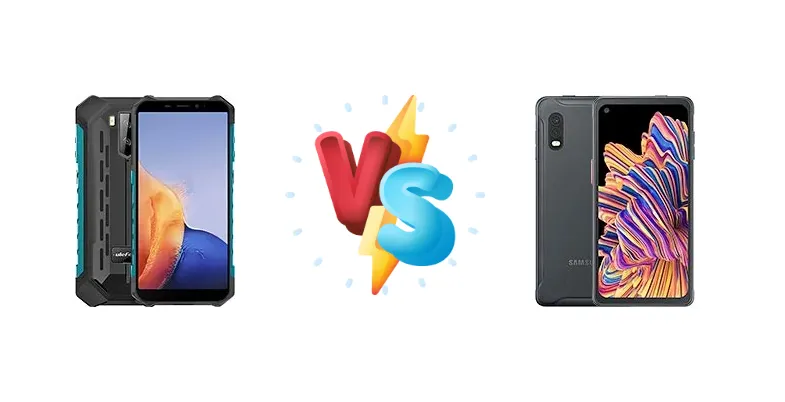
The rugged smartphone market caters to a specific need: durability. However, within this niche, trade-offs exist. We pit the budget-focused Ulefone Armor X9 against the more established Samsung Galaxy XCover Pro, examining how their differing chipsets and feature sets impact real-world usability for demanding professionals and outdoor enthusiasts.
🏆 Quick Verdict
For the average user prioritizing performance and a more refined experience, the Samsung Galaxy XCover Pro is the clear winner. Its Exynos 9611 chipset delivers a noticeable performance boost over the Ulefone Armor X9’s Helio A25, making it better suited for multitasking and demanding applications. However, the Armor X9 offers a compelling value proposition for those on a strict budget.
| Network |
|---|
| 2G bands | GSM 850 / 900 / 1800 / 1900 | GSM 850 / 900 / 1800 / 1900 |
| 3G bands | HSDPA 850 / 900 / 1700(AWS) / 1900 / 2100 | HSDPA 850 / 900 / 1900 / 2100 - International |
| 4G bands | 1, 2, 3, 4, 5, 7, 8, 12, 17, 19, 20, 28 | 1, 2, 3, 5, 7, 8, 20, 28, 38, 40, 41 - International |
| Speed | HSPA 21/5.76 Mbps, LTE Cat6 300/150 Mbps | HSPA 42.2/5.76 Mbps, LTE (3CA) Cat11 600/50 Mbps |
| Technology | GSM / HSPA / LTE | GSM / HSPA / LTE |
| | - | 1, 2, 3, 4, 5, 7, 12, 13, 14, 20, 29, 38, 40, 41, 66 - Canada |
| Launch |
|---|
| Announced | 2021, September 07 | 2020, January |
| Status | Available. Released 2021, September 07 | Available. Released 2020, January |
| Body |
|---|
| Dimensions | 158 x 77.5 x 13.9 mm (6.22 x 3.05 x 0.55 in) | 159.9 x 76.7 x 10 mm (6.30 x 3.02 x 0.39 in) |
| SIM | Nano-SIM + Nano-SIM | · Nano-SIM· Nano-SIM + Nano-SIM |
| Weight | 235 g (8.29 oz) | 218 g (7.69 oz) |
| | IP68/IP69K dust/water resistant (up to 1.5m for 30 min)
Drop-to-concrete resistance from up to 1.2m
MIL-STD-810G compliant | IP68 dust/water resistant (up to 1.5m for 35 min)
Drop-to-concrete resistance from up to 1.5m
MIL-STD-810G compliant*
*does not guarantee ruggedness or use in extreme conditions |
| Display |
|---|
| Protection | - | Corning Gorilla Glass 5 |
| Resolution | 720 x 1440 pixels, 18:9 ratio (~293 ppi density) | 1080 x 2340 pixels, 19.5:9 ratio (~409 ppi density) |
| Size | 5.5 inches, 78.1 cm2 (~63.8% screen-to-body ratio) | 6.3 inches, 97.4 cm2 (~79.4% screen-to-body ratio) |
| Type | IPS LCD | IPS LCD |
| Platform |
|---|
| CPU | Octa-core (4x1.8 GHz Cortex-A53 & 4x1.5 GHz Cortex-A53) | Octa-core (4x2.3 GHz Cortex-A73 & 4x1.7 GHz Cortex-A53) |
| Chipset | Mediatek MT6762D Helio A25 (12 nm) | Exynos 9611 (10 nm) |
| GPU | PowerVR GE8320 | Mali-G72 MP3 |
| OS | Android 11 | Android 10, upgradable to Android 13, One UI 5 |
| Memory |
|---|
| Card slot | microSDXC (uses shared SIM slot) | microSDXC (dedicated slot) |
| Internal | 32GB 3GB RAM | 64GB 4GB RAM |
| | eMMC 5.1 | - |
| Main Camera |
|---|
| Dual | 13 MP, f/2.2, (wide), AF
Auxiliary lens | 25 MP, f/1.7, 26mm (wide), PDAF
8 MP, f/2.2, 123˚ (ultrawide), 1/4.0", 1.12µm |
| Features | Dual-LED flash, HDR, panorama | Dual-LED flash, HDR, panorama |
| Single | 5 MP | - |
| Video | 1080p@30fps | 1080p@30fps |
| Selfie camera |
|---|
| Features | HDR | HDR |
| Single | 5 MP | 13 MP, f/2.0, (wide), 1/3.1", 1.12µm |
| Video | 1080p@30fps | 1080p@30fps |
| Sound |
|---|
| 3.5mm jack | Yes | Yes |
| 35mm jack | Yes | Yes |
| Loudspeaker | Yes | Yes |
| Comms |
|---|
| Bluetooth | 5.0, A2DP, LE | 5.0, A2DP, LE |
| NFC | Yes | Yes |
| Positioning | GPS, GLONASS, GALILEO, BDS | GPS, GLONASS, GALILEO, BDS |
| Radio | FM radio, RDS, recording | FM radio (market/region dependent) |
| USB | microUSB 2.0, OTG | USB Type-C 2.0 |
| WLAN | Wi-Fi 802.11 a/b/g/n/ac, Wi-Fi Direct | Wi-Fi 802.11 a/b/g/n/ac/k/v/r, dual-band, Wi-Fi Direct |
| Features |
|---|
| Sensors | Accelerometer, proximity, compass | Fingerprint (side-mounted), accelerometer, gyro, proximity, compass |
| | - | ANT+ |
| Battery |
|---|
| Charging | 10W wired | 15W wired |
| Type | Li-Po 5000 mAh | Li-Po 4050 mAh, removable |
| Misc |
|---|
| Colors | Red, Black, Green | Black |
| Models | - | SM-G715FN/DS, SM-G715FN, SM-G715F, SM-G715W, SM-G715U, SM-G715U1 |
| Price | About 150 EUR | About 120 EUR |
| SAR EU | - | 0.47 W/kg (head) 1.23 W/kg (body) |
Ulefone Armor X9
- Significantly lower price point
- Ruggedized design for extreme durability
- Potentially longer standby time due to less powerful processor
- Slow Helio A25 processor limits performance
- Slow 10W charging
- Likely inferior camera quality
Samsung Galaxy XCover Pro
- More powerful Exynos 9611 processor
- Faster 15W charging
- Superior camera capabilities due to advanced ISP
- Higher price tag
- Still a relatively basic display
- May not be as exceptionally rugged as the Ulefone
Display Comparison
Neither device boasts a cutting-edge display. Details regarding panel type (IPS vs. AMOLED) and resolution are missing for the Ulefone, but it's likely a standard LCD. The Samsung XCover Pro’s display is also likely LCD. The key difference lies in processing power; the Exynos 9611 has a more capable ISP, potentially leading to better image processing from the front and rear cameras. Bezels are expected to be substantial on both, prioritizing durability over a modern, edge-to-edge design.
Camera Comparison
Without detailed camera specs beyond the presence of a 2MP macro lens on the Ulefone (which is largely irrelevant), it’s difficult to make a precise comparison. However, the Exynos 9611’s image signal processor (ISP) is far more advanced than the ISP paired with the Helio A25. This means better dynamic range, noise reduction, and overall image quality on the Samsung. The XCover Pro is likely to offer more consistent performance in challenging lighting conditions. The Ulefone’s camera is likely adequate for basic snapshots, but won’t compete with the XCover Pro’s capabilities.
Performance
The Exynos 9611 (10nm) in the Galaxy XCover Pro represents a significant leap in processing power compared to the Helio A25 (12nm) in the Armor X9. The Exynos utilizes a Cortex-A73 core cluster clocked at 2.3GHz, offering substantially higher single-core performance than the A25’s 1.8GHz Cortex-A53 cores. This translates to snappier app launches, smoother multitasking, and a more responsive user experience. The 10nm process node also contributes to better thermal efficiency, reducing the likelihood of throttling under sustained load. While both are octa-core, the architectural differences are critical; the A73 cores are significantly more powerful than the A53 cores. This benefits users running demanding applications like mapping software or data collection tools.
Battery Life
The Ulefone Armor X9’s 10W charging is a significant drawback compared to the Samsung Galaxy XCover Pro’s 15W charging. While battery capacity isn’t specified, the faster charging speed of the XCover Pro will result in quicker top-ups. The more efficient Exynos 9611 chipset may also contribute to slightly better battery life, despite potentially similar capacity. For users who rely on their phone throughout the day, the XCover Pro’s faster charging is a practical advantage.
Buying Guide
Buy the Ulefone Armor X9 if you need an exceptionally affordable, highly durable phone primarily for basic communication and light tasks, and are willing to accept slower performance. Buy the Samsung Galaxy XCover Pro if you prefer a more powerful processor for running work apps, improved camera capabilities, and the backing of Samsung’s software support, even at a higher price point.
Frequently Asked Questions
❓ Does the Exynos 9611 in the Galaxy XCover Pro tend to overheat during prolonged use, like extended GPS navigation or video recording?
The Exynos 9611 is a relatively efficient chipset, and the Galaxy XCover Pro’s design incorporates thermal management features. While it may warm up during intensive tasks, it’s unlikely to experience significant overheating or throttling, especially compared to the Helio A25 which is more prone to thermal limitations.
❓ Is the 2MP macro camera on the Ulefone Armor X9 actually useful for taking detailed close-up photos?
Generally, 2MP macro cameras on budget phones produce images with limited detail and sharpness. The Ulefone Armor X9’s 2MP macro lens is likely to be more of a novelty feature than a genuinely useful tool for serious close-up photography. Expect soft images and limited dynamic range.
❓ Can the Samsung Galaxy XCover Pro handle demanding games like PUBG Mobile at high frame rates (60fps or higher)?
The Exynos 9611 can run PUBG Mobile, but achieving consistently high frame rates (60fps+) will depend on the graphics settings. Expect to play at medium settings for a smooth experience. Pushing for ultra settings may result in frame drops and stuttering. The Armor X9 would struggle to maintain even medium settings at playable frame rates.
❓ How does the software update support compare between Ulefone and Samsung for these devices?
Samsung provides significantly better software update support than Ulefone. The Galaxy XCover Pro is likely to receive more frequent security patches and potentially even Android version updates for a longer period. Ulefone’s update track record is less consistent, and updates may be delayed or unavailable.