
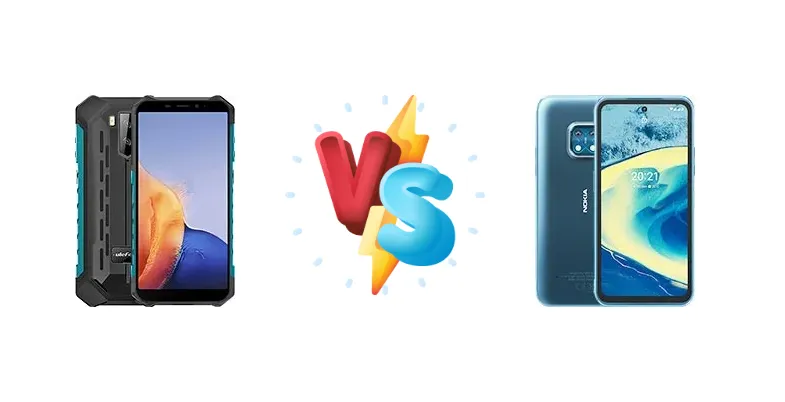
Ulefone Armor X9 vs Nokia XR20: A Head-to-Head Rugged Phone Showdown
| Phones Images | |||||
|---|---|---|---|---|---|
|
🏆 Quick Verdict
For the average user prioritizing future-proofing and smoother performance, the Nokia XR20 is the clear winner. Its Snapdragon 480 5G chipset and 18W charging offer a significantly better experience than the Ulefone Armor X9’s Helio A25 and 10W charging, despite the X9’s lower price point.
| PHONES | ||
|---|---|---|
| Phone Names | Ulefone Armor X9 | Nokia XR20 |
| Network | ||
|---|---|---|
| 2G bands | GSM 850 / 900 / 1800 / 1900 | GSM 850 / 900 / 1800 / 1900 |
| 3G bands | HSDPA 850 / 900 / 1700(AWS) / 1900 / 2100 | HSDPA 850 / 900 / 1700(AWS) / 1900 / 2100 |
| 4G bands | 1, 2, 3, 4, 5, 7, 8, 12, 17, 19, 20, 28 | 1, 2, 3, 4, 5, 7, 8, 12, 13, 14, 20, 25, 26, 28, 30, 38, 40, 41, 48, 66, 71 |
| 5G bands | - | 2, 5, 25, 38, 41, 48, 66, 77, 78 SA/NSA |
| Speed | HSPA 21/5.76 Mbps, LTE Cat6 300/150 Mbps | HSPA, LTE, 5G |
| Technology | GSM / HSPA / LTE | GSM / CDMA / HSPA / EVDO / LTE / 5G |
| - | CDMA2000 1xEV-DO | |
| Launch | ||
|---|---|---|
| Announced | 2021, September 07 | 2021, July 27 |
| Status | Available. Released 2021, September 07 | Available. Released 2021, August 04 |
| Body | ||
|---|---|---|
| Dimensions | 158 x 77.5 x 13.9 mm (6.22 x 3.05 x 0.55 in) | 171.6 x 81.5 x 10.6 mm (6.76 x 3.21 x 0.42 in) |
| SIM | Nano-SIM + Nano-SIM | · Nano-SIM· Nano-SIM + Nano-SIM |
| Weight | 235 g (8.29 oz) | 248 g (8.75 oz) |
| IP68/IP69K dust/water resistant (up to 1.5m for 30 min) Drop-to-concrete resistance from up to 1.2m MIL-STD-810G compliant | IP68 dust/water resistant (up to 1.5m for 60 min) Drop-to-concrete resistance from up to 1.8m MIL-STD-810H compliant | |
| Display | ||
|---|---|---|
| Protection | - | Corning Gorilla Glass Victus |
| Resolution | 720 x 1440 pixels, 18:9 ratio (~293 ppi density) | 1080 x 2400 pixels, 20:9 ratio (~395 ppi density) |
| Size | 5.5 inches, 78.1 cm2 (~63.8% screen-to-body ratio) | 6.67 inches, 107.4 cm2 (~76.8% screen-to-body ratio) |
| Type | IPS LCD | IPS LCD, 550 nits |
| Platform | ||
|---|---|---|
| CPU | Octa-core (4x1.8 GHz Cortex-A53 & 4x1.5 GHz Cortex-A53) | Octa-core (2x2.0 GHz Kryo 460 & 6x1.8 GHz Kryo 460) |
| Chipset | Mediatek MT6762D Helio A25 (12 nm) | Qualcomm SM4350 Snapdragon 480 5G (8 nm) |
| GPU | PowerVR GE8320 | Adreno 619 |
| OS | Android 11 | Android 11, upgradable to Android 13 |
| Memory | ||
|---|---|---|
| Card slot | microSDXC (uses shared SIM slot) | microSDXC (uses shared SIM slot) |
| Internal | 32GB 3GB RAM | 64GB 4GB RAM, 128GB 6GB RAM |
| eMMC 5.1 | - | |
| Main Camera | ||
|---|---|---|
| Dual | 13 MP, f/2.2, (wide), AF Auxiliary lens | 48 MP, f/1.8, (wide), 1/2.25", 0.8µm, PDAF 13 MP, f/2.4, 123˚ (ultrawide), 1/3.0", 1.12µm |
| Features | Dual-LED flash, HDR, panorama | Zeiss optics, Dual-LED dual-tone flash, second LED flash, HDR, panorama |
| Single | 5 MP | 8 MP, f/2.0 (wide), 1/4.0", 1.12µm |
| Video | 1080p@30fps | 1080p@30fps |
| Selfie camera | ||
|---|---|---|
| Features | HDR | - |
| Single | 5 MP | 8 MP, f/2.0 (wide), 1/4.0", 1.12µm |
| Video | 1080p@30fps | 1080p@30fps |
| Sound | ||
|---|---|---|
| 3.5mm jack | Yes | Yes |
| 35mm jack | Yes | Yes |
| Loudspeaker | Yes | Yes, with stereo speakers |
| Comms | ||
|---|---|---|
| Bluetooth | 5.0, A2DP, LE | 5.1, A2DP, LE, aptX Adaptive |
| NFC | Yes | Yes |
| Positioning | GPS, GLONASS, GALILEO, BDS | GPS (L1+L5), GLONASS, BDS, GALILEO, QZSS, NavIC |
| Radio | FM radio, RDS, recording | Unspecified |
| USB | microUSB 2.0, OTG | USB Type-C 3.0 |
| WLAN | Wi-Fi 802.11 a/b/g/n/ac, Wi-Fi Direct | Wi-Fi 802.11 a/b/g/n/ac/6, dual-band, Wi-Fi Direct |
| Features | ||
|---|---|---|
| Sensors | Accelerometer, proximity, compass | Fingerprint (side-mounted), accelerometer, gyro, proximity, compass, barometer |
| Battery | ||
|---|---|---|
| Charging | 10W wired | 18W wired 15W wireless |
| Type | Li-Po 5000 mAh | Li-Po 4630 mAh |
| Misc | ||
|---|---|---|
| Colors | Red, Black, Green | Ultra Blue, Granite Gray |
| Models | - | TA-1368, TA-1362 |
| Price | About 150 EUR | About 270 EUR |
| SAR EU | - | 1.13 W/kg (head) 1.43 W/kg (body) |
Ulefone Armor X9
- Significantly lower price point
- Rugged design for durability
- Basic functionality for essential tasks
- Outdated and slow Helio A25 chipset
- Slow 10W charging
- Limited future-proofing
Nokia XR20
- 5G connectivity for faster data speeds
- More powerful Snapdragon 480 chipset
- 18W wired and 15W wireless charging
- Better overall performance and responsiveness
- Higher price compared to the Ulefone Armor X9
- Rugged design may add bulk
Display Comparison
Neither device boasts a standout display. While specific display specs (resolution, panel type) are missing for the Ulefone Armor X9, its price point suggests a basic LCD panel. The Nokia XR20, similarly, doesn't advertise a high-end display. The key difference lies in processing power impacting UI smoothness. The XR20’s Snapdragon 480 will provide a more fluid experience navigating the interface and apps, even if both screens are similar in resolution.
Camera Comparison
Without detailed camera specs beyond the presence of cameras, a direct comparison is limited. However, the XR20’s higher processing power allows for more sophisticated image processing algorithms, potentially resulting in better image quality, especially in low-light conditions. The Ulefone Armor X9 will likely rely on simpler image processing, resulting in less detailed and dynamic range in photos. The absence of information on sensor sizes makes a definitive statement impossible, but the XR20’s chipset suggests a more capable camera system.
Performance
The performance gap is substantial. The Nokia XR20’s Qualcomm Snapdragon 480 5G, fabricated on an 8nm process, is a significant upgrade over the Ulefone Armor X9’s MediaTek Helio A25 (12nm). The Snapdragon 480’s Kryo 460 cores, with a 2x2.0 GHz and 6x1.8 GHz configuration, offer a noticeable performance boost over the Helio A25’s 4x1.8 GHz and 4x1.5 GHz Cortex-A53 cores. This translates to faster app loading times, smoother multitasking, and a more responsive overall experience on the XR20. The 8nm process also contributes to better thermal efficiency, reducing the likelihood of throttling during sustained use.
Battery Life
Both phones target all-day battery life, but the charging experience differs significantly. The Nokia XR20 supports 18W wired charging *and* 15W wireless charging, offering flexibility and convenience. The Ulefone Armor X9 is limited to 10W wired charging, meaning significantly longer charge times. While battery capacity isn’t specified, the XR20’s faster charging mitigates the impact of a potentially smaller battery, allowing users to quickly top up when needed. The wireless charging capability is a unique advantage for the XR20.
Buying Guide
Buy the Ulefone Armor X9 if you need an extremely budget-friendly, basic rugged phone for essential communication and light tasks, and aren't concerned with 5G or demanding applications. Buy the Nokia XR20 if you prefer a more capable device with 5G connectivity, faster charging, and a more responsive user experience, even if it comes at a higher cost. The XR20 is ideal for users who need a reliable phone for work in challenging environments or outdoor adventures.