
Ulefone Armor X9 vs. Blackview BV9900E: A Deep Dive into Rugged Smartphone Performance
| Phones Images | |||||
|---|---|---|---|---|---|
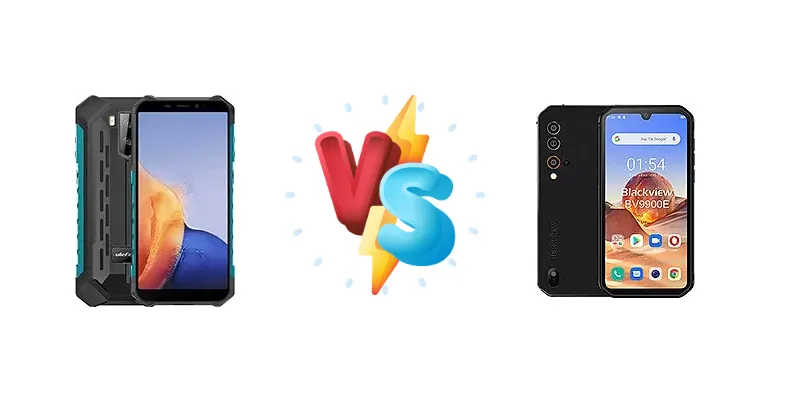
|
🏆 Quick Verdict
For the average user prioritizing performance and future-proofing, the Blackview BV9900E is the clear winner. Its Helio P90 chipset provides a substantial performance uplift over the Armor X9’s Helio A25, coupled with the convenience of 15W wired and 18W wireless charging. While the X9 offers affordability, the BV9900E delivers a more refined and capable experience.
| PHONES | ||
|---|---|---|
| Phone Names | Ulefone Armor X9 | Blackview BV9900E |
| Network | ||
|---|---|---|
| 2G bands | GSM 850 / 900 / 1800 / 1900 | GSM 850 / 900 / 1800 / 1900 |
| 3G bands | HSDPA 850 / 900 / 1700(AWS) / 1900 / 2100 | HSDPA 800 / 850 / 900 / 1700(AWS) / 1900 / 2100 |
| 4G bands | 1, 2, 3, 4, 5, 7, 8, 12, 17, 19, 20, 28 | 1, 2, 3, 4, 5, 7, 8, 12, 13, 17, 18, 19, 20, 25, 26, 28, 34, 38, 39, 40, 41, 66 |
| Speed | HSPA 21/5.76 Mbps, LTE Cat6 300/150 Mbps | HSPA, LTE |
| Technology | GSM / HSPA / LTE | GSM / CDMA / HSPA / CDMA2000 / LTE |
| Launch | ||
|---|---|---|
| Announced | 2021, September 07 | 2020, September 10. Released 2020, September |
| Status | Available. Released 2021, September 07 | Discontinued |
| Body | ||
|---|---|---|
| Dimensions | 158 x 77.5 x 13.9 mm (6.22 x 3.05 x 0.55 in) | 156.5 x 78.3 x 14.2 mm (6.16 x 3.08 x 0.56 in) |
| SIM | Nano-SIM + Nano-SIM | Nano-SIM + Nano-SIM |
| Weight | 235 g (8.29 oz) | 273 g (9.63 oz) |
| IP68/IP69K dust/water resistant (up to 1.5m for 30 min) Drop-to-concrete resistance from up to 1.2m MIL-STD-810G compliant | - | |
| Display | ||
|---|---|---|
| Protection | - | Corning Gorilla Glass 5 |
| Resolution | 720 x 1440 pixels, 18:9 ratio (~293 ppi density) | 1080 x 2280 pixels, 19:9 ratio (~432 ppi density) |
| Size | 5.5 inches, 78.1 cm2 (~63.8% screen-to-body ratio) | 5.84 inches, 85.1 cm2 (~69.5% screen-to-body ratio) |
| Type | IPS LCD | IPS LCD |
| Platform | ||
|---|---|---|
| CPU | Octa-core (4x1.8 GHz Cortex-A53 & 4x1.5 GHz Cortex-A53) | Octa-core (2x2.2 GHz Cortex-A75 & 6x2.0 GHz Cortex-A55) |
| Chipset | Mediatek MT6762D Helio A25 (12 nm) | Mediatek MT6779V/CE Helio P90 (12 nm) |
| GPU | PowerVR GE8320 | PowerVR GM9446 |
| OS | Android 11 | Android 10 |
| Memory | ||
|---|---|---|
| Card slot | microSDXC (uses shared SIM slot) | microSDXC |
| Internal | 32GB 3GB RAM | 128GB 6GB RAM |
| eMMC 5.1 | - | |
| Main Camera | ||
|---|---|---|
| Dual | 13 MP, f/2.2, (wide), AF Auxiliary lens | - |
| Features | Dual-LED flash, HDR, panorama | LED flash, HDR, panorama |
| Quad | - | 48 MP, f/1.8, (wide), PDAF 16 MP, 120˚ (ultrawide) 2 MP (macro) Auxiliary lens |
| Single | 5 MP | - |
| Video | 1080p@30fps | 4K@30fps, 1080p@60fps |
| Selfie camera | ||
|---|---|---|
| Features | HDR | - |
| Single | 5 MP | 16 MP, f/2.0, (wide) |
| Video | 1080p@30fps | 1080p@30fps |
| Sound | ||
|---|---|---|
| 3.5mm jack | Yes | - |
| 35mm jack | Yes | No |
| Loudspeaker | Yes | Yes |
| Comms | ||
|---|---|---|
| Bluetooth | 5.0, A2DP, LE | 5.0, A2DP, LE |
| NFC | Yes | Yes |
| Positioning | GPS, GLONASS, GALILEO, BDS | GPS, GLONASS, GALILEO, BDS |
| Radio | FM radio, RDS, recording | FM radio |
| USB | microUSB 2.0, OTG | USB Type-C 2.0, OTG |
| WLAN | Wi-Fi 802.11 a/b/g/n/ac, Wi-Fi Direct | Wi-Fi 802.11 a/b/g/n/ac |
| Features | ||
|---|---|---|
| Sensors | Accelerometer, proximity, compass | Fingerprint (side-mounted), accelerometer, gyro, proximity, compass, barometer |
| Battery | ||
|---|---|---|
| Charging | 10W wired | 15W wired 18W wireless |
| Type | Li-Po 5000 mAh | 4380 mAh |
| Misc | ||
|---|---|---|
| Colors | Red, Black, Green | Black, Silver |
| Price | About 150 EUR | About 260 EUR |
Ulefone Armor X9
- Most affordable option for a rugged phone.
- Potentially longer battery life due to less demanding chipset.
- Durable build quality expected from Ulefone's Armor series.
- Significantly slower performance compared to the BV9900E.
- Limited to 10W wired charging.
- Likely a less refined user experience.
Blackview BV9900E
- Much faster performance thanks to the Helio P90 chipset.
- Supports 15W wired and 18W wireless charging.
- Likely a better camera system and overall user experience.
- Higher price point than the Ulefone Armor X9.
- Potentially slightly lower battery life due to the more powerful processor.
- May be slightly bulkier due to the added features.
Display Comparison
Neither device’s display specifications are provided, so a direct comparison is limited. However, given the BV9900E’s higher positioning, it likely features a higher resolution panel and potentially better color accuracy. The Armor X9, targeting a lower price point, likely utilizes a more basic display. Both will prioritize durability over peak visual fidelity, with a focus on outdoor visibility.
Camera Comparison
Without detailed camera specifications, a direct comparison is difficult. However, the BV9900E, being a higher-tier device, likely features a more capable primary sensor and potentially better image processing algorithms. The Armor X9 will likely rely on software enhancements to compensate for a less sophisticated camera system. The presence of a 2MP macro camera on either device is largely a marketing gimmick, offering limited practical benefit due to the small sensor size and lack of optical image stabilization (OIS).
Performance
The core difference lies in the chipsets. The Blackview BV9900E’s MediaTek Helio P90 (MT6779V/CE) is a significant step up from the Ulefone Armor X9’s Helio A25 (MT6762D). The P90 utilizes a dual-cluster configuration with 2x 2.2 GHz Cortex-A75 cores and 6x 2.0 GHz Cortex-A55 cores, offering substantially better multi-core performance than the A25’s 4x 1.8 GHz Cortex-A53 and 4x 1.5 GHz Cortex-A53 setup. This translates to faster app loading times, smoother multitasking, and a more responsive user interface on the BV9900E. The A75 cores in the P90 are architecturally superior, providing a noticeable boost in single-core performance as well. This benefits gaming and responsiveness. The 12nm process node is shared, but the P90’s more efficient architecture likely results in better sustained performance under load.
Battery Life
While battery capacity isn’t specified, the charging capabilities highlight a key difference. The Blackview BV9900E supports both 15W wired and 18W wireless charging, offering greater convenience and flexibility. The Ulefone Armor X9 is limited to 10W wired charging. This means the BV9900E will reach a full charge significantly faster, even if the battery capacities are similar. Wireless charging is a significant advantage for users who prefer a cable-free experience.
Buying Guide
Buy the Ulefone Armor X9 if you need an extremely budget-friendly rugged phone for basic tasks like calls, texts, and light app usage, and battery life is paramount. You're willing to sacrifice performance for cost. Buy the Blackview BV9900E if you prefer a more responsive experience for multitasking, gaming, or demanding applications, and value the added convenience of wireless charging and a more powerful processor.