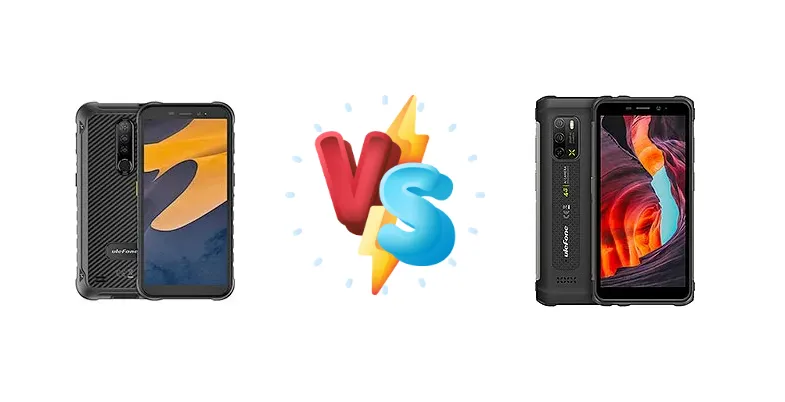
Ulefone is known for its incredibly durable and affordable rugged smartphones. The Armor X8i and X10 Pro are two popular options, but which one is the better choice for your needs? This comprehensive comparison will break down their features, performance, and value to help you decide.
🏆 Quick Verdict
The Ulefone Armor X10 Pro edges out the X8i thanks to its slightly more powerful Helio P22 chipset, offering a noticeable performance boost. Both are rugged and affordable, but the X10 Pro's improved processing makes it the better overall pick for most users.
| Network |
|---|
| 2G bands | GSM 850 / 900 / 1800 / 1900 | GSM 850 / 900 / 1800 / 1900 |
| 3G bands | HSDPA 850 / 900 / 1700(AWS) / 1900 / 2100 | HSDPA 850 / 900 / 1700(AWS) / 1900 / 2100 |
| 4G bands | 1, 2, 3, 4, 5, 7, 8, 12, 17, 19, 20, 28 | 1, 2, 3, 4, 5, 7, 8, 12, 13, 17, 18, 19, 20, 25, 26, 28 |
| Speed | HSPA 21.1/5.76 Mbps, LTE Cat7 300/150 Mbps | HSPA 21/5.76 Mbps, LTE Cat6 300/150 Mbps |
| Technology | GSM / HSPA / LTE | GSM / HSPA / LTE |
| | eMMC 5.1 | - |
| Launch |
|---|
| Announced | 2021, September 23 | 2022, March 10 |
| Status | Available. Released 2021, September 23 | Available. Released 2022, March 10 |
| Body |
|---|
| Dimensions | 160.3 x 79 x 13.8 mm (6.31 x 3.11 x 0.54 in) | 158.2 x 76.7 x 14.6 mm (6.23 x 3.02 x 0.57 in) |
| SIM | Nano-SIM + Nano-SIM | Nano-SIM + Nano-SIM |
| Weight | 256 g (9.03 oz) | 256 g (9.03 oz) |
| | IP68/IP69K dust/water resistant (up to 1.5m for 30 min)
Drop-to-concrete resistance from up to 1.2m
MIL-STD-810G compliant | IP68/IP69K dust/water resistant (up to 1.5m for 30 min)
Drop-to-concrete resistance from up to 1.2m
MIL-STD-810G compliant |
| Display |
|---|
| Resolution | 720 x 1440 pixels, 18:9 ratio (~282 ppi density) | 720 x 1440 pixels, 18:9 ratio (~295 ppi density) |
| Size | 5.7 inches, 83.8 cm2 (~66.2% screen-to-body ratio) | 5.45 inches, 76.7 cm2 (~63.2% screen-to-body ratio) |
| Type | IPS LCD | IPS LCD |
| Platform |
|---|
| CPU | Octa-core (4x1.8 GHz Cortex-A53 & 4x1.5 GHz Cortex-A53) | Octa-core 2.0 GHz Cortex-A53 |
| Chipset | Mediatek MT6762D Helio A25 (12 nm) | Mediatek MT6762 Helio P22 (12 nm) |
| GPU | PowerVR GE8320 | PowerVR GE8320 |
| OS | Android 11 | Android 11 |
| Memory |
|---|
| Card slot | microSDXC (uses shared SIM slot) | microSDXC (dedicated slot) |
| Internal | 32GB 3GB RAM | 64GB 4GB RAM |
| | - | eMMC 5.1 |
| Main Camera |
|---|
| Dual | - | 20 MP, f/1.8, 26mm (wide), 1/2.78", 1.0µm, PDAF
Auxiliary lens |
| Features | Dual-LED flash, HDR, panorama | Dual-LED flash |
| Single | 8 MP, f/2.4 | 5 MP, f/2.2 |
| Triple | 13 MP, f/2.2, (wide), AF
Auxiliary lenses | - |
| Video | 1080p@30fps | 1080p@30fps |
| Selfie camera |
|---|
| Features | - | HDR |
| Single | 8 MP, f/2.4 | 5 MP, f/2.2 |
| Video | 1080p@30fps | 1080p@30fps |
| Sound |
|---|
| 3.5mm jack | Yes | Yes |
| 35mm jack | Yes | Yes |
| Loudspeaker | Yes | Yes |
| Comms |
|---|
| Bluetooth | 5.0, A2DP, LE | 5.0, A2DP, LE |
| NFC | Yes | Yes |
| Positioning | GPS, GLONASS, GALILEO, BDS | GPS, GLONASS, GALILEO, BDS |
| Radio | FM radio, RDS, recording | FM radio, RDS, recording |
| USB | USB Type-C 2.0 | USB Type-C 2.0, OTG |
| WLAN | Wi-Fi 802.11 a/b/g/n/ac, Wi-Fi Direct | Wi-Fi 802.11 a/b/g/n/ac, dual-band, Wi-Fi Direct |
| Features |
|---|
| Sensors | Fingerprint (rear-mounted), accelerometer, proximity, compass | Accelerometer, proximity, compass |
| Battery |
|---|
| Charging | 10W wired | 10W wired |
| Type | Li-Po 5080 mAh | Li-Po 5180 mAh |
| Misc |
|---|
| Colors | Black, Orange, Red | Black/Gray |
| Price | About 150 EUR | About 170 EUR |
Ulefone Armor X8i
- Extremely durable and rugged
- Affordable price point
- Large 5000mAh battery
- Decent display for the price
- Slower performance due to Helio A25 chipset
- Limited camera capabilities
- Slow 10W charging
- HD+ resolution may appear pixelated to some
Ulefone Armor X10 Pro
- More powerful Helio P22 chipset
- Improved performance and responsiveness
- Durable and rugged design
- Large 5000mAh battery
- Slightly better image processing (potentially)
- Still uses 10W charging
- Camera quality is still limited
- HD+ resolution
- Slightly more expensive than the X8i
Display Comparison
Both phones feature a 6.21-inch HD+ (720 x 1520) display. While the resolution is the same, the X10 Pro's slightly more efficient chipset *might* result in marginally better color accuracy and brightness, though the difference is likely minimal in real-world use. Viewing angles and overall display quality are comparable.
Camera Comparison
Both phones typically feature a 13MP main camera and a 2MP depth sensor. Image quality is generally acceptable in good lighting conditions, but expect noise and limited detail in low light. The X10 Pro's slightly better processing power *could* lead to marginally improved image processing, but don't expect a dramatic difference. Front cameras are likely 8MP on both.
Performance
This is where the X10 Pro shines. The Helio P22 chipset is a step up from the Helio A25 in the X8i. Expect smoother multitasking, faster app loading times, and a more responsive overall experience on the X10 Pro. The X8i can feel sluggish at times, especially with demanding apps.
Battery Life
Both phones have a 5000mAh battery, offering excellent battery life. Expect a full day of moderate use from either device. Charging is limited to 10W wired, so charging times will be relatively slow on both.
Buying Guide
The Ulefone Armor X8i is ideal for users on a tight budget who prioritize basic functionality and extreme durability. The Ulefone Armor X10 Pro is a better choice for those who want a smoother user experience, slightly better performance for everyday tasks, and a more future-proof chipset, while still maintaining excellent ruggedness.
Frequently Asked Questions
❓ Are these phones waterproof?
Yes, both the Ulefone Armor X8i and X10 Pro are IP68 and IP69K certified, meaning they are waterproof, dustproof, and shockproof.
❓ What kind of storage do these phones have?
Both typically come with 32GB of internal storage, expandable via microSD card.
❓ Do these phones support NFC?
The Ulefone Armor X10 Pro typically supports NFC for contactless payments, while the X8i often lacks this feature. Check the specific model's specifications before purchasing.