
Ulefone Armor X8 vs. Armor 9E: A Deep Dive into Rugged Performance
| Phones Images | |||||
|---|---|---|---|---|---|
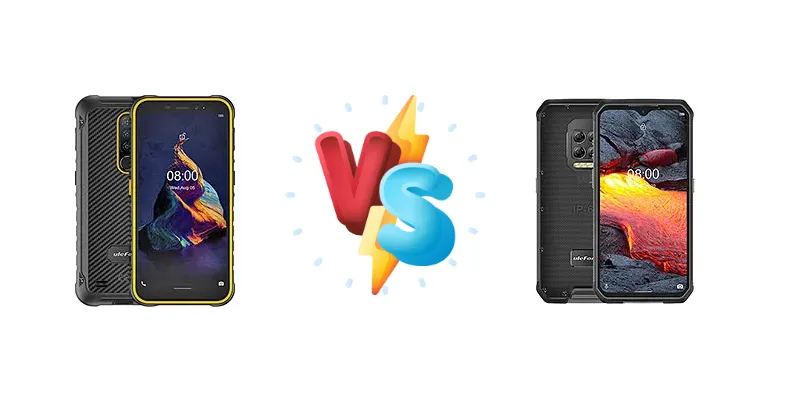
|
🏆 Quick Verdict
For the average user prioritizing responsiveness and future-proofing, the Ulefone Armor 9E is the clear winner. Its Helio P90 chipset delivers substantially better performance than the Armor X8’s Helio A25, making it suitable for more demanding tasks. However, the X8 remains a viable option for basic use cases where budget is paramount.
| PHONES | ||
|---|---|---|
| Phone Names | Ulefone Armor X8 | Ulefone Armor 9E |
| Network | ||
|---|---|---|
| 2G bands | GSM 850 / 900 / 1800 / 1900 | GSM 850 / 900 / 1800 / 1900 |
| 3G bands | HSDPA 850 / 900 / 1700(AWS) / 1900 / 2100 | HSDPA 850 / 900 / 1700(AWS) / 1900 / 2100 |
| 4G bands | 1, 2, 3, 4, 5, 7, 8, 12, 17, 19, 20, 28 | 1, 2, 3, 4, 5, 7, 8, 12, 13, 17, 18, 19, 20, 25, 26, 28, 34, 38, 39, 40, 41, 66 |
| Speed | HSPA 42.2/11.5 Mbps, LTE Cat6 300/150 Mbps | HSPA 42.2/11.5 Mbps, LTE Cat12 600/150 Mbps |
| Technology | GSM / HSPA / LTE | GSM / CDMA / HSPA / EVDO / LTE |
| - | CDMA2000 1xEV-DO | |
| Launch | ||
|---|---|---|
| Announced | 2020, October 06. Released 2020, October 06 | 2020, September 08. Released 2020, September 08 |
| Status | Discontinued | Discontinued |
| Body | ||
|---|---|---|
| Build | - | Front glass, aluminum back with rubber, aluminum frame |
| Dimensions | 160.3 x 79 x 13.8 mm (6.31 x 3.11 x 0.54 in) | 168.2 x 82 x 15 mm (6.62 x 3.23 x 0.59 in) |
| SIM | Nano-SIM + Nano-SIM | Nano-SIM + Nano-SIM |
| Weight | 256.3 g (9.03 oz) | 324 g (11.43 oz) |
| IP68/IP69K dust/water resistant (up to 1.5m for 30 mins) Drop-to-concrete resistance from up to 1.2 m MIL-STD-810G compliant | IP68/IP69K dust/water resistant (up to 1.5m for 30 min) Drop-to-concrete resistance from up to 1.2m MIL-STD-810G compliant | |
| Display | ||
|---|---|---|
| Protection | - | Scratch-resistant glass, oleophobic coating |
| Resolution | 720 x 1440 pixels, 18:9 ratio (~282 ppi density) | 1080 x 2340 pixels, 19.5:9 ratio (~409 ppi density) |
| Size | 5.7 inches, 83.8 cm2 (~66.2% screen-to-body ratio) | 6.3 inches, 97.4 cm2 (~70.6% screen-to-body ratio) |
| Type | IPS LCD | IPS LCD |
| Platform | ||
|---|---|---|
| CPU | Octa-core (4x1.8 GHz Cortex-A53 & 4x1.5 GHz Cortex-A53) | Octa-core (2x2.2 GHz Cortex-A75 & 6x2.0 GHz Cortex-A55) |
| Chipset | Mediatek MT6762D Helio A25 (12 nm) | Mediatek MT6779 Helio P90 (12 nm) |
| GPU | PowerVR GE8320 | PowerVR GM9446 |
| OS | Android 10 | Android 10 |
| Memory | ||
|---|---|---|
| Card slot | microSDXC (uses shared SIM slot) | microSDXC (uses shared SIM slot) |
| Internal | 64GB 4GB RAM | 128GB 8GB RAM |
| eMMC 5.1 | UFS 2.1 | |
| Main Camera | ||
|---|---|---|
| Features | Dual-LED flash, HDR, panorama | Quad-LED flash, HDR, panorama |
| Quad | - | 64 MP, f/1.9, 26mm (wide), 1/1.72", 0.8µm, PDAF 8 MP, f/2.4, 100˚ (ultrawide), 1/4.0", 1.12µm 2 MP (macro) Auxiliary lens |
| Triple | 13 MP, f/2.2, (wide), AF Auxiliary lenses | - |
| Video | 1080p@30fps | 4K@30fps, 1080p@30fps |
| Selfie camera | ||
|---|---|---|
| Features | - | HDR, panorama |
| Single | 8 MP, f/2.4 | 8 MP, f/2.2 |
| Video | 1080p@30fps | 1080p@30fps |
| Sound | ||
|---|---|---|
| 3.5mm jack | Yes | Yes |
| 35mm jack | Yes | Yes |
| Loudspeaker | Yes | Yes |
| Comms | ||
|---|---|---|
| Bluetooth | 5.0, A2DP, LE | 5.0, A2DP, LE |
| NFC | Yes | Yes |
| Positioning | GPS, GLONASS, GALILEO, BDS | GPS, GLONASS, GALILEO, BDS |
| Radio | - | FM radio, RDS, recording |
| USB | USB Type-C 2.0 | USB Type-C 2.0, OTG, accessory connector |
| WLAN | Wi-Fi 802.11 a/b/g/n/ac, Wi-Fi Direct | Wi-Fi 802.11 a/b/g/n/ac, Wi-Fi Direct |
| Features | ||
|---|---|---|
| Sensors | Fingerprint (rear-mounted), accelerometer, proximity, compass | Fingerprint (side-mounted), accelerometer, gyro, proximity, compass, coulombmeter |
| - | Endoscope mount (camera sold separately) | |
| Battery | ||
|---|---|---|
| Charging | - | 18W wired |
| Type | Li-Po 5080 mAh | Li-Po 6600 mAh |
| Misc | ||
|---|---|---|
| Colors | Black, Orange | Black |
| Price | About 130 EUR | About 290 EUR |
Ulefone Armor X8
- Most affordable option
- Excellent durability for the price
- Suitable for basic smartphone tasks
- Slow performance with demanding apps
- Limited multitasking capabilities
- Slower charging speeds
Ulefone Armor 9E
- Significantly faster performance
- Improved multitasking and gaming
- Faster 18W charging
- Higher price point
- May not offer a dramatically better camera experience
- Still utilizes an IPS LCD panel
Display Comparison
Neither Ulefone provides detailed display specifications beyond size and resolution in their marketing materials. Assuming typical IPS LCD panels for this price bracket, the display experience will likely be similar in terms of color accuracy and viewing angles. The absence of high refresh rates or advanced features like LTPO is expected. Bezels are likely comparable, focusing on durability rather than minimizing screen borders.
Camera Comparison
Detailed camera specifications are lacking. However, given the market segment, it’s safe to assume both phones feature similar sensor sizes and image processing capabilities. The focus is likely on providing functional cameras for documentation rather than high-end photography. The absence of Optical Image Stabilization (OIS) is probable on both models. The 9E’s more powerful ISP (Image Signal Processor) within the Helio P90 may offer slightly improved image processing, particularly in low-light conditions, but the difference will likely be marginal without knowing the specific sensor details.
Performance
The core difference lies in the chipsets. The Ulefone Armor X8 utilizes the Mediatek MT6762D Helio A25, featuring an octa-core CPU comprised of four Cortex-A53 cores clocked at 1.8 GHz and four at 1.5 GHz. This is an entry-level chipset designed for basic tasks. Conversely, the Armor 9E boasts the Mediatek MT6779 Helio P90. Its CPU configuration – two Cortex-A75 cores at 2.2 GHz and six Cortex-A55 cores at 2.0 GHz – represents a significant architectural leap. The A75 cores offer substantially higher single-core performance, crucial for app responsiveness, while the A55 cores provide efficient power consumption. This translates to faster app launches, smoother multitasking, and a more fluid user experience on the 9E. The P90 also benefits from a more capable GPU, enabling better graphics performance for gaming.
Battery Life
While battery capacity isn't specified, the Armor 9E’s inclusion of 18W wired charging is a notable advantage. The Armor X8 likely supports standard 10W charging. This means the 9E will reach a full charge significantly faster, reducing downtime. The Helio P90’s improved power efficiency may also contribute to slightly better battery life under heavy usage, despite potentially having a similar capacity battery to the X8.
Buying Guide
Buy the Ulefone Armor X8 if you need a highly affordable, extremely durable phone for basic communication, light social media, and occasional photography. It’s ideal for users who prioritize longevity and don’t require demanding app performance. Buy the Ulefone Armor 9E if you prefer a more responsive experience, faster app loading times, and the ability to handle moderate gaming or multitasking without significant slowdowns. It’s the better choice for users who need a rugged phone that can keep up with a more active digital lifestyle.