
Ulefone Armor X8 vs. Ulefone Armor 11 5G: A Deep Dive into Rugged Smartphone Evolution
| Phones Images | |||||
|---|---|---|---|---|---|
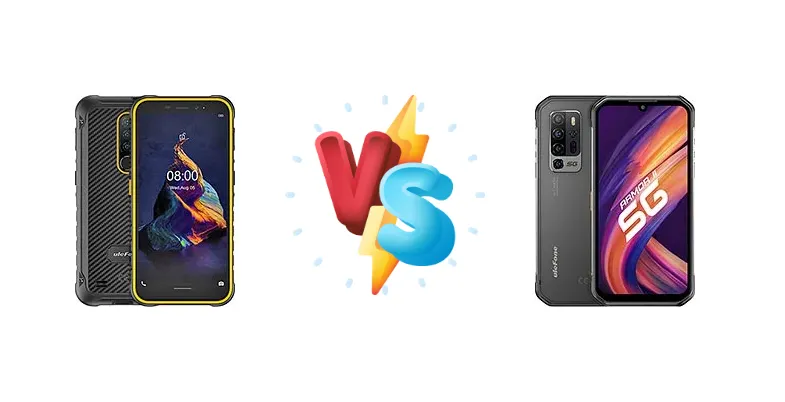
|
🏆 Quick Verdict
For the average user prioritizing future-proofing and performance, the Ulefone Armor 11 5G is the clear winner. Its Mediatek Dimensity 800 chipset delivers a substantial performance boost over the Armor X8’s Helio A25, enabling smoother multitasking, faster app loading, and 5G connectivity. However, the X8 remains a viable option for basic use cases where budget is the primary concern.
| PHONES | ||
|---|---|---|
| Phone Names | Ulefone Armor X8 | Ulefone Armor 11 5G |
| Network | ||
|---|---|---|
| 2G bands | GSM 850 / 900 / 1800 / 1900 | GSM 850 / 900 / 1800 / 1900 |
| 3G bands | HSDPA 850 / 900 / 1700(AWS) / 1900 / 2100 | HSDPA 850 / 900 / 1700(AWS) / 1900 / 2100 |
| 4G bands | 1, 2, 3, 4, 5, 7, 8, 12, 17, 19, 20, 28 | 1, 2, 3, 4, 5, 7, 8, 12, 13, 17, 18, 19, 20, 25, 26, 28, 34, 38, 39, 40, 41, 66 |
| 5G bands | - | 1, 3, 5, 8, 20, 28, 38, 41, 77, 78, 79 SA/NSA |
| Speed | HSPA 42.2/11.5 Mbps, LTE Cat6 300/150 Mbps | HSPA, LTE, 5G |
| Technology | GSM / HSPA / LTE | GSM / CDMA / HSPA / EVDO / LTE / 5G |
| - | CDMA2000 1xEV-DO | |
| Launch | ||
|---|---|---|
| Announced | 2020, October 06. Released 2020, October 06 | 2021, February 18 |
| Status | Discontinued | Available. Released 2021, March 08 |
| Body | ||
|---|---|---|
| Build | - | Front glass, aluminum back with rubber, aluminum frame |
| Dimensions | 160.3 x 79 x 13.8 mm (6.31 x 3.11 x 0.54 in) | 163.8 x 81.6 x 14.2 mm (6.45 x 3.21 x 0.56 in) |
| SIM | Nano-SIM + Nano-SIM | Nano-SIM + Nano-SIM |
| Weight | 256.3 g (9.03 oz) | 295 g (10.41 oz) |
| IP68/IP69K dust/water resistant (up to 1.5m for 30 mins) Drop-to-concrete resistance from up to 1.2 m MIL-STD-810G compliant | IP68 dust/water resistant (up to 1.5m for 30 min) Drop-to-concrete resistance from up to 1.2m MIL-STD-810G compliant | |
| Display | ||
|---|---|---|
| Protection | - | Oleophobic coating |
| Resolution | 720 x 1440 pixels, 18:9 ratio (~282 ppi density) | 720 x 1560 pixels, 19.5:9 ratio (~282 ppi density) |
| Size | 5.7 inches, 83.8 cm2 (~66.2% screen-to-body ratio) | 6.1 inches, 91.3 cm2 (~68.3% screen-to-body ratio) |
| Type | IPS LCD | IPS LCD |
| Platform | ||
|---|---|---|
| CPU | Octa-core (4x1.8 GHz Cortex-A53 & 4x1.5 GHz Cortex-A53) | Octa-core (4x2.0 GHz Cortex-A76 & 4x2.0 GHz Cortex-A55) |
| Chipset | Mediatek MT6762D Helio A25 (12 nm) | Mediatek Dimensity 800 (7 nm) |
| GPU | PowerVR GE8320 | Mali-G57 MP4 |
| OS | Android 10 | Android 10, planned upgrade to Android 11 |
| Memory | ||
|---|---|---|
| Card slot | microSDXC (uses shared SIM slot) | No |
| Internal | 64GB 4GB RAM | 256GB 8GB RAM |
| eMMC 5.1 | UFS 2.1 | |
| Main Camera | ||
|---|---|---|
| Features | Dual-LED flash, HDR, panorama | Dual-LED dual-tone flash, HDR, panorama |
| Penta | - | 48 MP, f/1.8, 26mm (wide), 1/2.0", 0.8µm, PDAF 13 MP, f/2.4, 125˚ (ultrawide) 20 MP, f/1.8, (night vision), 1/2.78", 1.0µm 2 MP (macro) Auxiliary lens |
| Single | - | 16 MP, f/2.0 |
| Triple | 13 MP, f/2.2, (wide), AF Auxiliary lenses | - |
| Video | 1080p@30fps | 4K@30fps, 1080p@30fps |
| Selfie camera | ||
|---|---|---|
| Features | - | HDR, panorama |
| Single | 8 MP, f/2.4 | 16 MP, f/2.0 |
| Video | 1080p@30fps | 1080p@30fps |
| Sound | ||
|---|---|---|
| 3.5mm jack | Yes | Yes |
| 35mm jack | Yes | Yes |
| Loudspeaker | Yes | Yes |
| Comms | ||
|---|---|---|
| Bluetooth | 5.0, A2DP, LE | 5.0, A2DP, LE |
| NFC | Yes | Yes |
| Positioning | GPS, GLONASS, GALILEO, BDS | GPS, GLONASS, GALILEO, BDS |
| Radio | - | FM radio, RDS, recording |
| USB | USB Type-C 2.0 | USB Type-C 2.0, OTG |
| WLAN | Wi-Fi 802.11 a/b/g/n/ac, Wi-Fi Direct | Wi-Fi 802.11 a/b/g/n/ac, Wi-Fi Direct |
| Features | ||
|---|---|---|
| Sensors | Fingerprint (rear-mounted), accelerometer, proximity, compass | Fingerprint (side-mounted), accelerometer, gyro, proximity, compass, baroceptor |
| Battery | ||
|---|---|---|
| Charging | - | 18W wired 10W wireless |
| Type | Li-Po 5080 mAh | Li-Po 5200 mAh |
| Misc | ||
|---|---|---|
| Colors | Black, Orange | Black |
| Price | About 130 EUR | About 480 EUR |
Ulefone Armor X8
- Most affordable option in the Ulefone Armor series.
- Highly durable and ruggedized design.
- Suitable for basic smartphone tasks.
- Limited performance due to the Helio A25 chipset.
- No 5G connectivity.
- Slower charging speeds.
Ulefone Armor 11 5G
- Significantly faster performance with the Dimensity 800.
- 5G connectivity for faster data speeds.
- 18W wired and 10W wireless charging.
- Higher price point than the Armor X8.
- May experience more heat under sustained load.
- Rugged design adds bulk.
Display Comparison
Neither Ulefone provides detailed display specifications beyond size. However, the core difference lies in the processing power driving the display. The Armor 11 5G’s Dimensity 800 chipset includes a more capable GPU, potentially enabling smoother animations and faster rendering of graphics-intensive content. While both likely utilize IPS LCD panels, the Armor 11 5G’s superior processing power will translate to a more responsive and visually fluid experience. Bezels are likely comparable given the rugged design constraints.
Camera Comparison
Detailed camera specs are unavailable, but the chipset difference heavily influences image processing capabilities. The Armor 11 5G’s Dimensity 800 includes a dedicated Image Signal Processor (ISP) that’s far more advanced than the one found in the Helio A25. This means better noise reduction, dynamic range, and overall image quality, especially in challenging lighting conditions. While both phones likely feature similar sensor resolutions, the Armor 11 5G will produce superior photos and videos due to its superior processing power. The presence of 5G also enables faster uploads of high-resolution content.
Performance
The performance gap between the Mediatek Helio A25 in the Armor X8 and the Dimensity 800 in the Armor 11 5G is substantial. The Helio A25, built on a 12nm process, features an octa-core CPU with Cortex-A53 cores clocked at 1.8GHz and 1.5GHz. This is geared towards basic tasks. The Armor 11 5G’s Dimensity 800, fabricated on a more efficient 7nm process, boasts a more modern CPU architecture with four Cortex-A76 cores at 2.0GHz and four Cortex-A55 cores at 2.0GHz. This translates to a significant uplift in single-core and multi-core performance, making the Armor 11 5G far more capable of handling demanding applications and multitasking. The Dimensity 800 also features a more powerful GPU, crucial for gaming and video playback.
Battery Life
Battery capacity isn’t specified for either device, but the Armor 11 5G introduces 18W wired charging and 10W wireless charging, a significant advantage over the Armor X8, which likely relies solely on slower wired charging. The 7nm Dimensity 800 is also more power-efficient than the 12nm Helio A25, potentially offsetting any difference in battery capacity. The Armor 11 5G’s faster charging speeds will reduce downtime and provide more convenient top-ups throughout the day.
Buying Guide
Buy the Ulefone Armor X8 if you need a highly affordable, extremely durable phone for basic communication, light app usage, and don’t require 5G. It’s ideal for construction workers, outdoor enthusiasts on a tight budget, or as a reliable backup device. Buy the Ulefone Armor 11 5G if you prioritize performance for demanding apps, gaming, and want the benefits of 5G connectivity for faster download speeds and lower latency, even if it comes at a higher price point.