
Ulefone Armor X8 vs Blackview BV9900E: A Deep Dive into Rugged Smartphone Performance
| Phones Images | |||||
|---|---|---|---|---|---|
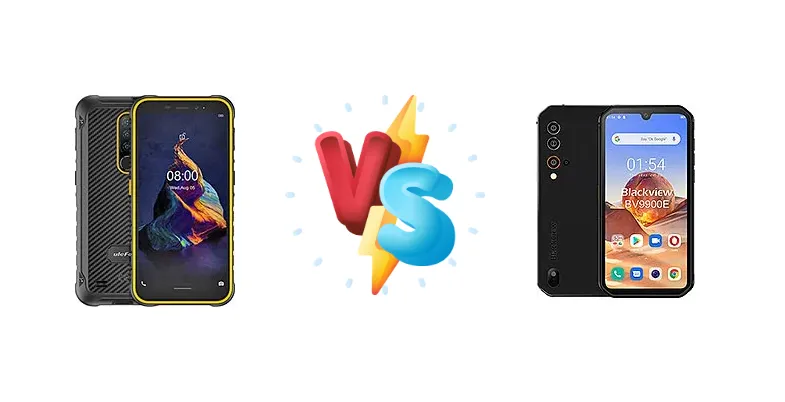
|
🏆 Quick Verdict
For the average user prioritizing affordability and basic functionality, the Ulefone Armor X8 is a viable option. However, the Blackview BV9900E is the clear winner for those needing more processing power for demanding apps, gaming, or future-proofing, justifying its higher price point with a significantly more capable Helio P90 chipset.
| PHONES | ||
|---|---|---|
| Phone Names | Ulefone Armor X8 | Blackview BV9900E |
| Network | ||
|---|---|---|
| 2G bands | GSM 850 / 900 / 1800 / 1900 | GSM 850 / 900 / 1800 / 1900 |
| 3G bands | HSDPA 850 / 900 / 1700(AWS) / 1900 / 2100 | HSDPA 800 / 850 / 900 / 1700(AWS) / 1900 / 2100 |
| 4G bands | 1, 2, 3, 4, 5, 7, 8, 12, 17, 19, 20, 28 | 1, 2, 3, 4, 5, 7, 8, 12, 13, 17, 18, 19, 20, 25, 26, 28, 34, 38, 39, 40, 41, 66 |
| Speed | HSPA 42.2/11.5 Mbps, LTE Cat6 300/150 Mbps | HSPA, LTE |
| Technology | GSM / HSPA / LTE | GSM / CDMA / HSPA / CDMA2000 / LTE |
| Launch | ||
|---|---|---|
| Announced | 2020, October 06. Released 2020, October 06 | 2020, September 10. Released 2020, September |
| Status | Discontinued | Discontinued |
| Body | ||
|---|---|---|
| Dimensions | 160.3 x 79 x 13.8 mm (6.31 x 3.11 x 0.54 in) | 156.5 x 78.3 x 14.2 mm (6.16 x 3.08 x 0.56 in) |
| SIM | Nano-SIM + Nano-SIM | Nano-SIM + Nano-SIM |
| Weight | 256.3 g (9.03 oz) | 273 g (9.63 oz) |
| IP68/IP69K dust/water resistant (up to 1.5m for 30 mins) Drop-to-concrete resistance from up to 1.2 m MIL-STD-810G compliant | - | |
| Display | ||
|---|---|---|
| Protection | - | Corning Gorilla Glass 5 |
| Resolution | 720 x 1440 pixels, 18:9 ratio (~282 ppi density) | 1080 x 2280 pixels, 19:9 ratio (~432 ppi density) |
| Size | 5.7 inches, 83.8 cm2 (~66.2% screen-to-body ratio) | 5.84 inches, 85.1 cm2 (~69.5% screen-to-body ratio) |
| Type | IPS LCD | IPS LCD |
| Platform | ||
|---|---|---|
| CPU | Octa-core (4x1.8 GHz Cortex-A53 & 4x1.5 GHz Cortex-A53) | Octa-core (2x2.2 GHz Cortex-A75 & 6x2.0 GHz Cortex-A55) |
| Chipset | Mediatek MT6762D Helio A25 (12 nm) | Mediatek MT6779V/CE Helio P90 (12 nm) |
| GPU | PowerVR GE8320 | PowerVR GM9446 |
| OS | Android 10 | Android 10 |
| Memory | ||
|---|---|---|
| Card slot | microSDXC (uses shared SIM slot) | microSDXC |
| Internal | 64GB 4GB RAM | 128GB 6GB RAM |
| eMMC 5.1 | - | |
| Main Camera | ||
|---|---|---|
| Features | Dual-LED flash, HDR, panorama | LED flash, HDR, panorama |
| Quad | - | 48 MP, f/1.8, (wide), PDAF 16 MP, 120˚ (ultrawide) 2 MP (macro) Auxiliary lens |
| Triple | 13 MP, f/2.2, (wide), AF Auxiliary lenses | - |
| Video | 1080p@30fps | 4K@30fps, 1080p@60fps |
| Selfie camera | ||
|---|---|---|
| Single | 8 MP, f/2.4 | 16 MP, f/2.0, (wide) |
| Video | 1080p@30fps | 1080p@30fps |
| Sound | ||
|---|---|---|
| 3.5mm jack | Yes | - |
| 35mm jack | Yes | No |
| Loudspeaker | Yes | Yes |
| Comms | ||
|---|---|---|
| Bluetooth | 5.0, A2DP, LE | 5.0, A2DP, LE |
| NFC | Yes | Yes |
| Positioning | GPS, GLONASS, GALILEO, BDS | GPS, GLONASS, GALILEO, BDS |
| Radio | - | FM radio |
| USB | USB Type-C 2.0 | USB Type-C 2.0, OTG |
| WLAN | Wi-Fi 802.11 a/b/g/n/ac, Wi-Fi Direct | Wi-Fi 802.11 a/b/g/n/ac |
| Features | ||
|---|---|---|
| Sensors | Fingerprint (rear-mounted), accelerometer, proximity, compass | Fingerprint (side-mounted), accelerometer, gyro, proximity, compass, barometer |
| Battery | ||
|---|---|---|
| Charging | - | 15W wired 18W wireless |
| Type | Li-Po 5080 mAh | 4380 mAh |
| Misc | ||
|---|---|---|
| Colors | Black, Orange | Black, Silver |
| Price | About 130 EUR | About 260 EUR |
Ulefone Armor X8
- Most affordable option for a rugged phone.
- Durable build quality for basic use.
- Simple and easy-to-use interface.
- Limited processing power for demanding tasks.
- Likely lower-quality display.
- Slow charging speeds.
Blackview BV9900E
- Significantly faster processor for gaming and multitasking.
- Wireless charging for added convenience.
- Potentially better camera performance due to ISP.
- Higher price point.
- May have slightly shorter battery life under heavy load (depending on battery capacity).
- More complex software features may require a learning curve.
Display Comparison
Neither device’s display specifications are provided, so a direct comparison is limited. However, given the Armor X8’s positioning, it likely features a lower-resolution panel and narrower color gamut. The BV9900E, benefiting from its higher price, likely has a sharper display with better color accuracy. Both will prioritize durability over display fidelity, meaning expect thicker glass and potentially lower peak brightness to conserve battery.
Camera Comparison
Without detailed camera specs, analysis is limited. However, the BV9900E’s more powerful ISP (Image Signal Processor) within the Helio P90 chipset will likely result in superior image processing, better dynamic range, and improved low-light performance. While both phones may include multiple lenses, the processing power of the P90 will be crucial for extracting detail and reducing noise. The Armor X8 will likely rely heavily on software processing, potentially leading to over-sharpened or artificial-looking images.
Performance
The core difference lies in the chipsets. The Ulefone Armor X8’s MediaTek Helio A25 is a 12nm processor with a Cortex-A53 based octa-core configuration. This is geared towards basic tasks. The Blackview BV9900E’s Helio P90, also 12nm, utilizes a more advanced architecture: two Cortex-A75 cores for performance and six Cortex-A55 cores for efficiency. This translates to a substantial performance advantage for the BV9900E, particularly in multi-threaded applications and gaming. The A75 cores offer significantly higher single-core performance, impacting app launch speeds and responsiveness. The BV9900E will handle demanding games and multitasking with ease, while the Armor X8 will struggle with graphically intensive titles.
Battery Life
Battery capacity isn’t specified for either device. However, the BV9900E’s 15W wired and 18W wireless charging capabilities offer a significant convenience advantage. The Armor X8 likely relies solely on slower wired charging. While a larger battery capacity on the Armor X8 could offset the slower charging, the P90’s more efficient architecture in the BV9900E could result in comparable or even better real-world battery life despite a potentially smaller capacity. Wireless charging is a key differentiator for the BV9900E, appealing to users who prefer cable-free convenience.
Buying Guide
Buy the Ulefone Armor X8 if you need a highly affordable, extremely durable phone for essential communication – calls, texts, and basic navigation. It’s ideal for users who prioritize longevity and don’t require intensive app usage. Buy the Blackview BV9900E if you prefer a rugged phone capable of handling demanding tasks like gaming, video editing, or running multiple apps simultaneously, and if you value the convenience of wireless charging.