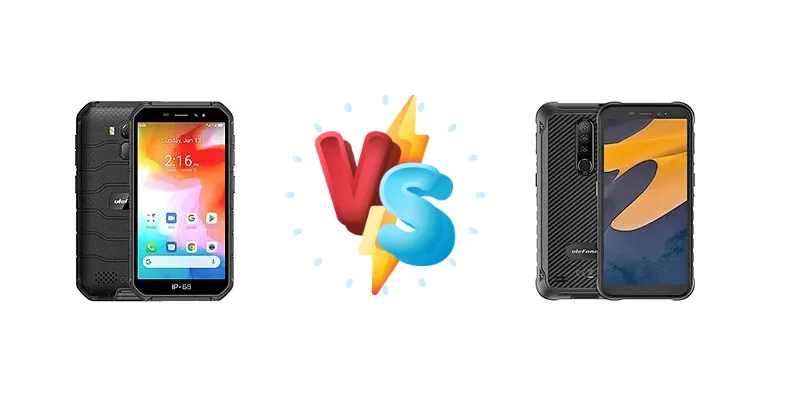
Ulefone's Armor series consistently delivers durable, affordable smartphones. The Armor X7 and X8i represent entry points into this rugged ecosystem, but a key difference lies under the hood. While both prioritize toughness, the X8i introduces a newer chipset, the Helio A25, promising improved performance over the X7’s Helio A20. This comparison dissects these differences to determine which phone offers the best value for users needing a resilient device.
🏆 Quick Verdict
For most users, the Ulefone Armor X8i is the better choice. The Helio A25’s octa-core configuration provides a noticeable performance uplift over the X7’s quad-core A20, resulting in smoother multitasking and app loading. While the X7 remains a viable option for basic use, the X8i’s extra processing power justifies the potential price difference.
| Network |
|---|
| 2G bands | GSM 850 / 900 / 1800 / 1900 | GSM 850 / 900 / 1800 / 1900 |
| 3G bands | HSDPA 850 / 900 / 1700(AWS) / 1900 / 2100 | HSDPA 850 / 900 / 1700(AWS) / 1900 / 2100 |
| 4G bands | 1, 2, 3, 4, 5, 7, 8, 12, 17, 19, 20 | 1, 2, 3, 4, 5, 7, 8, 12, 17, 19, 20, 28 |
| Speed | HSPA 42.2/11.5 Mbps, LTE Cat6 300/150 Mbps | HSPA 21.1/5.76 Mbps, LTE Cat7 300/150 Mbps |
| Technology | GSM / HSPA / LTE | GSM / HSPA / LTE |
| | - | eMMC 5.1 |
| Launch |
|---|
| Announced | 2020, March 19. Released 2020, March 19 | 2021, September 23 |
| Status | Discontinued | Available. Released 2021, September 23 |
| Body |
|---|
| Dimensions | 150 x 78.9 x 14.6 mm (5.91 x 3.11 x 0.57 in) | 160.3 x 79 x 13.8 mm (6.31 x 3.11 x 0.54 in) |
| SIM | Nano-SIM + Nano-SIM | Nano-SIM + Nano-SIM |
| Weight | 234 g (8.25 oz) | 256 g (9.03 oz) |
| | IP68/IP69K dust/water resistant (up to 1.5m for 30 mins)
Drop-to-concrete resistance from up to 1.2 m
MIL-STD-810G compliant | IP68/IP69K dust/water resistant (up to 1.5m for 30 min)
Drop-to-concrete resistance from up to 1.2m
MIL-STD-810G compliant |
| Display |
|---|
| Resolution | 720 x 1280 pixels, 16:9 ratio (~294 ppi density) | 720 x 1440 pixels, 18:9 ratio (~282 ppi density) |
| Size | 5.0 inches, 68.9 cm2 (~58.2% screen-to-body ratio) | 5.7 inches, 83.8 cm2 (~66.2% screen-to-body ratio) |
| Type | IPS LCD | IPS LCD |
| Platform |
|---|
| CPU | Quad-core 1.8 GHz Cortex-A53 | Octa-core (4x1.8 GHz Cortex-A53 & 4x1.5 GHz Cortex-A53) |
| Chipset | Mediatek MT6761 Helio A20 (12 nm) | Mediatek MT6762D Helio A25 (12 nm) |
| GPU | PowerVR GE8320 | PowerVR GE8320 |
| OS | Android 10 | Android 11 |
| Memory |
|---|
| Card slot | microSDXC (uses shared SIM slot) | microSDXC (uses shared SIM slot) |
| Internal | 16GB 2GB RAM | 32GB 3GB RAM |
| | eMMC 5.1 | - |
| Main Camera |
|---|
| Features | Dual-LED flash | Dual-LED flash, HDR, panorama |
| Single | 13 MP, f/2.2, (wide), AF | 8 MP, f/2.4 |
| Triple | - | 13 MP, f/2.2, (wide), AF
Auxiliary lenses |
| Video | 1080p@30fps | 1080p@30fps |
| Selfie camera |
|---|
| Single | 5 MP, f/2.2 | 8 MP, f/2.4 |
| Video | 720p@30fps | 1080p@30fps |
| Sound |
|---|
| 3.5mm jack | Yes | Yes |
| 35mm jack | Yes | Yes |
| Loudspeaker | Yes | Yes |
| Comms |
|---|
| Bluetooth | 5.0, A2DP, LE | 5.0, A2DP, LE |
| NFC | Yes | Yes |
| Positioning | GPS, GLONASS, GALILEO | GPS, GLONASS, GALILEO, BDS |
| Radio | FM radio | FM radio, RDS, recording |
| USB | microUSB 2.0 | USB Type-C 2.0 |
| WLAN | Wi-Fi 802.11 a/b/g/n/ac, Wi-Fi Direct | Wi-Fi 802.11 a/b/g/n/ac, Wi-Fi Direct |
| Features |
|---|
| Sensors | Fingerprint (rear-mounted), accelerometer, proximity, compass | Fingerprint (rear-mounted), accelerometer, proximity, compass |
| Battery |
|---|
| Charging | - | 10W wired |
| Type | Li-Po 4000 mAh | Li-Po 5080 mAh |
| Misc |
|---|
| Colors | Black, Orange | Black, Orange, Red |
| Price | About 80 EUR | About 150 EUR |
Ulefone Armor X7
- Potentially lower price point
- Rugged design for durability
- Sufficient for basic smartphone tasks
- Slower performance due to quad-core processor
- Less responsive multitasking
- May struggle with demanding apps
Ulefone Armor X8i
- Faster performance with octa-core processor
- Smoother multitasking and app loading
- Improved responsiveness for everyday use
- Potentially higher price
- Slow 10W charging
- Camera performance likely similar to X7
Display Comparison
Neither Ulefone provides detailed display specifications beyond resolution. Given their price point, expect IPS LCD panels with modest brightness levels. The focus here isn't on visual fidelity, but on durability and readability in outdoor conditions. Bezels are likely to be substantial on both models, prioritizing screen protection. Color accuracy is unlikely to be a strong suit for either device.
Camera Comparison
Both phones likely feature similar camera setups, with a primary sensor and potentially a secondary depth or macro lens. However, Ulefone’s marketing materials rarely highlight camera prowess in this segment. Expect image quality to be adequate in good lighting conditions, but struggle in low light. The focus is on functionality rather than photographic excellence. Any 2MP macro lens included on either device should be considered a marketing feature rather than a genuinely useful camera component.
Performance
The core difference between these phones is the chipset. The Ulefone Armor X7 utilizes the Mediatek Helio A20, a quad-core processor clocked at 1.8 GHz. The Armor X8i steps up to the Helio A25, featuring an octa-core configuration – four cores at 1.8 GHz and four at 1.5 GHz. This architectural shift is significant. While both use Cortex-A53 cores, the additional cores in the A25 allow for better parallel processing, leading to faster app launches, smoother multitasking, and improved responsiveness. The X8i will handle more demanding applications with greater ease, making it the preferable choice for users who aren't solely focused on basic communication.
Battery Life
Battery capacity isn't specified, but both phones likely house batteries in the 3000-4000 mAh range, typical for rugged devices in this price bracket. The X8i includes 10W wired charging, which is relatively slow by modern standards. However, given the likely modest power draw of the Helio A25, 10W charging should be sufficient to replenish the battery overnight. The X7, lacking specific charging information, likely offers a similar charging experience. Battery life will largely depend on usage patterns, but the X8i’s more efficient chipset could translate to slightly longer runtimes.
Buying Guide
Buy the Ulefone Armor X7 if you prioritize absolute affordability and only need a phone for essential tasks like calls, texts, and light web browsing. Its Helio A20 is sufficient for these basic functions. Buy the Ulefone Armor X8i if you anticipate heavier usage, including social media, occasional gaming, or running multiple apps simultaneously. The Helio A25’s octa-core architecture will deliver a significantly improved user experience.
Frequently Asked Questions
❓ Will the Ulefone Armor X8i handle popular games like PUBG Mobile?
While the Helio A25 isn't a gaming powerhouse, the X8i should be able to run PUBG Mobile at lower graphics settings. Expect frame rate dips during intense action, but it will be playable. The X7 would likely struggle to provide a consistently smooth gaming experience.
❓ Is the ruggedness of the Armor X8i and X7 comparable?
Yes, both phones are built to withstand drops, dust, and water exposure. Ulefone’s Armor series is known for its robust construction, and both the X7 and X8i adhere to similar durability standards. The specific IP rating isn't provided, but they are designed for demanding environments.
❓ Does the Ulefone Armor X8i support NFC for contactless payments?
Neither Ulefone's official specifications nor typical marketing materials for these models indicate NFC support. It's highly unlikely that either device includes this feature, focusing instead on core rugged functionality.