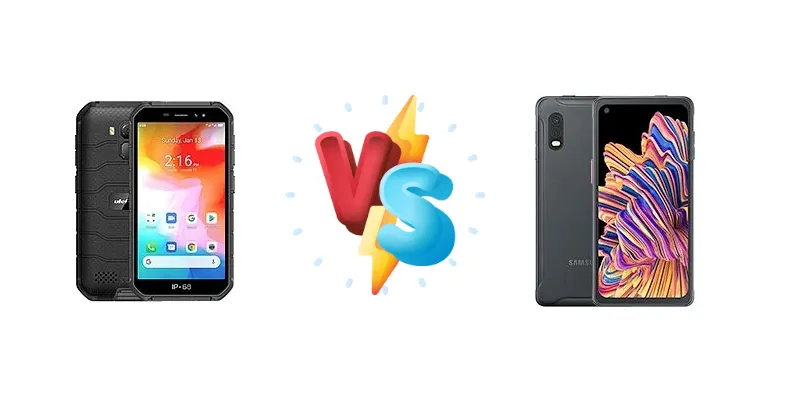
The rugged phone market caters to a specific need: durability. But within that niche, choices vary wildly in price and performance. We pit the Ulefone Armor X7, a budget-friendly option, against the Samsung Galaxy XCover Pro, a more established and powerful contender, to determine which best balances toughness with usability.
🏆 Quick Verdict
For users prioritizing affordability and basic functionality, the Ulefone Armor X7 offers a compelling entry point into the rugged phone world. However, the Samsung Galaxy XCover Pro’s significantly more powerful Exynos 9611 chipset and faster charging make it the superior choice for professionals and users demanding sustained performance.
| Network |
|---|
| 2G bands | GSM 850 / 900 / 1800 / 1900 | GSM 850 / 900 / 1800 / 1900 |
| 3G bands | HSDPA 850 / 900 / 1700(AWS) / 1900 / 2100 | HSDPA 850 / 900 / 1900 / 2100 - International |
| 4G bands | 1, 2, 3, 4, 5, 7, 8, 12, 17, 19, 20 | 1, 2, 3, 5, 7, 8, 20, 28, 38, 40, 41 - International |
| Speed | HSPA 42.2/11.5 Mbps, LTE Cat6 300/150 Mbps | HSPA 42.2/5.76 Mbps, LTE (3CA) Cat11 600/50 Mbps |
| Technology | GSM / HSPA / LTE | GSM / HSPA / LTE |
| | - | 1, 2, 3, 4, 5, 7, 12, 13, 14, 20, 29, 38, 40, 41, 66 - Canada |
| Launch |
|---|
| Announced | 2020, March 19. Released 2020, March 19 | 2020, January |
| Status | Discontinued | Available. Released 2020, January |
| Body |
|---|
| Dimensions | 150 x 78.9 x 14.6 mm (5.91 x 3.11 x 0.57 in) | 159.9 x 76.7 x 10 mm (6.30 x 3.02 x 0.39 in) |
| SIM | Nano-SIM + Nano-SIM | · Nano-SIM· Nano-SIM + Nano-SIM |
| Weight | 234 g (8.25 oz) | 218 g (7.69 oz) |
| | IP68/IP69K dust/water resistant (up to 1.5m for 30 mins)
Drop-to-concrete resistance from up to 1.2 m
MIL-STD-810G compliant | IP68 dust/water resistant (up to 1.5m for 35 min)
Drop-to-concrete resistance from up to 1.5m
MIL-STD-810G compliant*
*does not guarantee ruggedness or use in extreme conditions |
| Display |
|---|
| Protection | - | Corning Gorilla Glass 5 |
| Resolution | 720 x 1280 pixels, 16:9 ratio (~294 ppi density) | 1080 x 2340 pixels, 19.5:9 ratio (~409 ppi density) |
| Size | 5.0 inches, 68.9 cm2 (~58.2% screen-to-body ratio) | 6.3 inches, 97.4 cm2 (~79.4% screen-to-body ratio) |
| Type | IPS LCD | IPS LCD |
| Platform |
|---|
| CPU | Quad-core 1.8 GHz Cortex-A53 | Octa-core (4x2.3 GHz Cortex-A73 & 4x1.7 GHz Cortex-A53) |
| Chipset | Mediatek MT6761 Helio A20 (12 nm) | Exynos 9611 (10 nm) |
| GPU | PowerVR GE8320 | Mali-G72 MP3 |
| OS | Android 10 | Android 10, upgradable to Android 13, One UI 5 |
| Memory |
|---|
| Card slot | microSDXC (uses shared SIM slot) | microSDXC (dedicated slot) |
| Internal | 16GB 2GB RAM | 64GB 4GB RAM |
| | eMMC 5.1 | - |
| Main Camera |
|---|
| Dual | - | 25 MP, f/1.7, 26mm (wide), PDAF
8 MP, f/2.2, 123˚ (ultrawide), 1/4.0", 1.12µm |
| Features | Dual-LED flash | Dual-LED flash, HDR, panorama |
| Single | 13 MP, f/2.2, (wide), AF | - |
| Video | 1080p@30fps | 1080p@30fps |
| Selfie camera |
|---|
| Features | - | HDR |
| Single | 5 MP, f/2.2 | 13 MP, f/2.0, (wide), 1/3.1", 1.12µm |
| Video | 720p@30fps | 1080p@30fps |
| Sound |
|---|
| 3.5mm jack | Yes | Yes |
| 35mm jack | Yes | Yes |
| Loudspeaker | Yes | Yes |
| Comms |
|---|
| Bluetooth | 5.0, A2DP, LE | 5.0, A2DP, LE |
| NFC | Yes | Yes |
| Positioning | GPS, GLONASS, GALILEO | GPS, GLONASS, GALILEO, BDS |
| Radio | FM radio | FM radio (market/region dependent) |
| USB | microUSB 2.0 | USB Type-C 2.0 |
| WLAN | Wi-Fi 802.11 a/b/g/n/ac, Wi-Fi Direct | Wi-Fi 802.11 a/b/g/n/ac/k/v/r, dual-band, Wi-Fi Direct |
| Features |
|---|
| Sensors | Fingerprint (rear-mounted), accelerometer, proximity, compass | Fingerprint (side-mounted), accelerometer, gyro, proximity, compass |
| | - | ANT+ |
| Battery |
|---|
| Charging | - | 15W wired |
| Type | Li-Po 4000 mAh | Li-Po 4050 mAh, removable |
| Misc |
|---|
| Colors | Black, Orange | Black |
| Models | - | SM-G715FN/DS, SM-G715FN, SM-G715F, SM-G715W, SM-G715U, SM-G715U1 |
| Price | About 80 EUR | About 120 EUR |
| SAR EU | - | 0.47 W/kg (head) 1.23 W/kg (body) |
Ulefone Armor X7
- Significantly lower price point
- Potentially longer standby time (depending on battery capacity)
- Rugged design for basic protection
- Weak processor performance
- Likely limited camera quality
- Slower charging (estimated)
Samsung Galaxy XCover Pro
- Powerful Exynos 9611 processor
- Faster 15W charging
- More refined software experience
- Higher price
- Potentially shorter battery life under heavy load
- Still a mid-range camera system
Display Comparison
Neither device boasts a cutting-edge display. Details on panel type (IPS vs. TFT) and resolution are missing for the Ulefone, but given its price point, it's likely a lower-resolution TFT. The Samsung XCover Pro, while not specified, likely uses an IPS panel for better viewing angles. The key difference isn't display quality, but likely durability; both are designed to withstand drops, but specifics on glass type (Gorilla Glass version) are absent for both. Bezels are expected to be substantial on both, prioritizing screen protection over a modern, edge-to-edge design.
Camera Comparison
Camera specs are where details become sparse for the Ulefone. The Samsung Galaxy XCover Pro’s camera system, while not flagship-level, is likely more capable due to its image signal processor (ISP) integrated within the Exynos 9611. The Ulefone likely relies on basic software processing. The presence of a 2MP macro camera on the Ulefone is largely a marketing tactic; its limited resolution offers minimal practical benefit. Focusing on the main sensor, the Exynos’s ISP will likely deliver better dynamic range and noise reduction, especially in challenging lighting conditions.
Performance
The performance gap is substantial. The Ulefone Armor X7’s MediaTek Helio A20, a quad-core Cortex-A53 processor built on a 12nm process, is geared towards basic tasks. The Samsung Galaxy XCover Pro’s Exynos 9611, an octa-core chip (4x2.3 GHz Cortex-A73 & 4x1.7 GHz Cortex-A53) fabricated on a more efficient 10nm node, delivers significantly more processing power. The Cortex-A73 cores in the Exynos provide a noticeable advantage in app loading times, multitasking, and handling demanding applications. While both utilize Cortex-A53 cores, the Exynos’s higher clock speeds and core count provide a clear advantage. The 10nm process also contributes to better thermal efficiency, reducing the likelihood of throttling under sustained load.
Battery Life
Battery capacity isn’t specified for the Ulefone, but rugged phones generally prioritize long battery life. The Samsung Galaxy XCover Pro supports 15W wired charging, a moderate speed. The Ulefone’s charging speed is unknown, but likely slower. While a larger battery capacity on the Ulefone might offer longer standby time, the Exynos 9611’s more efficient 10nm process could offset a smaller battery capacity in real-world usage, especially with moderate to heavy app usage. The 15W charging on the Samsung will provide a quicker top-up when needed.
Buying Guide
Buy the Ulefone Armor X7 if you need a highly durable phone for occasional outdoor use, prioritize battery life over speed, and are on a strict budget. Buy the Samsung Galaxy XCover Pro if you require a robust device for demanding work environments, need faster processing for apps and multitasking, and value Samsung’s software ecosystem and faster 15W charging.
Frequently Asked Questions
❓ Does the Exynos 9611 in the Galaxy XCover Pro tend to overheat during prolonged use, like extended navigation or video recording?
The Exynos 9611 is a mid-range chip, but its 10nm process and the XCover Pro’s design should mitigate significant overheating. While it may get warm during intensive tasks, it’s unlikely to throttle performance severely unless exposed to extreme ambient temperatures. The Ulefone’s Helio A20 is less powerful and therefore less prone to overheating, but also less capable of handling sustained workloads.
❓ Is the 2MP macro camera on the Ulefone Armor X7 actually useful for taking detailed close-up photos?
Unfortunately, no. A 2MP sensor lacks the resolution and detail needed for truly impressive macro photography. It’s primarily a marketing feature and will likely produce blurry, low-quality images. The Samsung XCover Pro, while not boasting a dedicated macro lens, can likely achieve better close-up results using its main sensor and digital zoom.
❓ Can the Samsung Galaxy XCover Pro handle demanding games like PUBG Mobile at high frame rates (60fps or higher)?
The Exynos 9611 can run PUBG Mobile, but achieving consistently high frame rates (60fps+) will depend on the graphics settings. Expect to play at medium settings for a smoother experience. The Ulefone Armor X7’s Helio A20 will struggle to run PUBG Mobile smoothly, even at the lowest settings.