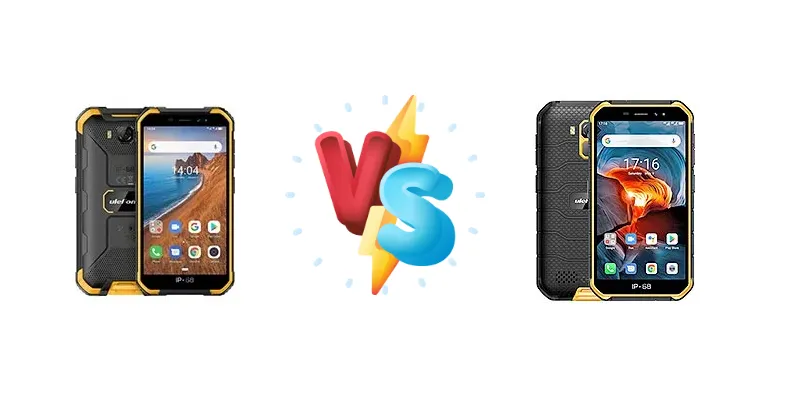
Ulefone's Armor series consistently targets the budget-friendly rugged phone market. The Armor X6 and X7 Pro represent two generations of this approach. While both offer durability, a significant difference lies under the hood. This comparison dissects the chipset and architectural improvements of the X7 Pro to determine if the upgrade justifies the cost for users prioritizing performance and efficiency.
🏆 Quick Verdict
For most users, the Ulefone Armor X7 Pro is the superior choice. Its Helio A20 chipset, built on a 12nm process, delivers a noticeable performance boost over the X6’s older 28nm MT6580, translating to smoother multitasking and a more responsive user experience. While both are rugged, the X7 Pro offers a more future-proof platform.
| Network |
|---|
| 2G bands | GSM 850 / 900 / 1800 / 1900 | GSM 850 / 900 / 1800 / 1900 |
| 3G bands | HSDPA 850 / 900 / 1700(AWS) / 1900 / 2100 | HSDPA 850 / 900 / 1700(AWS) / 1900 / 2100 |
| 4G bands | - | 1, 2, 3, 4, 5, 7, 8, 12, 17, 19, 20 |
| Speed | HSPA 42.2/11.5 Mbps | HSPA 42.2/11.5 Mbps, LTE Cat6 300/150 Mbps |
| Technology | GSM / HSPA | GSM / HSPA / LTE |
| Launch |
|---|
| Announced | 2019, December. Released 2019, December | 2020, June 08. Released 2020, June 08 |
| Status | Discontinued | Discontinued |
| Body |
|---|
| Dimensions | 150 x 78.9 x 14.4 mm (5.91 x 3.11 x 0.57 in) | 150 x 78.9 x 14.6 mm (5.91 x 3.11 x 0.57 in) |
| SIM | Nano-SIM + Nano-SIM | Nano-SIM + Nano-SIM |
| Weight | 223.8 g (7.90 oz) | 234 g (8.25 oz) |
| | IP68 dust/water resistant (up to 1.5m for 30 mins)
Drop-to-concrete resistance from up to 1.2 m
MIL-STD-810G compliant | IP68/IP69K dust/water resistant (up to 1.5m for 30 mins)
Drop-to-concrete resistance from up to 1.2 m
MIL-STD-810G compliant |
| Display |
|---|
| Resolution | 720 x 1280 pixels, 16:9 ratio (~294 ppi density) | 720 x 1280 pixels, 16:9 ratio (~294 ppi density) |
| Size | 5.0 inches, 68.9 cm2 (~58.2% screen-to-body ratio) | 5.0 inches, 68.9 cm2 (~58.2% screen-to-body ratio) |
| Type | IPS LCD | IPS LCD |
| Platform |
|---|
| CPU | Quad-core 1.3 GHz Cortex-A7 | Quad-core 1.8 GHz Cortex-A53 |
| Chipset | Mediatek MT6580 (28 nm) | Mediatek MT6761 Helio A20 (12 nm) |
| GPU | Mali-400 | PowerVR GE8320 |
| OS | Android 9.0 (Pie) | Android 10 |
| Memory |
|---|
| Card slot | microSDXC (uses shared SIM slot) | microSDXC (uses shared SIM slot) |
| Internal | 16GB 2GB RAM | 32GB 4GB RAM |
| | eMMC 5.1 | eMMC 5.1 |
| Main Camera |
|---|
| Dual | - | 13 MP, f/2.2, (wide), AF
Auxiliary lens |
| Features | Dual-LED flash | Dual-LED flash |
| Single | 8 MP, f/2.2, (wide), AF | - |
| Video | 720p@30fps | 1080p@30fps |
| Selfie camera |
|---|
| Single | 5 MP | 5 MP, f/2.2 |
| Video | 720p@30fps | 720p@30fps |
| Sound |
|---|
| 3.5mm jack | Yes | Yes |
| 35mm jack | Yes | Yes |
| Loudspeaker | Yes | Yes |
| Comms |
|---|
| Bluetooth | 4.0, A2DP | 5.0, A2DP, LE |
| NFC | No | Yes |
| Positioning | GPS | GPS, GLONASS, GALILEO |
| Radio | Stereo FM radio, RDS, recording | FM radio |
| USB | microUSB 2.0 | microUSB 2.0 |
| WLAN | Wi-Fi 802.11 b/g/n | Wi-Fi 802.11 a/b/g/n/ac, Wi-Fi Direct |
| Features |
|---|
| Sensors | Accelerometer, proximity, compass | Fingerprint (rear-mounted), accelerometer, proximity, compass |
| Battery |
|---|
| Type | Li-Po 4000 mAh | Li-Po 4000 mAh |
| Misc |
|---|
| Colors | Black | Black, Orange |
| Price | - | About 110 EUR |
| SAR | - | 0.80 W/kg (head) 0.79 W/kg (body) |
Ulefone Armor X6
- Lower price point (likely)
- Rugged build quality
- Simple and easy to use
- Outdated chipset
- Poor performance for multitasking
- Limited app compatibility
Ulefone Armor X7 Pro
- More powerful and efficient chipset
- Improved multitasking capabilities
- Better long-term software support (potentially)
- Higher price point
- Still a budget device with limitations
- Camera quality likely remains basic
Display Comparison
Neither Ulefone provides detailed display specifications in the provided data. However, given their market segment, both likely utilize IPS LCD panels. The key difference isn't display quality, but the chipset's ability to efficiently drive it. The X7 Pro’s Helio A20, with its improved GPU, will likely offer a smoother experience when scrolling and navigating the UI, even if the resolution and panel type are similar. Expect both to struggle in direct sunlight.
Camera Comparison
Without detailed camera specs, a direct comparison is difficult. Both phones likely feature basic camera setups geared towards functional photography rather than high-quality imaging. The presence of a 2MP macro camera on either device is largely a marketing tactic, offering limited practical benefit due to the low resolution. The X7 Pro’s more powerful chipset *could* enable slightly better image processing, but the primary determinant of image quality will be the main sensor, which is not specified in the provided data.
Performance
The core of the difference lies in the chipsets. The Ulefone Armor X6’s Mediatek MT6580, built on a 28nm process, features a quad-core 1.3 GHz Cortex-A7 CPU. This is an older architecture, known for its limited performance and efficiency. The Armor X7 Pro steps up to the Mediatek MT6761 Helio A20, fabricated on a more efficient 12nm process, and boasting a quad-core 1.8 GHz Cortex-A53 CPU. The A53 architecture represents a significant improvement over the A7, offering better performance per clock cycle. The 12nm process further enhances efficiency, reducing heat and improving battery life. This translates to a more responsive user experience, faster app loading times, and the ability to handle more demanding tasks on the X7 Pro.
Battery Life
Battery capacity isn't specified for either device. However, the X7 Pro’s more efficient 12nm Helio A20 chipset will undoubtedly contribute to longer battery life compared to the X6’s power-hungry 28nm MT6580. Even with a similar battery capacity, the X7 Pro will likely achieve significantly more screen-on time. Charging wattage is also unknown, but the chipset’s power management capabilities could also influence charging speeds.
Buying Guide
Buy the Ulefone Armor X6 if you need an extremely basic, durable phone for essential communication and are on a very tight budget. It’s suitable for users who primarily make calls, send texts, and require a phone that can withstand harsh conditions without demanding performance. Buy the Ulefone Armor X7 Pro if you prefer a more responsive device capable of handling light multitasking, occasional gaming, and benefit from improved power efficiency, making it ideal for outdoor workers or adventurers who rely on their phone throughout the day.
Frequently Asked Questions
❓ Will the Helio A20 in the Ulefone Armor X7 Pro handle popular games like PUBG Mobile?
While the Helio A20 can run PUBG Mobile, expect to play at low to medium settings with reduced frame rates. It's not a gaming-focused chipset, and demanding titles will likely experience lag and stuttering. The X6’s MT6580 would struggle even more.
❓ Is the Ulefone Armor X7 Pro a significant upgrade for someone coming from the Armor X6 for everyday tasks like browsing and social media?
Yes, the X7 Pro offers a noticeably smoother experience for everyday tasks. The faster CPU and more efficient architecture result in quicker app loading times, smoother scrolling, and less lag when switching between applications. The X6’s older chipset will feel sluggish in comparison.
❓ Does the Ulefone Armor X7 Pro support VoLTE and 4G LTE bands compatible with US carriers?
Ulefone's compatibility with US carriers can be inconsistent. It's crucial to check the specific LTE bands supported by the X7 Pro against your carrier's network before purchasing. The MT6761 Helio A20 *generally* supports a wider range of bands than the MT6580, but verification is essential.