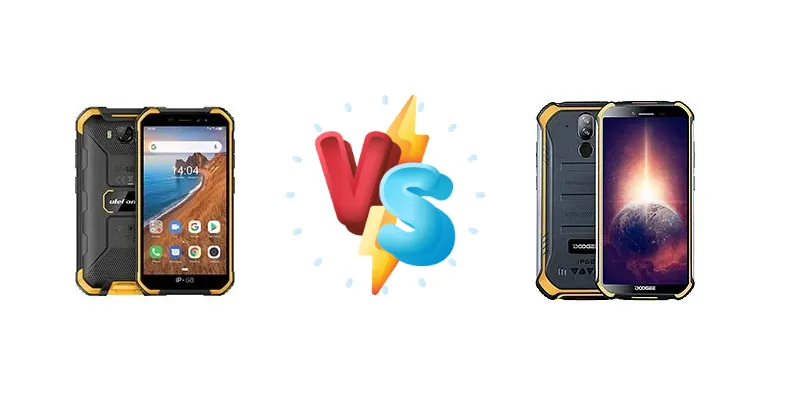
The Ulefone Armor X6 and Doogee S40 Pro represent the entry-level segment of the rugged smartphone market, catering to users needing durability without a flagship price tag. However, significant differences in their underlying hardware dictate vastly different user experiences, particularly regarding performance and efficiency. This comparison dissects these differences to determine which device offers the best balance for demanding tasks and everyday use.
🏆 Quick Verdict
For the average user prioritizing responsiveness and future-proofing, the Doogee S40 Pro is the clear winner. Its Helio A25 chipset, built on a more efficient 12nm process, provides a substantial performance uplift over the Ulefone Armor X6’s aging MT6580. While both offer rugged builds, the S40 Pro’s modern processor makes it the more capable daily driver.
| Network |
|---|
| 2G bands | GSM 850 / 900 / 1800 / 1900 | GSM 850 / 900 / 1800 / 1900 |
| 3G bands | HSDPA 850 / 900 / 1700(AWS) / 1900 / 2100 | HSDPA 900 / 2100 |
| 4G bands | - | 1, 3, 7, 8, 20 |
| Speed | HSPA 42.2/11.5 Mbps | HSPA, LTE |
| Technology | GSM / HSPA | GSM / HSPA / LTE |
| Launch |
|---|
| Announced | 2019, December. Released 2019, December | 2020, July 17. Released 2020, July |
| Status | Discontinued | Discontinued |
| Body |
|---|
| Dimensions | 150 x 78.9 x 14.4 mm (5.91 x 3.11 x 0.57 in) | 158.2 x 79.4 x 14.1 mm (6.23 x 3.13 x 0.56 in) |
| SIM | Nano-SIM + Nano-SIM | Nano-SIM + Nano-SIM |
| Weight | 223.8 g (7.90 oz) | 238 g (8.40 oz) |
| | IP68 dust/water resistant (up to 1.5m for 30 mins)
Drop-to-concrete resistance from up to 1.2 m
MIL-STD-810G compliant | - |
| Display |
|---|
| Protection | - | Corning Gorilla Glass |
| Resolution | 720 x 1280 pixels, 16:9 ratio (~294 ppi density) | 720 x 1440 pixels, 18:9 ratio (~295 ppi density) |
| Size | 5.0 inches, 68.9 cm2 (~58.2% screen-to-body ratio) | 5.45 inches, 76.7 cm2 (~61.0% screen-to-body ratio) |
| Type | IPS LCD | IPS LCD |
| Platform |
|---|
| CPU | Quad-core 1.3 GHz Cortex-A7 | Octa-core (4x1.8 GHz Cortex-A53 & 4x1.5 GHz Cortex-A53) |
| Chipset | Mediatek MT6580 (28 nm) | Mediatek MT6762 Helio A25 (12 nm) |
| GPU | Mali-400 | PowerVR GE8320 |
| OS | Android 9.0 (Pie) | Android 10 |
| Memory |
|---|
| Card slot | microSDXC (uses shared SIM slot) | microSDXC (uses shared SIM slot) |
| Internal | 16GB 2GB RAM | 64GB 4GB RAM |
| | eMMC 5.1 | - |
| Main Camera |
|---|
| Dual | - | 13 MP, f/2.8, (wide)
Auxiliary lens |
| Features | Dual-LED flash | LED flash |
| Single | 8 MP, f/2.2, (wide), AF | - |
| Video | 720p@30fps | 1080p |
| Selfie camera |
|---|
| Single | 5 MP | 5 MP, f/2.8, (wide) |
| Video | 720p@30fps | Yes |
| Sound |
|---|
| 3.5mm jack | Yes | - |
| 35mm jack | Yes | Yes |
| Loudspeaker | Yes | Yes |
| Comms |
|---|
| Bluetooth | 4.0, A2DP | 5.0, A2DP, LE |
| NFC | No | Yes |
| Positioning | GPS | GPS, GLONASS, GALILEO, BDS |
| Radio | Stereo FM radio, RDS, recording | FM radio |
| USB | microUSB 2.0 | microUSB 2.0, OTG |
| WLAN | Wi-Fi 802.11 b/g/n | Wi-Fi 802.11 a/b/g/n |
| Features |
|---|
| Sensors | Accelerometer, proximity, compass | Fingerprint (rear-mounted), accelerometer, proximity, compass |
| Battery |
|---|
| Charging | - | 10W wired |
| Type | Li-Po 4000 mAh | 4650 mAh |
| Misc |
|---|
| Colors | Black | Black, Orange, Green |
| Price | - | About 150 EUR |
Ulefone Armor X6
- Extremely affordable price point
- Rugged build quality for basic protection
- Simple and straightforward Android experience
- Outdated and slow MT6580 processor
- Limited multitasking capabilities
- Poor camera performance expected
Doogee S40 Pro
- More powerful and efficient Helio A25 chipset
- Improved multitasking and app responsiveness
- Better potential for software updates
- Only 10W wired charging
- Display specifications are unknown
- Still a budget device with limitations
Display Comparison
Neither Ulefone nor Doogee provide detailed display specifications for these models. Given their price points, it’s safe to assume both utilize IPS LCD panels with modest resolutions (likely 720p+). The lack of information prevents a direct comparison of brightness or color accuracy. However, the S40 Pro’s newer chipset *could* support a slightly higher refresh rate, though this is speculative. Bezels are likely substantial on both devices, prioritizing durability over a modern, edge-to-edge design.
Camera Comparison
Detailed camera specifications are scarce for both devices. It’s reasonable to expect both feature a primary camera and potentially a secondary depth or macro sensor. However, the image processing capabilities are likely limited by the respective chipsets. The S40 Pro’s Helio A25 offers a more powerful ISP (Image Signal Processor), potentially resulting in better image quality, particularly in low-light conditions. The Ulefone’s older chipset will struggle with complex image processing tasks. Any 2MP macro sensors on either device should be considered marketing filler rather than a genuine photographic asset.
Performance
The core difference lies in the chipsets. The Ulefone Armor X6’s Mediatek MT6580, a 28nm quad-core processor, is demonstrably slower and less efficient than the Doogee S40 Pro’s Mediatek MT6762 Helio A25. The Helio A25’s octa-core configuration (4x1.8 GHz Cortex-A53 & 4x1.5 GHz Cortex-A53) provides significantly improved multi-tasking capabilities and smoother app launches. The 12nm fabrication process of the Helio A25 also translates to better thermal management and battery life compared to the older 28nm MT6580. Users will notice a substantial difference in responsiveness when navigating the UI and running applications on the S40 Pro.
Battery Life
Battery capacity isn’t specified for either device, but rugged phones typically prioritize long battery life. The Doogee S40 Pro benefits from the more efficient Helio A25 chipset, which will consume less power during typical usage. While the S40 Pro only supports 10W wired charging, the improved efficiency means it may achieve a full charge in a comparable timeframe to the X6, even if the X6 had a slightly larger battery capacity. The real-world impact of the A25’s efficiency will be noticeable in extended standby times and longer usage between charges.
Buying Guide
Buy the Ulefone Armor X6 if you need a supremely basic, ultra-affordable rugged phone for essential communication and minimal app usage – think construction workers needing a durable call device. Buy the Doogee S40 Pro if you prefer a more responsive experience for light multitasking, media consumption, and occasional gaming, and value a more modern chipset for better software support and longevity.
Frequently Asked Questions
❓ Will the Helio A25 in the Doogee S40 Pro struggle with demanding games like PUBG Mobile?
While the Helio A25 isn't a gaming powerhouse, it can handle PUBG Mobile at lower graphics settings and frame rates. Expect playable performance at balanced or low settings, but don't anticipate a smooth experience at maximum settings. The Ulefone Armor X6’s MT6580 would likely struggle significantly even at the lowest settings.
❓ How durable are these phones, and what kind of protection do they offer?
Both phones are marketed as rugged, meaning they should withstand drops, dust, and water exposure. However, specific IP ratings (e.g., IP68, IP69K) aren't readily available. Expect basic protection against the elements, suitable for construction sites or outdoor activities, but avoid intentionally subjecting them to extreme conditions without verifying the specific IP rating.
❓ Is the software experience on either phone heavily customized?
Both Ulefone and Doogee typically ship their phones with a lightly customized version of Android. Expect some pre-installed apps (bloatware) and a slightly altered UI, but the core Android experience should remain relatively familiar. Software update support is likely limited on both devices due to their budget nature.