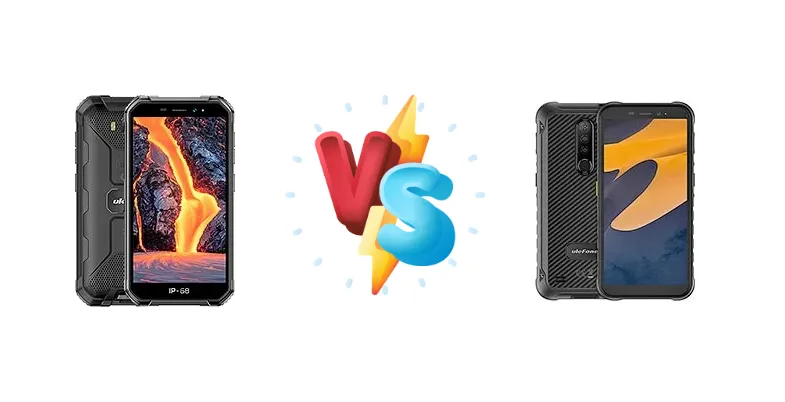
Ulefone consistently targets the rugged smartphone niche, offering durable devices at competitive price points. The Armor X6 Pro and X8i represent two compelling options, but cater to slightly different priorities. The X6 Pro is an older model, potentially available at a lower price, while the X8i introduces a newer chipset. This comparison dissects the key differences to determine which phone delivers the best value for your money.
🏆 Quick Verdict
For most users, the Ulefone Armor X8i is the better choice. Its Helio A25 chipset, featuring an octa-core CPU, provides a noticeable performance uplift over the X6 Pro’s quad-core Helio A22. While both phones share similar rugged builds, the X8i’s improved processing power translates to a smoother user experience and better multitasking capabilities.
| Network |
|---|
| 2G bands | GSM 850 / 900 / 1800 / 1900 | GSM 850 / 900 / 1800 / 1900 |
| 3G bands | HSDPA 850 / 900 / 1700(AWS) / 1900 / 2100 | HSDPA 850 / 900 / 1700(AWS) / 1900 / 2100 |
| 4G bands | 1, 2, 3, 4, 5, 7, 8, 12, 17, 19, 20 | 1, 2, 3, 4, 5, 7, 8, 12, 17, 19, 20, 28 |
| Speed | HSPA, LTE | HSPA 21.1/5.76 Mbps, LTE Cat7 300/150 Mbps |
| Technology | GSM / HSPA / LTE | GSM / HSPA / LTE |
| | - | eMMC 5.1 |
| Launch |
|---|
| Announced | 2022, July 16 | 2021, September 23 |
| Status | Available. Released 2022, July 16 | Available. Released 2021, September 23 |
| Body |
|---|
| Dimensions | 150 x 78.9 x 14.4 mm (5.91 x 3.11 x 0.57 in) | 160.3 x 79 x 13.8 mm (6.31 x 3.11 x 0.54 in) |
| SIM | Nano-SIM + Nano-SIM | Nano-SIM + Nano-SIM |
| Weight | 227 g (8.01 oz) | 256 g (9.03 oz) |
| | IP68 dust/water resistant (up to 1.5m for 30 min)
Drop-to-concrete resistance from up to 1.2m
MIL-STD-810G compliant | IP68/IP69K dust/water resistant (up to 1.5m for 30 min)
Drop-to-concrete resistance from up to 1.2m
MIL-STD-810G compliant |
| Display |
|---|
| Resolution | 720 x 1280 pixels, 16:9 ratio (~294 ppi density) | 720 x 1440 pixels, 18:9 ratio (~282 ppi density) |
| Size | 5.0 inches, 68.9 cm2 (~58.2% screen-to-body ratio) | 5.7 inches, 83.8 cm2 (~66.2% screen-to-body ratio) |
| Type | IPS LCD | IPS LCD |
| Platform |
|---|
| CPU | Quad-core 2.0 GHz Cortex-A53 | Octa-core (4x1.8 GHz Cortex-A53 & 4x1.5 GHz Cortex-A53) |
| Chipset | Mediatek MT6761 Helio A22 (12 nm) | Mediatek MT6762D Helio A25 (12 nm) |
| GPU | PowerVR GE8320 | PowerVR GE8320 |
| OS | Android 12 | Android 11 |
| Memory |
|---|
| Card slot | microSDXC (uses shared SIM slot) | microSDXC (uses shared SIM slot) |
| Internal | 32GB 4GB RAM | 32GB 3GB RAM |
| | eMMC 5.1 | - |
| Main Camera |
|---|
| Features | Dual-LED flash | Dual-LED flash, HDR, panorama |
| Single | 13 MP, f/2.2, (wide), AF | 8 MP, f/2.4 |
| Triple | - | 13 MP, f/2.2, (wide), AF
Auxiliary lenses |
| Video | 1080p@30fps | 1080p@30fps |
| Selfie camera |
|---|
| Single | 5 MP, f/2.2 | 8 MP, f/2.4 |
| Video | 720p@30fps | 1080p@30fps |
| Sound |
|---|
| 3.5mm jack | Yes | Yes |
| 35mm jack | Yes | Yes |
| Loudspeaker | Yes | Yes |
| Comms |
|---|
| Bluetooth | 5.0, A2DP, LE | 5.0, A2DP, LE |
| NFC | Yes | Yes |
| Positioning | GPS, GLONASS, BDS, GALILEO | GPS, GLONASS, GALILEO, BDS |
| Radio | Stereo FM radio, RDS, recording | FM radio, RDS, recording |
| USB | microUSB 2.0 | USB Type-C 2.0 |
| WLAN | Wi-Fi 802.11 a/b/g/n/ac, dual-band | Wi-Fi 802.11 a/b/g/n/ac, Wi-Fi Direct |
| Features |
|---|
| Sensors | Accelerometer, proximity, compass | Fingerprint (rear-mounted), accelerometer, proximity, compass |
| Battery |
|---|
| Charging | - | 10W wired |
| Type | Li-Po 4000 mAh | Li-Po 5080 mAh |
| Misc |
|---|
| Colors | Black, Orange | Black, Orange, Red |
| Price | - | About 150 EUR |
Ulefone Armor X6 Pro
- Potentially lower price point due to being an older model.
- Rugged build quality for durability.
- Sufficient for basic smartphone tasks.
- Quad-core processor limits multitasking and performance.
- Likely slower app loading times.
- May struggle with modern applications.
Ulefone Armor X8i
- Octa-core Helio A25 provides a significant performance boost.
- Smoother multitasking and app switching.
- Improved responsiveness compared to the X6 Pro.
- 10W charging is relatively slow.
- May be slightly more expensive than the X6 Pro.
- Camera performance likely limited by sensor quality.
Display Comparison
Neither Ulefone provides detailed display specifications beyond size and resolution in their marketing materials. However, given the price point, both likely utilize IPS LCD panels. The focus here isn't on display quality, but rather durability. Both phones are built to withstand harsh conditions, and the display is a key component of that. Expect similar viewing angles and color reproduction, with neither phone likely to excel in brightness or color accuracy compared to mainstream smartphones.
Camera Comparison
Ulefone’s marketing often emphasizes megapixel counts, but the actual camera performance is likely limited by the sensors and image processing capabilities. Without detailed sensor size information, it’s difficult to make a definitive judgment. However, the focus should be on practical image quality in various lighting conditions. Expect both phones to struggle in low light, and the 2MP macro cameras on both models are likely to deliver limited detail. The primary camera’s performance will be the deciding factor, and the A25’s slightly improved ISP (Image Signal Processor) *may* offer a marginal improvement in image processing, but this is speculative without further testing.
Performance
The core difference between these two devices lies in their chipsets. The Ulefone Armor X6 Pro utilizes the Mediatek MT6761 Helio A22, a quad-core processor clocked at 2.0 GHz. The Armor X8i steps up to the Mediatek MT6762D Helio A25, boasting an octa-core configuration with a split clock speed of 1.8 GHz and 1.5 GHz. This architectural shift – from four cores to eight – is crucial. The A25’s additional cores allow for significantly improved multitasking and smoother performance in demanding applications. While both are based on a 12nm process, the A25’s increased core count provides a tangible advantage for users who frequently switch between apps or engage in light gaming.
Battery Life
Battery capacity isn’t specified in the provided data, but rugged phones typically prioritize long battery life. The Armor X8i includes 10W wired charging, which is relatively slow by modern standards. The X6 Pro’s charging speed is not specified, but is likely similar. The real-world battery performance will depend on usage patterns, but the more efficient Helio A25 in the X8i *could* translate to slightly longer battery life, even if both phones have similar capacity batteries. The slower charging speed on both devices means overnight charging is recommended.
Buying Guide
Buy the Ulefone Armor X6 Pro if you prioritize absolute lowest cost and only need a phone for basic tasks like calls, texts, and light app usage. Its older chipset is sufficient for minimal demands. Buy the Ulefone Armor X8i if you value a more responsive user experience, occasional gaming, or running multiple apps simultaneously. The Helio A25 offers a significant performance boost, making it a worthwhile upgrade for those who demand more from their rugged device.
Frequently Asked Questions
❓ Will the Ulefone Armor X8i handle popular games like PUBG Mobile?
While the Helio A25 isn't a gaming powerhouse, the Armor X8i can run PUBG Mobile at lower settings. Expect frame rate drops during intense action, and don't anticipate a high-graphics experience. The X6 Pro would struggle significantly more with this title.
❓ How does the ruggedness of the X8i compare to the X6 Pro, considering they're both Ulefone Armor models?
Both phones adhere to Ulefone’s rugged design philosophy, offering IP68/IP69K ratings for water, dust, and shock resistance. The physical build quality and materials are likely very similar, meaning both can withstand drops, extreme temperatures, and submersion in water. The difference lies in the internal components and their ability to handle stress.
❓ Is the 10W charging on the X8i a significant drawback?
Yes, 10W charging is slow compared to modern smartphones. Expect a full charge to take several hours. However, rugged phones often prioritize battery life over fast charging, and the X8i’s more efficient chipset may partially offset this limitation.