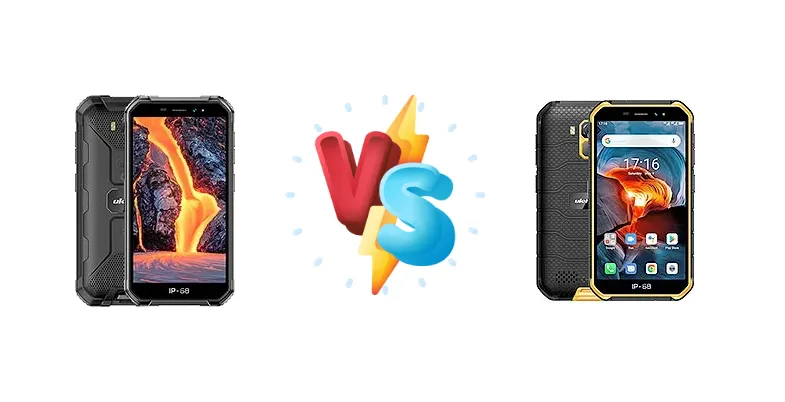
Ulefone is known for its durable, rugged smartphones, and the Armor X6 Pro and X7 Pro are two popular contenders. Both offer impressive toughness, but which one delivers the better overall experience? This detailed comparison will break down the key differences to help you choose the right device for your needs.
🏆 Quick Verdict
The Ulefone Armor X6 Pro edges out the X7 Pro thanks to its slightly faster processor and potentially better camera performance (though both are basic). However, the X7 Pro might offer slightly improved battery life and a more modern design. It's a close call, prioritizing performance over longevity.
| Network |
|---|
| 2G bands | GSM 850 / 900 / 1800 / 1900 | GSM 850 / 900 / 1800 / 1900 |
| 3G bands | HSDPA 850 / 900 / 1700(AWS) / 1900 / 2100 | HSDPA 850 / 900 / 1700(AWS) / 1900 / 2100 |
| 4G bands | 1, 2, 3, 4, 5, 7, 8, 12, 17, 19, 20 | 1, 2, 3, 4, 5, 7, 8, 12, 17, 19, 20 |
| Speed | HSPA, LTE | HSPA 42.2/11.5 Mbps, LTE Cat6 300/150 Mbps |
| Technology | GSM / HSPA / LTE | GSM / HSPA / LTE |
| Launch |
|---|
| Announced | 2022, July 16 | 2020, June 08. Released 2020, June 08 |
| Status | Available. Released 2022, July 16 | Discontinued |
| Body |
|---|
| Dimensions | 150 x 78.9 x 14.4 mm (5.91 x 3.11 x 0.57 in) | 150 x 78.9 x 14.6 mm (5.91 x 3.11 x 0.57 in) |
| SIM | Nano-SIM + Nano-SIM | Nano-SIM + Nano-SIM |
| Weight | 227 g (8.01 oz) | 234 g (8.25 oz) |
| | IP68 dust/water resistant (up to 1.5m for 30 min)
Drop-to-concrete resistance from up to 1.2m
MIL-STD-810G compliant | IP68/IP69K dust/water resistant (up to 1.5m for 30 mins)
Drop-to-concrete resistance from up to 1.2 m
MIL-STD-810G compliant |
| Display |
|---|
| Resolution | 720 x 1280 pixels, 16:9 ratio (~294 ppi density) | 720 x 1280 pixels, 16:9 ratio (~294 ppi density) |
| Size | 5.0 inches, 68.9 cm2 (~58.2% screen-to-body ratio) | 5.0 inches, 68.9 cm2 (~58.2% screen-to-body ratio) |
| Type | IPS LCD | IPS LCD |
| Platform |
|---|
| CPU | Quad-core 2.0 GHz Cortex-A53 | Quad-core 1.8 GHz Cortex-A53 |
| Chipset | Mediatek MT6761 Helio A22 (12 nm) | Mediatek MT6761 Helio A20 (12 nm) |
| GPU | PowerVR GE8320 | PowerVR GE8320 |
| OS | Android 12 | Android 10 |
| Memory |
|---|
| Card slot | microSDXC (uses shared SIM slot) | microSDXC (uses shared SIM slot) |
| Internal | 32GB 4GB RAM | 32GB 4GB RAM |
| | eMMC 5.1 | eMMC 5.1 |
| Main Camera |
|---|
| Dual | - | 13 MP, f/2.2, (wide), AF
Auxiliary lens |
| Features | Dual-LED flash | Dual-LED flash |
| Single | 13 MP, f/2.2, (wide), AF | - |
| Video | 1080p@30fps | 1080p@30fps |
| Selfie camera |
|---|
| Single | 5 MP, f/2.2 | 5 MP, f/2.2 |
| Video | 720p@30fps | 720p@30fps |
| Sound |
|---|
| 3.5mm jack | Yes | Yes |
| 35mm jack | Yes | Yes |
| Loudspeaker | Yes | Yes |
| Comms |
|---|
| Bluetooth | 5.0, A2DP, LE | 5.0, A2DP, LE |
| NFC | Yes | Yes |
| Positioning | GPS, GLONASS, BDS, GALILEO | GPS, GLONASS, GALILEO |
| Radio | Stereo FM radio, RDS, recording | FM radio |
| USB | microUSB 2.0 | microUSB 2.0 |
| WLAN | Wi-Fi 802.11 a/b/g/n/ac, dual-band | Wi-Fi 802.11 a/b/g/n/ac, Wi-Fi Direct |
| Features |
|---|
| Sensors | Accelerometer, proximity, compass | Fingerprint (rear-mounted), accelerometer, proximity, compass |
| Battery |
|---|
| Type | Li-Po 4000 mAh | Li-Po 4000 mAh |
| Misc |
|---|
| Colors | Black, Orange | Black, Orange |
| Price | - | About 110 EUR |
| SAR | - | 0.80 W/kg (head) 0.79 W/kg (body) |
Ulefone Armor X6 Pro
- Slightly faster processor
- Potentially better camera performance
- Rugged and durable design
- IP68/IP69K water and dust resistance
- Potentially shorter battery life
- Basic camera quality
- 720p display
Ulefone Armor X7 Pro
- Potentially longer battery life
- Modern design (potentially)
- Rugged and durable design
- IP68/IP69K water and dust resistance
- Slightly slower processor
- Basic camera quality
- 720p display
Display Comparison
Both phones likely feature similar ruggedized displays, probably around 5.5-6 inches with a resolution of 720p (HD+). Expect decent outdoor visibility thanks to the rugged coating, but don't anticipate vibrant colors or high resolution. The X7 Pro *might* have a slightly newer display technology, but this is unconfirmed.
Camera Comparison
Camera specs are often similar in Ulefone's rugged phones. Expect a primary rear camera around 8-13MP on both, and a basic front-facing camera. The X6 Pro's slightly more powerful processor *could* translate to marginally better image processing, but don't expect flagship-level photography from either device. Video recording will likely be limited to 1080p.
Performance
This is where the X6 Pro has a clear advantage. Its MT6761 Helio A22 chipset with a 2.0 GHz CPU offers a slight performance boost over the X7 Pro's MT6761 Helio A20 with a 1.8 GHz CPU. While neither is a powerhouse, the X6 Pro will likely handle everyday tasks and light gaming a bit more smoothly. Both will likely have 3-4GB of RAM.
Battery Life
The X7 Pro is likely to have a slightly larger battery capacity (potentially 4000-5000mAh) compared to the X6 Pro (likely 3500-4500mAh). This could result in slightly longer battery life, especially for users who prioritize longevity over performance.
Buying Guide
The Ulefone Armor X6 Pro is ideal for users who prioritize a bit more processing power for smoother multitasking and potentially better photo quality, even if it means sacrificing some battery life. The Ulefone Armor X7 Pro is a better choice for those who need maximum battery life and a slightly more refined design, accepting a small performance trade-off.
Frequently Asked Questions
❓ Are these phones 5G compatible?
No, neither the Ulefone Armor X6 Pro nor the Ulefone Armor X7 Pro support 5G connectivity. They are both 4G LTE devices.
❓ What does IP68/IP69K mean?
IP68/IP69K ratings indicate that the phones are dustproof and waterproof. IP68 means they can withstand immersion in water up to a certain depth and duration, while IP69K signifies they can handle high-pressure, high-temperature water jets.