
Ulefone Armor X5 vs. Blackview BV9800 Pro: Which Rugged Phone Reigns Supreme?
| Phones Images | |||||
|---|---|---|---|---|---|
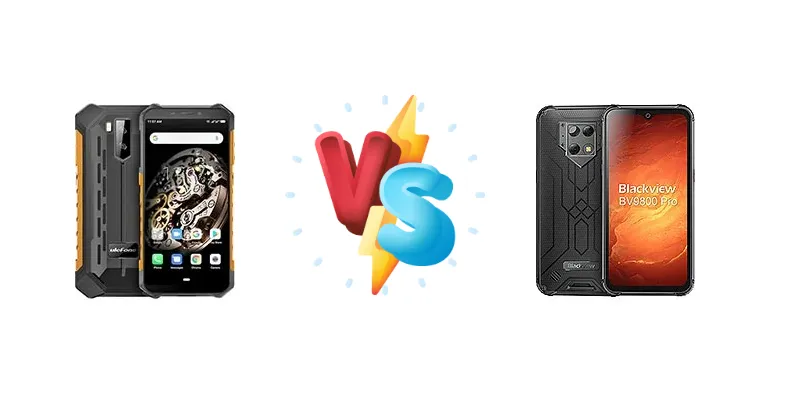
|
🏆 Quick Verdict
For the average user prioritizing responsiveness and future-proofing, the Blackview BV9800 Pro is the clear winner. Its Helio P70 chipset, built on a more efficient 12nm process, offers a noticeable performance uplift over the Ulefone Armor X5’s Helio P23. While the X5 remains a viable budget option, the BV9800 Pro’s faster charging and more capable processor justify the price difference.
| PHONES | ||
|---|---|---|
| Phone Names | Ulefone Armor X5 | Blackview BV9800 Pro |
| Network | ||
|---|---|---|
| 2G bands | GSM 850 / 900 / 1800 / 1900 | GSM 850 / 900 / 1800 / 1900 |
| 3G bands | HSDPA 850 / 900 / 1700(AWS) / 1900 / 2100 | HSDPA 800 / 850 / 900 / 1700(AWS) / 1900 / 2100 |
| 4G bands | 1, 2, 3, 4, 5, 7, 8, 12, 17, 19, 20, 28 | 1, 2, 3, 4, 5, 6, 7, 8, 12, 13, 17, 18, 19, 20, 25, 26, 28, 34, 38, 39, 40, 41, 66 |
| Speed | HSPA 21.1/5.76 Mbps, LTE (2CA) Cat7 300/150 Mbps | HSPA, LTE |
| Technology | GSM / HSPA / LTE | GSM / CDMA / HSPA / CDMA2000 / LTE |
| Launch | ||
|---|---|---|
| Announced | 2019, December. Released 2019, December | 2019, October 28. Released 2019, November |
| Status | Discontinued | Discontinued |
| Body | ||
|---|---|---|
| Dimensions | 150 x 78.9 x 14.4 mm (5.91 x 3.11 x 0.57 in) | 168.5 x 81 x 14.8 mm (6.63 x 3.19 x 0.58 in) |
| SIM | Nano-SIM + Nano-SIM | Nano-SIM + Nano-SIM |
| Weight | 223.8 g (7.90 oz) | 322 g (11.36 oz) |
| IP68 dust/water resistant (up to 1.5m for 30 mins) Drop-to-concrete resistance from up to 1.2 m MIL-STD-810G compliant | - | |
| Display | ||
|---|---|---|
| Resolution | 720 x 1440 pixels, 18:9 ratio (~293 ppi density) | 1080 x 2340 pixels, 19.5:9 ratio (~409 ppi density) |
| Size | 5.5 inches, 78.1 cm2 (~66.0% screen-to-body ratio) | 6.3 inches, 97.4 cm2 (~71.4% screen-to-body ratio) |
| Type | IPS LCD | IPS LCD |
| Platform | ||
|---|---|---|
| CPU | Octa-core (4x2.3 GHz Cortex-A53 & 4x1.5 GHz Cortex-A53) | Octa-core (4x2.1 GHz Cortex-A73 & 4x2.0 GHz Cortex-A53) |
| Chipset | Mediatek MT6763 Helio P23 (16 nm) | Mediatek MT6771V/CT Helio P70 (12 nm) |
| GPU | Mali-G71 MP2 | Mali-G72 MP3 |
| OS | Android 9.0 (Pie) | Android 9.0 (Pie) |
| Memory | ||
|---|---|---|
| Card slot | microSDXC (uses shared SIM slot) | microSDXC |
| Internal | 32GB 3GB RAM | 128GB 6GB RAM |
| eMMC 5.1 | - | |
| Main Camera | ||
|---|---|---|
| Dual | 13 MP, f/1.8, (wide), AF 2 MP | - |
| Features | Dual-LED flash | Thermal imaging, LED flash |
| Triple | - | 48 MP, (wide), PDAF 5 MP, thermal assisted camera FLIR thermal camera (Lepton module) |
| Video | 1080p@30fps | 1080p@30fps |
| Selfie camera | ||
|---|---|---|
| Single | 5 MP | 16 MP, f/2.0, (wide) |
| Video | 720p@30fps | 1080p@30fps |
| Sound | ||
|---|---|---|
| 3.5mm jack | Yes | - |
| 35mm jack | Yes | Yes |
| Loudspeaker | Yes | Yes |
| Comms | ||
|---|---|---|
| Bluetooth | 5.0, A2DP, LE | 4.1, A2DP |
| NFC | No | Yes |
| Positioning | GPS, GLONASS | GPS, GLONASS, GALILEO |
| Radio | Stereo FM radio, RDS, recording | FM radio |
| USB | microUSB 2.0 | USB Type-C 2.0, OTG |
| WLAN | Wi-Fi 802.11 a/b/g/n/ac, dual-band, Wi-Fi Direct | Wi-Fi 802.11 a/b/g/n/ac |
| Features | ||
|---|---|---|
| Sensors | Accelerometer, proximity, compass | Fingerprint (side-mounted), accelerometer, gyro, proximity, compass, barometer |
| Battery | ||
|---|---|---|
| Charging | 10W wired | 18W wired |
| Type | Li-Po 5000 mAh | 6580 mAh |
| Misc | ||
|---|---|---|
| Colors | Black, Red, Orange | Black, Orange |
| Price | - | About 340 EUR |
Ulefone Armor X5
- Lower price point makes it accessible.
- Rugged design provides essential drop and water resistance.
- Suitable for basic smartphone tasks.
- Helio P23 chipset is outdated and less performant.
- Slow 10W charging.
- Likely lower-quality display and camera.
Blackview BV9800 Pro
- More powerful Helio P70 chipset for smoother performance.
- Faster 18W wired charging.
- Likely better display and camera quality.
- Higher price compared to the Ulefone Armor X5.
- May not be significantly more durable than the X5 (ruggedness is similar).
- Larger size and weight are possible due to more features.
Display Comparison
Neither device’s display specifications are provided, so a direct comparison is limited. However, given the Armor X5’s positioning as a budget device, it likely features a lower-resolution panel and less sophisticated color calibration than the BV9800 Pro. Expect the BV9800 Pro to offer a more vibrant and detailed viewing experience, assuming it follows Blackview’s typical display quality for its pro-level models. Bezels are likely to be larger on the X5 to reduce manufacturing costs.
Camera Comparison
Without specific camera sensor details, analysis is limited. However, the BV9800 Pro, being a 'Pro' model, likely incorporates a larger main sensor and more advanced image processing algorithms. The Armor X5, targeting a lower price point, will likely feature a more basic camera setup. While both phones may include multiple lenses, the quality of those additional lenses (especially the often-included 2MP macro) is likely to be minimal on the X5. The P70’s image signal processor (ISP) will also contribute to better image quality on the BV9800 Pro, particularly in low-light conditions.
Performance
The core difference lies in the chipsets. The Blackview BV9800 Pro’s MediaTek Helio P70 (12nm) represents a significant architectural leap over the Ulefone Armor X5’s Helio P23 (16nm). The P70 utilizes Cortex-A73 cores (2.1 GHz) in its octa-core configuration, offering substantially better single-core performance than the P23’s Cortex-A53 cores (2.3 GHz). While the P23 has a higher clock speed on some cores, the A73 architecture is more efficient and delivers more performance per clock cycle. This translates to snappier app launches, smoother multitasking, and a more responsive user interface on the BV9800 Pro. The 12nm process further enhances efficiency, potentially leading to better thermal management under sustained load.
Battery Life
Battery capacity isn’t specified for either device, but the charging wattage provides a clear advantage to the Blackview BV9800 Pro. Its 18W wired charging significantly outperforms the Ulefone Armor X5’s 10W charging. This means the BV9800 Pro will replenish its battery much faster, minimizing downtime. Even if the Armor X5 has a slightly larger battery capacity, the slower charging speed will likely result in a less convenient user experience. The faster charging is particularly beneficial for users who rely heavily on their phone throughout the day and need quick top-ups.
Buying Guide
Buy the Ulefone Armor X5 if you need a truly budget-friendly rugged phone for basic tasks like calls, texts, and light app usage, and aren't concerned with demanding applications. Buy the Blackview BV9800 Pro if you prefer a more responsive experience, plan to use your phone for navigation, photography, or occasional gaming, and value faster charging for minimal downtime.