
Ulefone Armor X32 vs Power Armor 13: Which Rugged Phone Reigns Supreme?
| Phones Images | |||||
|---|---|---|---|---|---|
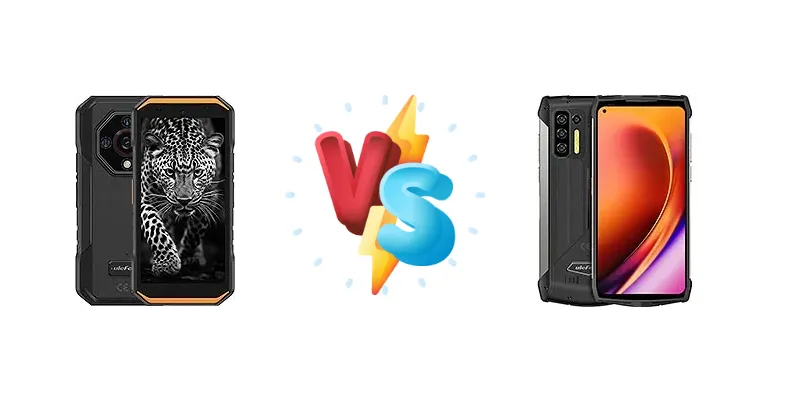
|
🏆 Quick Verdict
For most users, the Ulefone Power Armor 13 is the superior choice. While the Armor X32 boasts impressive 56:28h endurance, the Power Armor 13’s 33W wired, 15W wireless, and 5W reverse wireless charging, coupled with a respectable 296h endurance, offers greater versatility and convenience.
| PHONES | ||
|---|---|---|
| Phone Names | Ulefone Armor X32 | Ulefone Power Armor 13 |
| Network | ||
|---|---|---|
| 2G bands | GSM 850 / 900 / 1800 / 1900 | GSM 850 / 900 / 1800 / 1900 |
| 3G bands | HSDPA 800 / 850 / 900 / 1700(AWS) / 1900 / 2100 | HSDPA 850 / 900 / 1700(AWS) / 1900 / 2100 |
| 4G bands | 1, 2, 3, 4, 5, 7, 8, 12, 13, 17, 18, 19, 20, 25, 26, 28, 32, 66, 71 | 1, 2, 3, 4, 5, 7, 8, 12, 13, 17, 18, 19, 20, 25, 26, 28, 38, 40, 66 |
| 5G bands | 1, 2, 3, 5, 7, 8, 20, 25, 28, 38, 40, 41, 66, 71, 77, 78, 79 SA/NSA/Sub6 | - |
| Speed | HSPA, LTE, 5G | HSPA 42.2/11.5 Mbps, LTE Cat12 600/150 Mbps |
| Technology | GSM / CDMA / HSPA / LTE / 5G | GSM / HSPA / LTE |
| Launch | ||
|---|---|---|
| Announced | 2025, April 03 | 2021, July 22 |
| Status | Available. Released 2025, April 14 | Available. Released 2021, July 26 |
| Body | ||
|---|---|---|
| Dimensions | 163.4 x 80.8 x 14.5 mm (6.43 x 3.18 x 0.57 in) | 183.7 x 85.4 x 20.8 mm (7.23 x 3.36 x 0.82 in) |
| SIM | Nano-SIM + Nano-SIM | Nano-SIM + Nano-SIM |
| Weight | 280 g (9.88 oz) | 492 g (1.08 lb) |
| - | IP68 dust/water resistant (up to 1.5m for 30 min) Drop-to-concrete resistance from up to 1.2m MIL-STD-810G compliant | |
| Display | ||
|---|---|---|
| Protection | Corning Gorilla Glass 5, Mohs level 4 | Corning Gorilla Glass 3 |
| Resolution | 720 x 1440 pixels, 18:9 ratio (~285 ppi density) | 1080 x 2400 pixels, 20:9 ratio (~386 ppi density) |
| Size | 5.65 inches, 82.4 cm2 (~62.4% screen-to-body ratio) | 6.81 inches, 112.0 cm2 (~71.4% screen-to-body ratio) |
| Type | IPS LCD, 90Hz, 600 nits (peak) | IPS LCD |
| Platform | ||
|---|---|---|
| CPU | Octa-core (2x2.0 GHz Cortex-A75 & 6x1.8 GHz Cortex-A55) | Octa-core (2x2.05 GHz Cortex-A76 & 6x2.0 GHz Cortex-A55) |
| Chipset | Mediatek Helio G91 (12 nm) | Mediatek MT6785V/CD Helio G95 (12 nm) |
| GPU | Mali-G52 MC2 | Mali-G76 MC4 |
| OS | Android 14 | Android 11 |
| Memory | ||
|---|---|---|
| Card slot | microSDXC (dedicated slot) | microSDXC (uses shared SIM slot) |
| Internal | 128GB 6GB RAM | 256GB 8GB RAM |
| Main Camera | ||
|---|---|---|
| Features | LED flash, HDR, panorama | Quad-LED flash, HDR, panorama |
| Penta | - | 48 MP, f/1.8, 26mm (wide), 1/2.0", 0.8µm, PDAF 8 MP, f/2.2, (ultrawide) 2 MP (macro) Auxiliary lens |
| Triple | 48 MP, f/1.8, (wide), 1/2.0", 0.8µm, PDAF 20 MP, f/1.8, (night vision), 2 infrared lights 2 MP (macro) | - |
| Video | 1440p@30fps, 1080p@30fps | 4K@30fps, 1080p@30fps |
| Selfie camera | ||
|---|---|---|
| Features | - | HDR, panorama |
| Single | 16 MP, f/2.2, (wide), 1.0µm | 16 MP, f/2.2 |
| Video | 1080p@30fps | 1080p@30fps |
| Sound | ||
|---|---|---|
| 3.5mm jack | - | Yes |
| 35mm jack | Yes | Yes |
| Loudspeaker | Yes | Yes |
| Comms | ||
|---|---|---|
| Bluetooth | 5.2, A2DP, LE | 5.0, A2DP, LE |
| Infrared port | Yes | - |
| NFC | Yes | Yes |
| Positioning | GPS, GALILEO, GLONASS, BDS, QZSS | GPS, GLONASS, GALILEO, BDS |
| Radio | Wireless FM radio | FM radio, RDS, recording |
| USB | USB Type-C 2.0 | - |
| WLAN | Wi-Fi 802.11 a/b/g/n/ac, dual-band | Wi-Fi 802.11 a/b/g/n/ac, dual-band |
| Features | ||
|---|---|---|
| Sensors | Fingerprint (side-mounted), accelerometer, gyro, proximity, compass, barometer | Fingerprint (side-mounted), accelerometer, gyro, proximity, compass, baroceptor, coulombmeter |
| - | Infrared distance measure (error range: 1~20m, ±10mm; 20~40m, ±25mm) | |
| Battery | ||
|---|---|---|
| Charging | 18W wired | 33W wired 15W wireless 5W reverse wireless |
| Type | Li-Po 5500 mAh | Li-Po 13200 mAh |
| Misc | ||
|---|---|---|
| Colors | Black, Black/Orange, Black/Green | Black |
| Price | - | About 300 EUR |
| Tests | ||
|---|---|---|
| Battery life | - | Endurance rating 296h |
| Camera | - | Photo / Video |
| Display | - | Contrast ratio: 1306:1 (nominal) |
| Loudspeaker | - | -28.3 LUFS (Average) |
| Performance | - | AnTuTu: 294194 (v8), 351678 (v9) GeekBench: 1610 (v5.1) GFXBench: 18fps (ES 3.1 onscreen) |
| EU LABEL | ||
|---|---|---|
| Battery | 56:28h endurance, 1000 cycles | - |
| Energy | Class B | - |
| Free fall | Class A (270 falls) | - |
| Repairability | Class C | - |
Ulefone Armor X32
- Exceptional battery life (56:28h endurance)
- 1000 charge cycle claim suggests long-term battery health
- Competitive processor for the price range
- Slow 18W wired charging
- No wireless charging support
- Limited display information
Ulefone Power Armor 13
- Faster 33W wired charging
- 15W wireless charging and 5W reverse wireless charging
- Brighter display (401 nits)
- Shorter battery life compared to Armor X32 (296h endurance)
- Similar camera specifications to Armor X32 (lacking detail)
- Slightly higher price point (likely)
Display Comparison
The Ulefone Power Armor 13 features a display with a measured peak brightness of 401 nits and a 1306:1 contrast ratio. While the Armor X32’s display specifications are not provided, the Power Armor 13’s higher brightness makes it more usable outdoors in direct sunlight. Both displays share the same contrast ratio, suggesting similar panel technology, but the Armor 13’s measured brightness provides a tangible advantage for visibility.
Camera Comparison
Both phones list 'Photo / Video' capabilities, but lack specific details regarding sensor size, aperture, or image stabilization. Without further information, it’s difficult to assess camera performance. The absence of details suggests neither phone prioritizes camera quality as a key selling point. It's reasonable to assume both utilize similar budget-oriented camera modules.
Performance
Both devices utilize MediaTek Helio G series chipsets, but the Power Armor 13’s Helio G95 offers a slight edge over the Armor X32’s Helio G91. The G95 features a Cortex-A76 core clocked at 2.05 GHz, compared to the Armor X32’s 2.0 GHz Cortex-A75. This architectural improvement, alongside a slightly higher clock speed, translates to marginally faster performance in CPU-intensive tasks. Both chipsets are built on a 12nm process, suggesting similar thermal characteristics, but the G95’s more efficient core design may result in slightly better sustained performance.
Battery Life
The Ulefone Armor X32 dominates in raw endurance, achieving an impressive 56:28h rating. However, the Power Armor 13 compensates with significantly faster charging. Its 33W wired charging is more than double the Armor X32’s 18W, drastically reducing charge times. Furthermore, the Power Armor 13 adds 15W wireless charging and 5W reverse wireless charging, features absent on the Armor X32. While the Armor X32’s 1000 charge cycle claim is noteworthy, the Power Armor 13’s charging versatility makes it more convenient for everyday use.
Buying Guide
Buy the Ulefone Armor X32 if you absolutely prioritize maximum battery life above all else and rarely need to charge your phone during a typical day. Its 56:28h endurance is exceptional. Buy the Ulefone Power Armor 13 if you value faster charging speeds, wireless charging options, and a brighter display, even if it means slightly less overall battery runtime. It’s the more practical choice for users who need to quickly top up their device or share power with other gadgets.