
Ulefone Armor X32 vs. Ulefone Armor X12 Pro: A Deep Dive into Rugged Performance
| Phones Images | |||||
|---|---|---|---|---|---|
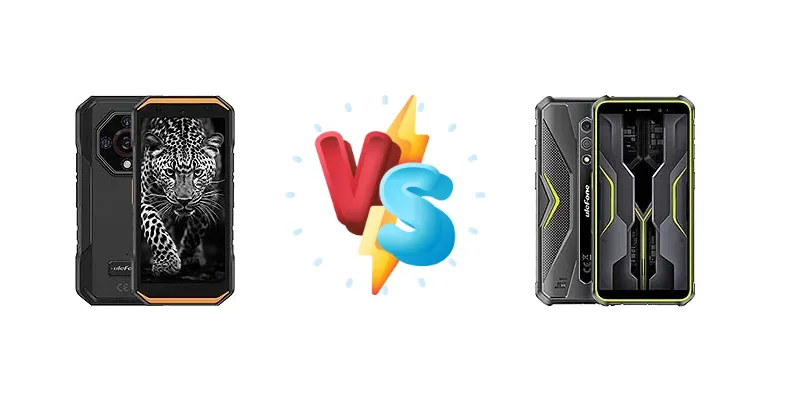
|
🏆 Quick Verdict
For most users, the Ulefone Armor X32 is the superior choice. Its Helio G91 chipset, coupled with a significantly longer 56:28h battery endurance, provides a noticeable performance and usability advantage over the X12 Pro’s Helio G36 and 48:31h endurance. While the X12 Pro remains a capable device, the X32 offers a more future-proof experience.
| PHONES | ||
|---|---|---|
| Phone Names | Ulefone Armor X32 | Ulefone Armor X12 Pro |
| Network | ||
|---|---|---|
| 2G bands | GSM 850 / 900 / 1800 / 1900 | GSM 850 / 900 / 1800 / 1900 |
| 3G bands | HSDPA 800 / 850 / 900 / 1700(AWS) / 1900 / 2100 | HSDPA 850 / 900 / 1700(AWS) / 1900 / 2100 |
| 4G bands | 1, 2, 3, 4, 5, 7, 8, 12, 13, 17, 18, 19, 20, 25, 26, 28, 32, 66, 71 | 1, 2, 3, 4, 5, 7, 8, 12, 17, 19, 20, 28 |
| 5G bands | 1, 2, 3, 5, 7, 8, 20, 25, 28, 38, 40, 41, 66, 71, 77, 78, 79 SA/NSA/Sub6 | - |
| Speed | HSPA, LTE, 5G | HSPA, LTE |
| Technology | GSM / CDMA / HSPA / LTE / 5G | GSM / HSPA / LTE |
| Launch | ||
|---|---|---|
| Announced | 2025, April 03 | 2023, August |
| Status | Available. Released 2025, April 14 | Available. Released 2023, August |
| Body | ||
|---|---|---|
| Dimensions | 163.4 x 80.8 x 14.5 mm (6.43 x 3.18 x 0.57 in) | 157.2 x 76.8 x 14.3 mm (6.19 x 3.02 x 0.56 in) |
| SIM | Nano-SIM + Nano-SIM | Nano-SIM + Nano-SIM |
| Weight | 280 g (9.88 oz) | 257 g (9.07 oz) |
| Display | ||
|---|---|---|
| Protection | Corning Gorilla Glass 5, Mohs level 4 | Mohs level 4 |
| Resolution | 720 x 1440 pixels, 18:9 ratio (~285 ppi density) | 720 x 1440 pixels, 18:9 ratio (~295 ppi density) |
| Size | 5.65 inches, 82.4 cm2 (~62.4% screen-to-body ratio) | 5.45 inches, 76.7 cm2 (~63.5% screen-to-body ratio) |
| Type | IPS LCD, 90Hz, 600 nits (peak) | IPS LCD |
| Platform | ||
|---|---|---|
| CPU | Octa-core (2x2.0 GHz Cortex-A75 & 6x1.8 GHz Cortex-A55) | Octa-core (4x2.2 GHz Cortex-A53 & 4x1.7 GHz Cortex-A53) |
| Chipset | Mediatek Helio G91 (12 nm) | Mediatek Helio G36 (12 nm) |
| GPU | Mali-G52 MC2 | PowerVR GE8320 |
| OS | Android 14 | Android 13 |
| Memory | ||
|---|---|---|
| Card slot | microSDXC (dedicated slot) | microSDXC (dedicated slot) |
| Internal | 128GB 6GB RAM | 64GB 4GB RAM |
| Main Camera | ||
|---|---|---|
| Features | LED flash, HDR, panorama | LED flash |
| Single | - | 13 MP, f/2.2, (wide), 1.12µm, PDAF |
| Triple | 48 MP, f/1.8, (wide), 1/2.0", 0.8µm, PDAF 20 MP, f/1.8, (night vision), 2 infrared lights 2 MP (macro) | - |
| Video | 1440p@30fps, 1080p@30fps | 1080p@30fps |
| Selfie camera | ||
|---|---|---|
| Single | 16 MP, f/2.2, (wide), 1.0µm | 8 MP, f/2.0, (wide), 1.4µm |
| Video | 1080p@30fps | Yes |
| Sound | ||
|---|---|---|
| 35mm jack | Yes | Yes |
| Loudspeaker | Yes | Yes |
| Comms | ||
|---|---|---|
| Bluetooth | 5.2, A2DP, LE | 5.0, A2DP, LE |
| Infrared port | Yes | - |
| NFC | Yes | Yes |
| Positioning | GPS, GALILEO, GLONASS, BDS, QZSS | GPS, GLONASS, GALILEO, BDS |
| Radio | Wireless FM radio | Wireless FM radio, RDS, recording |
| USB | USB Type-C 2.0 | USB Type-C 2.0 |
| WLAN | Wi-Fi 802.11 a/b/g/n/ac, dual-band | Wi-Fi 802.11 a/b/g/n/ac, dual-band |
| Features | ||
|---|---|---|
| Sensors | Fingerprint (side-mounted), accelerometer, gyro, proximity, compass, barometer | Accelerometer, proximity |
| Battery | ||
|---|---|---|
| Charging | 18W wired | 10W wired |
| Type | Li-Po 5500 mAh | Li-Po 4860 mAh |
| Misc | ||
|---|---|---|
| Colors | Black, Black/Orange, Black/Green | Black, Black/Orange, Black/Green |
| Price | - | About 130 EUR |
| EU LABEL | ||
|---|---|---|
| Battery | 56:28h endurance, 1000 cycles | 48:31h endurance, 1000 cycles |
| Energy | Class B | Class B |
| Free fall | Class A (270 falls) | Class A (270 falls) |
| Repairability | Class C | Class C |
Ulefone Armor X32
- Superior performance with the Helio G91 chipset.
- Significantly longer battery life (56:28h endurance).
- Faster 18W wired charging.
- Potentially higher price point.
- Limited information on display specifications.
Ulefone Armor X12 Pro
- More affordable price (likely).
- Rugged design and build quality.
- Decent battery life for basic usage (48:31h endurance).
- Inferior performance with the Helio G36 chipset.
- Slower 10W wired charging.
Display Comparison
Neither Ulefone provides display specifications beyond size and resolution, so a direct comparison is limited. However, the chipset difference suggests the X32 may be capable of driving a higher refresh rate panel if Ulefone chose to implement one. Both likely utilize IPS LCD technology common in this price bracket. The focus here is on durability, so expect reinforced glass, but detailed color accuracy and brightness data are unavailable.
Camera Comparison
Without detailed camera specifications, a direct comparison is challenging. Both phones likely feature a multi-camera setup, but the quality will heavily depend on sensor size and image processing. It’s reasonable to assume the X32, benefiting from its more powerful chipset, will have superior image processing capabilities, resulting in better dynamic range and noise reduction. The inclusion of a 2MP macro camera on both devices is largely a marketing tactic, offering limited practical benefit due to the small sensor size.
Performance
The core difference lies in the chipsets. The Ulefone Armor X32’s Mediatek Helio G91 (12nm) features an octa-core configuration with 2x2.0 GHz Cortex-A75 and 6x1.8 GHz Cortex-A55 cores. This architecture is significantly more powerful than the X12 Pro’s Helio G36 (12nm) with its 4x2.2 GHz Cortex-A53 and 4x1.7 GHz Cortex-A53 cores. The Cortex-A75 cores in the G91 offer a substantial performance uplift in single-core tasks and improved efficiency. This translates to snappier app launches, smoother multitasking, and a more responsive user experience. The G91’s architecture is better suited for handling modern applications and light gaming, while the G36 will likely struggle with more demanding titles.
Battery Life
The Ulefone Armor X32 boasts a significant advantage in battery endurance, achieving 56:28h in testing compared to the X12 Pro’s 48:31h. While both phones offer 1000 charge cycles, the X32’s longer endurance means fewer charging cycles are needed over the phone’s lifespan. The X32 also supports 18W wired charging, a step up from the X12 Pro’s 10W, resulting in faster recharge times, though neither is particularly rapid by modern standards.
Buying Guide
Buy the Ulefone Armor X32 if you prioritize performance for tasks like navigation, data-intensive work apps, or occasional gaming, and require maximum battery life for extended field work. Buy the Ulefone Armor X12 Pro if you are on a tighter budget and primarily need a reliable, rugged phone for basic communication, light app usage, and don't anticipate heavy multitasking or demanding applications.