
Ulefone Armor X32 vs. Nokia XR20: A Deep Dive into Rugged Smartphone Choices
| Phones Images | |||||
|---|---|---|---|---|---|
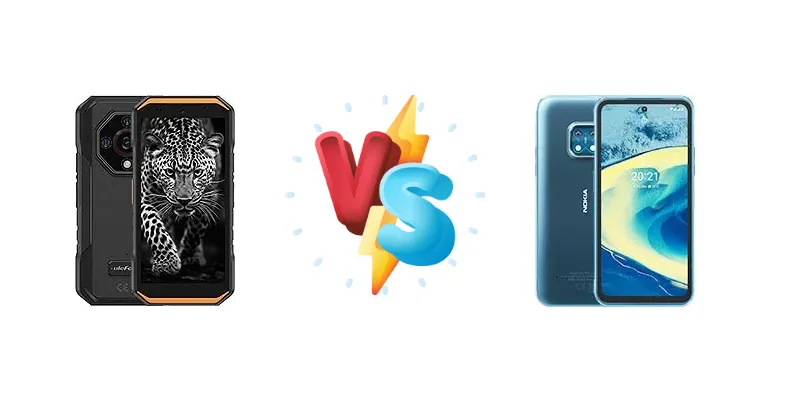
|
🏆 Quick Verdict
For users prioritizing maximum uptime and a lower upfront cost, the Ulefone Armor X32 is the better choice, boasting significantly longer battery endurance. However, the Nokia XR20 wins for those needing 5G and valuing a more streamlined software experience with guaranteed updates.
| PHONES | ||
|---|---|---|
| Phone Names | Ulefone Armor X32 | Nokia XR20 |
| Network | ||
|---|---|---|
| 2G bands | GSM 850 / 900 / 1800 / 1900 | GSM 850 / 900 / 1800 / 1900 |
| 3G bands | HSDPA 800 / 850 / 900 / 1700(AWS) / 1900 / 2100 | HSDPA 850 / 900 / 1700(AWS) / 1900 / 2100 |
| 4G bands | 1, 2, 3, 4, 5, 7, 8, 12, 13, 17, 18, 19, 20, 25, 26, 28, 32, 66, 71 | 1, 2, 3, 4, 5, 7, 8, 12, 13, 14, 20, 25, 26, 28, 30, 38, 40, 41, 48, 66, 71 |
| 5G bands | 1, 2, 3, 5, 7, 8, 20, 25, 28, 38, 40, 41, 66, 71, 77, 78, 79 SA/NSA/Sub6 | 2, 5, 25, 38, 41, 48, 66, 77, 78 SA/NSA |
| Speed | HSPA, LTE, 5G | HSPA, LTE, 5G |
| Technology | GSM / CDMA / HSPA / LTE / 5G | GSM / CDMA / HSPA / EVDO / LTE / 5G |
| - | CDMA2000 1xEV-DO | |
| Launch | ||
|---|---|---|
| Announced | 2025, April 03 | 2021, July 27 |
| Status | Available. Released 2025, April 14 | Available. Released 2021, August 04 |
| Body | ||
|---|---|---|
| Dimensions | 163.4 x 80.8 x 14.5 mm (6.43 x 3.18 x 0.57 in) | 171.6 x 81.5 x 10.6 mm (6.76 x 3.21 x 0.42 in) |
| SIM | Nano-SIM + Nano-SIM | · Nano-SIM· Nano-SIM + Nano-SIM |
| Weight | 280 g (9.88 oz) | 248 g (8.75 oz) |
| - | IP68 dust/water resistant (up to 1.5m for 60 min) Drop-to-concrete resistance from up to 1.8m MIL-STD-810H compliant | |
| Display | ||
|---|---|---|
| Protection | Corning Gorilla Glass 5, Mohs level 4 | Corning Gorilla Glass Victus |
| Resolution | 720 x 1440 pixels, 18:9 ratio (~285 ppi density) | 1080 x 2400 pixels, 20:9 ratio (~395 ppi density) |
| Size | 5.65 inches, 82.4 cm2 (~62.4% screen-to-body ratio) | 6.67 inches, 107.4 cm2 (~76.8% screen-to-body ratio) |
| Type | IPS LCD, 90Hz, 600 nits (peak) | IPS LCD, 550 nits |
| Platform | ||
|---|---|---|
| CPU | Octa-core (2x2.0 GHz Cortex-A75 & 6x1.8 GHz Cortex-A55) | Octa-core (2x2.0 GHz Kryo 460 & 6x1.8 GHz Kryo 460) |
| Chipset | Mediatek Helio G91 (12 nm) | Qualcomm SM4350 Snapdragon 480 5G (8 nm) |
| GPU | Mali-G52 MC2 | Adreno 619 |
| OS | Android 14 | Android 11, upgradable to Android 13 |
| Memory | ||
|---|---|---|
| Card slot | microSDXC (dedicated slot) | microSDXC (uses shared SIM slot) |
| Internal | 128GB 6GB RAM | 64GB 4GB RAM, 128GB 6GB RAM |
| Main Camera | ||
|---|---|---|
| Dual | - | 48 MP, f/1.8, (wide), 1/2.25", 0.8µm, PDAF 13 MP, f/2.4, 123˚ (ultrawide), 1/3.0", 1.12µm |
| Features | LED flash, HDR, panorama | Zeiss optics, Dual-LED dual-tone flash, second LED flash, HDR, panorama |
| Single | - | 8 MP, f/2.0 (wide), 1/4.0", 1.12µm |
| Triple | 48 MP, f/1.8, (wide), 1/2.0", 0.8µm, PDAF 20 MP, f/1.8, (night vision), 2 infrared lights 2 MP (macro) | - |
| Video | 1440p@30fps, 1080p@30fps | 1080p@30fps |
| Selfie camera | ||
|---|---|---|
| Single | 16 MP, f/2.2, (wide), 1.0µm | 8 MP, f/2.0 (wide), 1/4.0", 1.12µm |
| Video | 1080p@30fps | 1080p@30fps |
| Sound | ||
|---|---|---|
| 3.5mm jack | - | Yes |
| 35mm jack | Yes | Yes |
| Loudspeaker | Yes | Yes, with stereo speakers |
| Comms | ||
|---|---|---|
| Bluetooth | 5.2, A2DP, LE | 5.1, A2DP, LE, aptX Adaptive |
| Infrared port | Yes | - |
| NFC | Yes | Yes |
| Positioning | GPS, GALILEO, GLONASS, BDS, QZSS | GPS (L1+L5), GLONASS, BDS, GALILEO, QZSS, NavIC |
| Radio | Wireless FM radio | Unspecified |
| USB | USB Type-C 2.0 | USB Type-C 3.0 |
| WLAN | Wi-Fi 802.11 a/b/g/n/ac, dual-band | Wi-Fi 802.11 a/b/g/n/ac/6, dual-band, Wi-Fi Direct |
| Features | ||
|---|---|---|
| Sensors | Fingerprint (side-mounted), accelerometer, gyro, proximity, compass, barometer | Fingerprint (side-mounted), accelerometer, gyro, proximity, compass, barometer |
| Battery | ||
|---|---|---|
| Charging | 18W wired | 18W wired 15W wireless |
| Type | Li-Po 5500 mAh | Li-Po 4630 mAh |
| Misc | ||
|---|---|---|
| Colors | Black, Black/Orange, Black/Green | Ultra Blue, Granite Gray |
| Models | - | TA-1368, TA-1362 |
| Price | - | About 270 EUR |
| SAR EU | - | 1.13 W/kg (head) 1.43 W/kg (body) |
| EU LABEL | ||
|---|---|---|
| Battery | 56:28h endurance, 1000 cycles | - |
| Energy | Class B | - |
| Free fall | Class A (270 falls) | - |
| Repairability | Class C | - |
Ulefone Armor X32
- Exceptional battery life (56:28h endurance)
- Potentially longer battery lifespan (1000 charge cycles)
- More affordable price point (likely)
- Lacks 5G connectivity
- Older chipset (Helio G91) may struggle with demanding tasks
Nokia XR20
- 5G connectivity for faster data speeds
- More efficient chipset (Snapdragon 480, 8nm)
- Wireless charging convenience
- Shorter battery life compared to Ulefone
- Potentially higher price
Display Comparison
Neither device boasts a cutting-edge display. Details on panel type, resolution, and refresh rate are missing, but the focus here is clearly on practicality over visual fidelity. The absence of LTPO or high refresh rates suggests both prioritize power efficiency. The real-world impact will be similar viewing experiences, likely adequate for outdoor visibility but not ideal for media consumption.
Camera Comparison
Without detailed camera specs beyond the chipsets, a direct comparison is limited. However, the Snapdragon 480 typically supports more advanced image signal processors (ISPs) than the Helio G91, potentially leading to better image processing, especially in low-light conditions. The absence of information regarding sensor size and optical image stabilization (OIS) makes it difficult to assess image quality definitively, but the Nokia likely has an edge in computational photography.
Performance
The chipset choice is a key differentiator. The Ulefone Armor X32 utilizes the Mediatek Helio G91 (12nm), while the Nokia XR20 features the Qualcomm Snapdragon 480 5G (8nm). While both CPUs share a 2x2.0 GHz and 6x1.8 GHz core configuration, the 8nm process of the Snapdragon 480 offers a theoretical advantage in power efficiency and thermal management. This translates to potentially better sustained performance under load for the Nokia, especially considering the G91's reputation for running warmer. The Snapdragon 480 also unlocks 5G connectivity, a feature absent in the Ulefone.
Battery Life
The Ulefone Armor X32 shines in battery endurance, achieving a remarkable 56:28h rating. This is a significant advantage over what we'd expect from the Nokia XR20, which, while likely offering respectable battery life, doesn't have the same endurance focus. Both support 18W wired charging, but the Nokia XR20 adds 15W wireless charging, offering a convenient alternative. The Ulefone's 1000 charge cycle claim suggests a focus on long-term battery health, potentially mitigating degradation over years of use.
Buying Guide
Buy the Ulefone Armor X32 if you need a phone that can genuinely last for days on a single charge, and your work or hobbies frequently take you off-grid where 5G isn't available or necessary. Buy the Nokia XR20 if you require 5G connectivity for faster data speeds, appreciate a cleaner Android experience with promised software updates, and value the convenience of wireless charging.