
Ulefone Armor X32 vs Doogee S98 Pro: A Deep Dive into Rugged Performance
| Phones Images | |||||
|---|---|---|---|---|---|
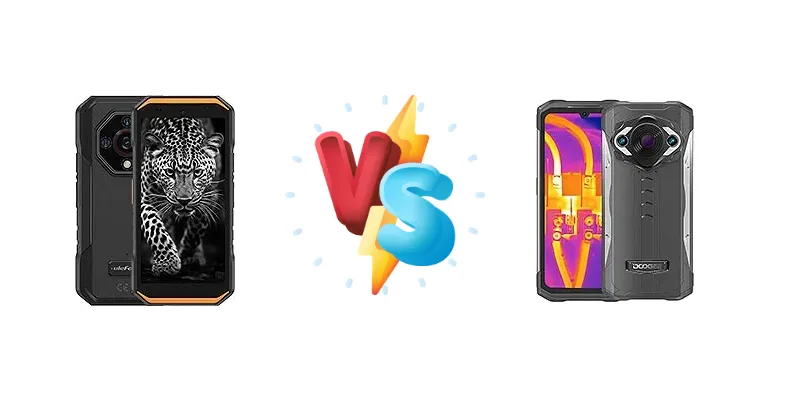
|
🏆 Quick Verdict
For the average user prioritizing battery endurance and value, the Ulefone Armor X32 emerges as the winner. Its impressive 56:28h endurance rating significantly surpasses what we'd expect from the Doogee S98 Pro, despite the latter's faster charging. However, users who frequently multitask or game will appreciate the Doogee S98 Pro's slightly more capable CPU.
| PHONES | ||
|---|---|---|
| Phone Names | Ulefone Armor X32 | Doogee S98 Pro |
| Network | ||
|---|---|---|
| 2G bands | GSM 850 / 900 / 1800 / 1900 | GSM 850 / 900 / 1800 / 1900 |
| 3G bands | HSDPA 800 / 850 / 900 / 1700(AWS) / 1900 / 2100 | HSDPA 800 / 850 / 900 / 1700(AWS) / 1900 / 2100 |
| 4G bands | 1, 2, 3, 4, 5, 7, 8, 12, 13, 17, 18, 19, 20, 25, 26, 28, 32, 66, 71 | 1, 2, 3, 4, 5, 7, 8, 12, 13, 17, 18, 19, 20, 25, 26, 28, 34, 38, 39, 40, 41, 66 |
| 5G bands | 1, 2, 3, 5, 7, 8, 20, 25, 28, 38, 40, 41, 66, 71, 77, 78, 79 SA/NSA/Sub6 | - |
| Speed | HSPA, LTE, 5G | HSPA, LTE |
| Technology | GSM / CDMA / HSPA / LTE / 5G | GSM / CDMA / HSPA / LTE |
| Launch | ||
|---|---|---|
| Announced | 2025, April 03 | 2022, May 27 |
| Status | Available. Released 2025, April 14 | Available. Released 2022, June 06 |
| Body | ||
|---|---|---|
| Dimensions | 163.4 x 80.8 x 14.5 mm (6.43 x 3.18 x 0.57 in) | 172 x 82 x 15.5 mm (6.77 x 3.23 x 0.61 in) |
| SIM | Nano-SIM + Nano-SIM | Nano-SIM + Nano-SIM |
| Weight | 280 g (9.88 oz) | 320 g (11.29 oz) |
| Display | ||
|---|---|---|
| Protection | Corning Gorilla Glass 5, Mohs level 4 | Corning Gorilla Glass |
| Resolution | 720 x 1440 pixels, 18:9 ratio (~285 ppi density) | 1080 x 2340 pixels, 19.5:9 ratio (~409 ppi density) |
| Size | 5.65 inches, 82.4 cm2 (~62.4% screen-to-body ratio) | 6.3 inches, 97.4 cm2 (~69.1% screen-to-body ratio) |
| Type | IPS LCD, 90Hz, 600 nits (peak) | IPS LCD, 500 nits (peak) |
| Platform | ||
|---|---|---|
| CPU | Octa-core (2x2.0 GHz Cortex-A75 & 6x1.8 GHz Cortex-A55) | Octa-core (2x2.05 GHz Cortex-A76 & 6x2.0 GHz Cortex-A55) |
| Chipset | Mediatek Helio G91 (12 nm) | Mediatek MT6781 Helio G96 (12 nm) |
| GPU | Mali-G52 MC2 | Mali-G57 MC2 |
| OS | Android 14 | Android 12 |
| Memory | ||
|---|---|---|
| Card slot | microSDXC (dedicated slot) | microSDXC (dedicated slot) |
| Internal | 128GB 6GB RAM | 256GB 8GB RAM |
| Main Camera | ||
|---|---|---|
| Features | LED flash, HDR, panorama | Dual-LED flash, HDR, panorama |
| Triple | 48 MP, f/1.8, (wide), 1/2.0", 0.8µm, PDAF 20 MP, f/1.8, (night vision), 2 infrared lights 2 MP (macro) | 48 MP, f/1.8, (wide), PDAF 20 MP, f/1.8, (night vision), 2 infrared night vision lights Thermal imaging camera |
| Video | 1440p@30fps, 1080p@30fps | 1440p, 1080p |
| Selfie camera | ||
|---|---|---|
| Single | 16 MP, f/2.2, (wide), 1.0µm | 16 MP, f/2.0, (wide) |
| Video | 1080p@30fps | 1080p |
| Sound | ||
|---|---|---|
| 35mm jack | Yes | Unspecified |
| Loudspeaker | Yes | Yes |
| Comms | ||
|---|---|---|
| Bluetooth | 5.2, A2DP, LE | 5.1, A2DP, LE |
| Infrared port | Yes | - |
| NFC | Yes | Yes |
| Positioning | GPS, GALILEO, GLONASS, BDS, QZSS | GPS, GLONASS, BDS, GALILEO |
| Radio | Wireless FM radio | FM radio |
| USB | USB Type-C 2.0 | USB Type-C 2.0, OTG |
| WLAN | Wi-Fi 802.11 a/b/g/n/ac, dual-band | Wi-Fi 802.11 a/b/g/n/ac, dual-band |
| Features | ||
|---|---|---|
| Sensors | Fingerprint (side-mounted), accelerometer, gyro, proximity, compass, barometer | Fingerprint (side-mounted), accelerometer, gyro, proximity, compass |
| Battery | ||
|---|---|---|
| Charging | 18W wired | 33W wired 15W wireless |
| Type | Li-Po 5500 mAh | 6000 mAh |
| Misc | ||
|---|---|---|
| Colors | Black, Black/Orange, Black/Green | Black |
| Price | - | About 470 EUR |
| EU LABEL | ||
|---|---|---|
| Battery | 56:28h endurance, 1000 cycles | - |
| Energy | Class B | - |
| Free fall | Class A (270 falls) | - |
| Repairability | Class C | - |
Ulefone Armor X32
- Exceptional battery life (56:28h endurance)
- Excellent value for money
- Rugged build quality for demanding environments
- Slower charging speed (18W)
- Potentially less powerful CPU for intensive tasks
Doogee S98 Pro
- Faster charging (33W wired, 15W wireless)
- Slightly more powerful CPU (Helio G96)
- Potentially better camera system
- Shorter battery life compared to Ulefone Armor X32
- Higher price point
Display Comparison
Neither device's display specifications are provided, so a direct comparison is limited. However, given the price point of the Armor X32, it likely utilizes an IPS LCD panel, prioritizing durability and cost-effectiveness. The S98 Pro, positioned as a more premium device, may incorporate a higher-quality panel with better color accuracy and viewing angles. The absence of details like resolution and refresh rate makes a definitive statement impossible, but the S98 Pro likely offers a more visually appealing experience.
Camera Comparison
Without detailed camera specifications, a comprehensive comparison is challenging. However, the market segment suggests the Doogee S98 Pro likely features a more sophisticated camera system. While both phones likely include multiple lenses, the S98 Pro’s positioning suggests a larger primary sensor and potentially optical image stabilization (OIS), resulting in better low-light performance and sharper images. The Armor X32 will likely focus on providing functional photography for documentation purposes, while the S98 Pro aims for a more versatile and higher-quality imaging experience.
Performance
The Doogee S98 Pro boasts the Mediatek Helio G96 chipset, featuring a CPU with 2x2.05 GHz Cortex-A76 cores and 6x2.0 GHz Cortex-A55 cores. This represents a slight architectural advantage over the Ulefone Armor X32’s Helio G91, which uses 2x2.0 GHz Cortex-A75 cores and 6x1.8 GHz Cortex-A55 cores. The Cortex-A76 cores in the G96 offer improved single-core performance, translating to snappier app launches and smoother multitasking. While both chipsets are fabricated on a 12nm process, the G96’s core architecture provides a marginal performance edge, benefiting users who demand more from their device.
Battery Life
The Ulefone Armor X32’s standout feature is its exceptional 56:28h endurance rating, indicating significantly longer battery life than the Doogee S98 Pro. While the S98 Pro compensates with 33W wired and 15W wireless charging, the Armor X32’s longevity is a major advantage for users who spend extended periods away from power outlets. The 18W charging on the X32 is slower, but the substantial battery capacity minimizes the need for frequent top-ups. The S98 Pro’s wireless charging is a convenience feature the X32 lacks, but the trade-off is reduced overall runtime.
Buying Guide
Buy the Ulefone Armor X32 if you need a long-lasting, dependable rugged phone for essential tasks, extended outdoor use, or as a reliable workhorse where battery life is paramount. Buy the Doogee S98 Pro if you prefer faster charging speeds, occasional gaming, and a slightly more responsive user experience, and are willing to trade some battery endurance for that performance boost.