
Ulefone Armor X32 vs. Cat S62 Pro: A Head-to-Head Rugged Smartphone Showdown
| Phones Images | |||||
|---|---|---|---|---|---|
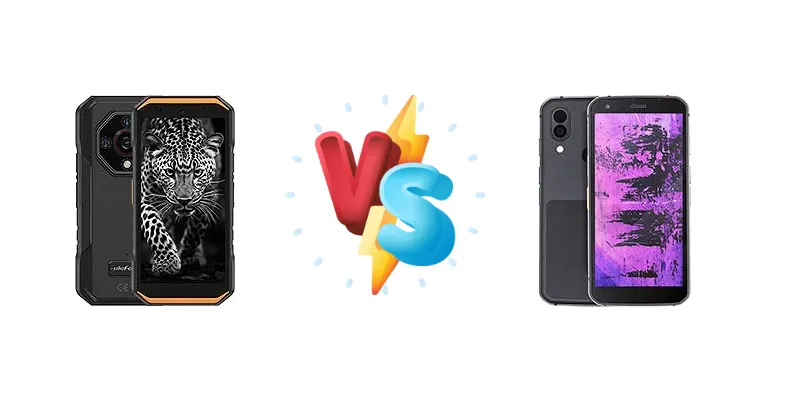
|
🏆 Quick Verdict
For the average user prioritizing long-term battery life and a more modern chipset, the Ulefone Armor X32 emerges as the better value. Its Helio G91 offers a performance edge, and the impressive 56:28h endurance significantly surpasses what the Cat S62 Pro can likely achieve, making it ideal for extended fieldwork or travel.
| PHONES | ||
|---|---|---|
| Phone Names | Ulefone Armor X32 | Cat S62 Pro |
| Network | ||
|---|---|---|
| 2G bands | GSM 850 / 900 / 1800 / 1900 | GSM 850 / 900 / 1800 / 1900 |
| 3G bands | HSDPA 800 / 850 / 900 / 1700(AWS) / 1900 / 2100 | HSDPA 850 / 900 / 1700(AWS) / 1900 / 2100 |
| 4G bands | 1, 2, 3, 4, 5, 7, 8, 12, 13, 17, 18, 19, 20, 25, 26, 28, 32, 66, 71 | 1, 2, 3, 4, 5, 7, 8, 20, 28, 38, 40 |
| 5G bands | 1, 2, 3, 5, 7, 8, 20, 25, 28, 38, 40, 41, 66, 71, 77, 78, 79 SA/NSA/Sub6 | - |
| Speed | HSPA, LTE, 5G | HSPA 42.2/5.76 Mbps, LTE (2CA) Cat13 400/150 Mbps |
| Technology | GSM / CDMA / HSPA / LTE / 5G | GSM / HSPA / LTE |
| Launch | ||
|---|---|---|
| Announced | 2025, April 03 | 2020, June 28. Released 2020, August 17 |
| Status | Available. Released 2025, April 14 | Discontinued |
| Body | ||
|---|---|---|
| Build | - | Glass front (Gorilla Glass 6), plastic back, aluminum frame |
| Dimensions | 163.4 x 80.8 x 14.5 mm (6.43 x 3.18 x 0.57 in) | 158.5 x 76.7 x 11.9 mm (6.24 x 3.02 x 0.47 in) |
| SIM | Nano-SIM + Nano-SIM | · Nano-SIM· Nano-SIM + Nano-SIM |
| Weight | 280 g (9.88 oz) | 248 g (8.75 oz) |
| - | IP68/IP69 dust/water resistant (up to 1.5m for 35 mins) Drop-to-concrete resistance from up to 1.8m MIL-STD-810H compliant | |
| Display | ||
|---|---|---|
| Protection | Corning Gorilla Glass 5, Mohs level 4 | Corning Gorilla Glass 6 |
| Resolution | 720 x 1440 pixels, 18:9 ratio (~285 ppi density) | 1080 x 2160 pixels, 18:9 ratio (~424 ppi density) |
| Size | 5.65 inches, 82.4 cm2 (~62.4% screen-to-body ratio) | 5.7 inches, 83.8 cm2 (~69.0% screen-to-body ratio) |
| Type | IPS LCD, 90Hz, 600 nits (peak) | IPS LCD |
| Platform | ||
|---|---|---|
| CPU | Octa-core (2x2.0 GHz Cortex-A75 & 6x1.8 GHz Cortex-A55) | Octa-core (4x2.2 GHz Kryo 260 Gold & 4x1.8 GHz Kryo 260 Silver) |
| Chipset | Mediatek Helio G91 (12 nm) | Qualcomm SDM660 Snapdragon 660 (14 nm) |
| GPU | Mali-G52 MC2 | Adreno 512 |
| OS | Android 14 | Android 10 |
| Memory | ||
|---|---|---|
| Card slot | microSDXC (dedicated slot) | microSDXC (dedicated slot) |
| Internal | 128GB 6GB RAM | 128GB 6GB RAM |
| Main Camera | ||
|---|---|---|
| Dual | - | 12 MP, f/1.8, (wide), 1/2.55", 1.4µm, dual pixel PDAF FLIR thermal camera (Lepton 3.5 module) |
| Features | LED flash, HDR, panorama | Thermal imaging, heat palettes, temp. spot meter, LED flash |
| Triple | 48 MP, f/1.8, (wide), 1/2.0", 0.8µm, PDAF 20 MP, f/1.8, (night vision), 2 infrared lights 2 MP (macro) | - |
| Video | 1440p@30fps, 1080p@30fps | 1080p@30fps, gyro-EIS |
| Selfie camera | ||
|---|---|---|
| Single | 16 MP, f/2.2, (wide), 1.0µm | 8 MP |
| Video | 1080p@30fps | 1080p@30fps |
| Sound | ||
|---|---|---|
| 3.5mm jack | - | No |
| 35mm jack | Yes | No |
| Loudspeaker | Yes | Yes |
| Comms | ||
|---|---|---|
| Bluetooth | 5.2, A2DP, LE | 5.0, A2DP, LE |
| Infrared port | Yes | - |
| NFC | Yes | Yes |
| Positioning | GPS, GALILEO, GLONASS, BDS, QZSS | GPS, GLONASS, GALILEO, BDS |
| Radio | Wireless FM radio | FM radio |
| USB | USB Type-C 2.0 | USB Type-C 2.0, OTG |
| WLAN | Wi-Fi 802.11 a/b/g/n/ac, dual-band | Wi-Fi 802.11 a/b/g/n/ac, dual-band, Wi-Fi Direct |
| Features | ||
|---|---|---|
| Sensors | Fingerprint (side-mounted), accelerometer, gyro, proximity, compass, barometer | Fingerprint (rear-mounted), accelerometer, gyro, proximity, compass |
| Battery | ||
|---|---|---|
| Charging | 18W wired | - |
| Type | Li-Po 5500 mAh | Li-Ion 4000 mAh |
| Misc | ||
|---|---|---|
| Colors | Black, Black/Orange, Black/Green | Black |
| Price | - | About 530 EUR |
| EU LABEL | ||
|---|---|---|
| Battery | 56:28h endurance, 1000 cycles | - |
| Energy | Class B | - |
| Free fall | Class A (270 falls) | - |
| Repairability | Class C | - |
Ulefone Armor X32
- Superior battery endurance (56:28h)
- More modern and efficient chipset (Helio G91)
- Potentially better performance for multitasking
- Brand recognition is lower than Cat
- Long-term software support is uncertain
Cat S62 Pro
- Established brand reputation for rugged devices
- Potentially better software support and updates
- Qualcomm chipset offers a stable platform
- Older and less efficient chipset (Snapdragon 660)
- Likely shorter battery life
- Higher price point for comparable performance
Display Comparison
Neither device’s display specifications are provided, so a direct comparison is limited. However, given the target market, both likely utilize IPS LCD panels optimized for outdoor visibility. The Cat S62 Pro, being a slightly older model, may have narrower viewing angles or lower peak brightness. The Ulefone Armor X32’s newer manufacturing process *could* translate to a more efficient display, contributing to its overall battery endurance. Bezels are likely substantial on both to reinforce structural integrity.
Camera Comparison
Without detailed camera specs, a definitive comparison is difficult. However, rugged phones often prioritize practicality over photographic excellence. Both devices likely feature a main camera suitable for documenting work or outdoor activities. The absence of information regarding sensor size or aperture makes it impossible to assess low-light performance. It’s reasonable to assume both phones include basic image processing algorithms, but the Ulefone Armor X32’s newer chipset *could* offer slightly more advanced computational photography capabilities. We can safely assume any secondary cameras (like macro lenses) on either device will be of limited utility.
Performance
The core difference lies in the chipsets. The Ulefone Armor X32’s Mediatek Helio G91 (12nm) utilizes a more modern architecture – Cortex-A75 and A55 cores – compared to the Cat S62 Pro’s Qualcomm Snapdragon 660 (14nm). While the Snapdragon 660 boasts a slightly higher peak CPU clock speed (2.2 GHz vs 2.0 GHz), the Helio G91’s newer core design and smaller manufacturing node generally translate to better performance per watt. This means the X32 is likely to handle multitasking and demanding applications more efficiently, with potentially less thermal throttling during sustained use. The Snapdragon 660’s Kryo cores are optimized for Qualcomm’s ecosystem, but the G91’s architecture is a step forward in raw processing capability.
Battery Life
The Ulefone Armor X32’s 56:28h endurance is a standout feature. This suggests a significantly larger battery capacity and/or more efficient power management compared to the Cat S62 Pro. While the S62 Pro’s battery capacity is unknown, the older Snapdragon 660 chipset and 14nm process are less efficient. The X32’s 18W wired charging is standard for this class, but the extended battery life minimizes the need for frequent top-ups. The Cat S62 Pro’s charging speed is also likely around 18W, but its smaller battery will fill faster, though it will also deplete more quickly.
Buying Guide
Buy the Ulefone Armor X32 if you need a phone that can genuinely last for days on a single charge and benefits from a more recent processor for smoother app performance. This is the phone for outdoor enthusiasts, construction workers, or anyone who frequently finds themselves away from power outlets. Buy the Cat S62 Pro if you prioritize a brand with a strong reputation in the rugged space and potentially better software support, though you'll trade off some battery life and processing power for that peace of mind.