
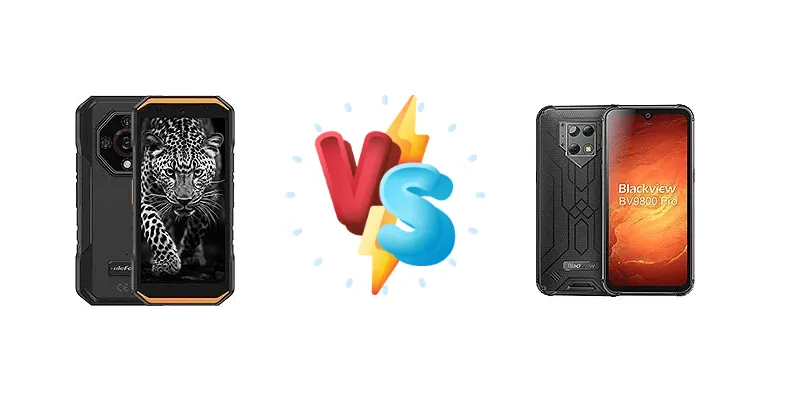
Ulefone Armor X32 vs. Blackview BV9800 Pro: A Deep Dive into Rugged Smartphone Performance
| Phones Images | |||||
|---|---|---|---|---|---|
|
🏆 Quick Verdict
For the average user prioritizing sustained performance and longer battery life, the Ulefone Armor X32 emerges as the stronger choice. Its Helio G91 chipset, featuring newer Cortex-A75 cores, provides a noticeable advantage in demanding tasks, while the reported 56:28h endurance ensures all-day usability even under heavy load.
| PHONES | ||
|---|---|---|
| Phone Names | Ulefone Armor X32 | Blackview BV9800 Pro |
| Network | ||
|---|---|---|
| 2G bands | GSM 850 / 900 / 1800 / 1900 | GSM 850 / 900 / 1800 / 1900 |
| 3G bands | HSDPA 800 / 850 / 900 / 1700(AWS) / 1900 / 2100 | HSDPA 800 / 850 / 900 / 1700(AWS) / 1900 / 2100 |
| 4G bands | 1, 2, 3, 4, 5, 7, 8, 12, 13, 17, 18, 19, 20, 25, 26, 28, 32, 66, 71 | 1, 2, 3, 4, 5, 6, 7, 8, 12, 13, 17, 18, 19, 20, 25, 26, 28, 34, 38, 39, 40, 41, 66 |
| 5G bands | 1, 2, 3, 5, 7, 8, 20, 25, 28, 38, 40, 41, 66, 71, 77, 78, 79 SA/NSA/Sub6 | - |
| Speed | HSPA, LTE, 5G | HSPA, LTE |
| Technology | GSM / CDMA / HSPA / LTE / 5G | GSM / CDMA / HSPA / CDMA2000 / LTE |
| Launch | ||
|---|---|---|
| Announced | 2025, April 03 | 2019, October 28. Released 2019, November |
| Status | Available. Released 2025, April 14 | Discontinued |
| Body | ||
|---|---|---|
| Dimensions | 163.4 x 80.8 x 14.5 mm (6.43 x 3.18 x 0.57 in) | 168.5 x 81 x 14.8 mm (6.63 x 3.19 x 0.58 in) |
| SIM | Nano-SIM + Nano-SIM | Nano-SIM + Nano-SIM |
| Weight | 280 g (9.88 oz) | 322 g (11.36 oz) |
| Display | ||
|---|---|---|
| Protection | Corning Gorilla Glass 5, Mohs level 4 | - |
| Resolution | 720 x 1440 pixels, 18:9 ratio (~285 ppi density) | 1080 x 2340 pixels, 19.5:9 ratio (~409 ppi density) |
| Size | 5.65 inches, 82.4 cm2 (~62.4% screen-to-body ratio) | 6.3 inches, 97.4 cm2 (~71.4% screen-to-body ratio) |
| Type | IPS LCD, 90Hz, 600 nits (peak) | IPS LCD |
| Platform | ||
|---|---|---|
| CPU | Octa-core (2x2.0 GHz Cortex-A75 & 6x1.8 GHz Cortex-A55) | Octa-core (4x2.1 GHz Cortex-A73 & 4x2.0 GHz Cortex-A53) |
| Chipset | Mediatek Helio G91 (12 nm) | Mediatek MT6771V/CT Helio P70 (12 nm) |
| GPU | Mali-G52 MC2 | Mali-G72 MP3 |
| OS | Android 14 | Android 9.0 (Pie) |
| Memory | ||
|---|---|---|
| Card slot | microSDXC (dedicated slot) | microSDXC |
| Internal | 128GB 6GB RAM | 128GB 6GB RAM |
| Main Camera | ||
|---|---|---|
| Features | LED flash, HDR, panorama | Thermal imaging, LED flash |
| Triple | 48 MP, f/1.8, (wide), 1/2.0", 0.8µm, PDAF 20 MP, f/1.8, (night vision), 2 infrared lights 2 MP (macro) | 48 MP, (wide), PDAF 5 MP, thermal assisted camera FLIR thermal camera (Lepton module) |
| Video | 1440p@30fps, 1080p@30fps | 1080p@30fps |
| Selfie camera | ||
|---|---|---|
| Single | 16 MP, f/2.2, (wide), 1.0µm | 16 MP, f/2.0, (wide) |
| Video | 1080p@30fps | 1080p@30fps |
| Sound | ||
|---|---|---|
| 35mm jack | Yes | Yes |
| Loudspeaker | Yes | Yes |
| Comms | ||
|---|---|---|
| Bluetooth | 5.2, A2DP, LE | 4.1, A2DP |
| Infrared port | Yes | - |
| NFC | Yes | Yes |
| Positioning | GPS, GALILEO, GLONASS, BDS, QZSS | GPS, GLONASS, GALILEO |
| Radio | Wireless FM radio | FM radio |
| USB | USB Type-C 2.0 | USB Type-C 2.0, OTG |
| WLAN | Wi-Fi 802.11 a/b/g/n/ac, dual-band | Wi-Fi 802.11 a/b/g/n/ac |
| Features | ||
|---|---|---|
| Sensors | Fingerprint (side-mounted), accelerometer, gyro, proximity, compass, barometer | Fingerprint (side-mounted), accelerometer, gyro, proximity, compass, barometer |
| Battery | ||
|---|---|---|
| Charging | 18W wired | 18W wired |
| Type | Li-Po 5500 mAh | 6580 mAh |
| Misc | ||
|---|---|---|
| Colors | Black, Black/Orange, Black/Green | Black, Orange |
| Price | - | About 340 EUR |
| EU LABEL | ||
|---|---|---|
| Battery | 56:28h endurance, 1000 cycles | - |
| Energy | Class B | - |
| Free fall | Class A (270 falls) | - |
| Repairability | Class C | - |
Ulefone Armor X32
- More modern and efficient Helio G91 chipset
- Superior battery endurance (56:28h)
- 1000 charge cycle battery lifespan
- Display specifications unknown
- Camera details lacking
Blackview BV9800 Pro
- Potentially lower price point
- Established chipset (Helio P70)
- Rugged design
- Older chipset architecture (Helio P70)
- Inferior battery endurance compared to X32
- Less efficient CPU cores
Display Comparison
Neither device's display specifications are provided, so a direct comparison is limited. However, given the rugged nature of both phones, we can assume both utilize durable, scratch-resistant glass. The BV9800 Pro, being a slightly older model, may have lower peak brightness and color accuracy compared to newer panels. Users should prioritize checking independent reviews for detailed display analysis, focusing on outdoor visibility and color reproduction.
Camera Comparison
Without detailed camera specifications, a comprehensive comparison is impossible. However, the rugged phone segment often prioritizes durability over camera quality. It’s likely both phones feature a primary sensor, potentially accompanied by auxiliary lenses of limited utility (like the often-present 2MP macro). Users should focus on reviews that assess real-world image quality, dynamic range, and low-light performance, rather than relying on megapixel counts.
Performance
The core difference lies in the chipsets. The Ulefone Armor X32’s Mediatek Helio G91 (12nm) utilizes two Cortex-A75 cores clocked at 2.0 GHz, paired with six Cortex-A55 cores at 1.8 GHz. This architecture is demonstrably more efficient and powerful than the Blackview BV9800 Pro’s Helio P70 (12nm), which features four Cortex-A73 cores at 2.1 GHz and four Cortex-A53 cores at 2.0 GHz. The A75 cores in the G91 offer a significant IPC (Instructions Per Clock) improvement over the A73, translating to snappier app launches and smoother multitasking. While the P70’s higher clock speed on the A73 cores might offer a slight edge in single-core tasks, the G91’s overall architecture is better suited for sustained workloads.
Battery Life
The Ulefone Armor X32 boasts an impressive 56:28h endurance rating, suggesting excellent power efficiency. While both phones share the same 18W wired charging, the X32’s superior endurance means it will require less frequent charging. The X32 also claims 1000 charge cycles, indicating a longer lifespan before significant battery degradation. This is a crucial advantage for users who rely on their phones for extended periods in remote locations.
Buying Guide
Buy the Ulefone Armor X32 if you need a rugged phone that can handle demanding applications like navigation, data logging, or light gaming, and you value extended battery life for field work or outdoor adventures. Buy the Blackview BV9800 Pro if you prioritize a slightly older, but still capable, chipset and are looking for a potentially more affordable rugged option, suitable for basic communication and less intensive tasks.