
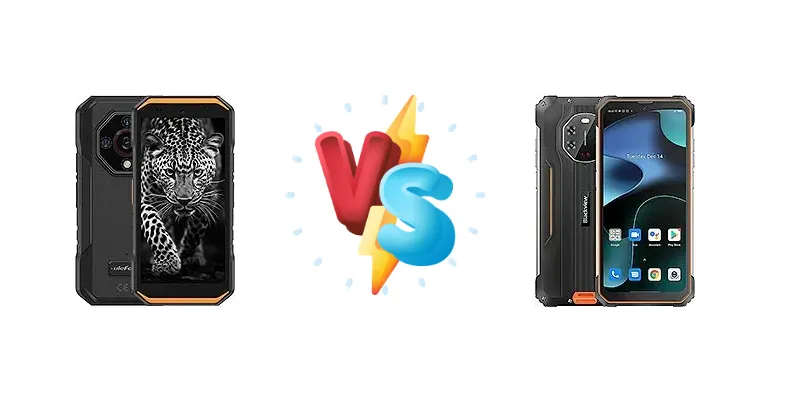
Ulefone Armor X32 vs. Blackview BV8800: A Deep Dive into Rugged Smartphone Performance
| Phones Images | |||||
|---|---|---|---|---|---|
|
🏆 Quick Verdict
For users prioritizing exceptional battery endurance and a more efficient processor, the Ulefone Armor X32 is the clear winner. Its 56:28h endurance significantly outpaces the Blackview BV8800’s 199h rating. However, the BV8800’s faster 33W charging and slightly more powerful chipset appeal to those who value speed over longevity.
| PHONES | ||
|---|---|---|
| Phone Names | Ulefone Armor X32 | Blackview BV8800 |
| Network | ||
|---|---|---|
| 2G bands | GSM 850 / 900 / 1800 / 1900 | GSM 850 / 900 / 1800 / 1900 |
| 3G bands | HSDPA 800 / 850 / 900 / 1700(AWS) / 1900 / 2100 | HSDPA 800 / 850 / 900 / 1700(AWS) / 1900 / 2100 |
| 4G bands | 1, 2, 3, 4, 5, 7, 8, 12, 13, 17, 18, 19, 20, 25, 26, 28, 32, 66, 71 | 1, 2, 3, 4, 5, 7, 8, 12, 13, 17, 18, 19, 20, 25, 26, 28, 30, 34, 38, 39, 40, 41, 66 |
| 5G bands | 1, 2, 3, 5, 7, 8, 20, 25, 28, 38, 40, 41, 66, 71, 77, 78, 79 SA/NSA/Sub6 | - |
| Speed | HSPA, LTE, 5G | HSPA, LTE |
| Technology | GSM / CDMA / HSPA / LTE / 5G | GSM / CDMA / HSPA / CDMA2000 / LTE |
| - | CDMA2000 1x | |
| Launch | ||
|---|---|---|
| Announced | 2025, April 03 | 2021, December 24 |
| Status | Available. Released 2025, April 14 | Available. Released 2022, January 10 |
| Body | ||
|---|---|---|
| Dimensions | 163.4 x 80.8 x 14.5 mm (6.43 x 3.18 x 0.57 in) | 176.2 x 83.5 x 17.7 mm (6.94 x 3.29 x 0.70 in) |
| SIM | Nano-SIM + Nano-SIM | Nano-SIM + Nano-SIM |
| Weight | 280 g (9.88 oz) | 367 g (12.95 oz) |
| - | IP68/IP69K dust/water resistant (up to 1.5m for 30 min) Drop-to-concrete resistance from up to 1.5m MIL-STD-810H compliant | |
| Display | ||
|---|---|---|
| Protection | Corning Gorilla Glass 5, Mohs level 4 | - |
| Resolution | 720 x 1440 pixels, 18:9 ratio (~285 ppi density) | 1080 x 2408 pixels, 20:9 ratio (~401 ppi density) |
| Size | 5.65 inches, 82.4 cm2 (~62.4% screen-to-body ratio) | 6.58 inches, 104.3 cm2 (~70.9% screen-to-body ratio) |
| Type | IPS LCD, 90Hz, 600 nits (peak) | IPS LCD, 90Hz, 480 nits |
| Platform | ||
|---|---|---|
| CPU | Octa-core (2x2.0 GHz Cortex-A75 & 6x1.8 GHz Cortex-A55) | Octa-core (2x2.05 GHz Cortex-A76 & 6x2.0 GHz Cortex-A55) |
| Chipset | Mediatek Helio G91 (12 nm) | Mediatek MT6781 Helio G96 (12 nm) |
| GPU | Mali-G52 MC2 | Mali-G57 MC2 |
| OS | Android 14 | Android 11, Doke-OS 3.0 |
| Memory | ||
|---|---|---|
| Card slot | microSDXC (dedicated slot) | No |
| Internal | 128GB 6GB RAM | 128GB 8GB RAM |
| - | UFS 2.1 | |
| Main Camera | ||
|---|---|---|
| Features | LED flash, HDR, panorama | Dual-LED flash, HDR, panorama |
| Quad | - | 50 MP, f/1.8, (wide), PDAF 8 MP, f/2.2, 117˚ (ultrawide) 20 MP, f/1.8, (IR camera), 2 IR emitters Auxiliary lens |
| Single | - | 16 MP, f/2.0, (wide) |
| Triple | 48 MP, f/1.8, (wide), 1/2.0", 0.8µm, PDAF 20 MP, f/1.8, (night vision), 2 infrared lights 2 MP (macro) | - |
| Video | 1440p@30fps, 1080p@30fps | 1440p@30fps |
| Selfie camera | ||
|---|---|---|
| Single | 16 MP, f/2.2, (wide), 1.0µm | 16 MP, f/2.0, (wide) |
| Video | 1080p@30fps | 1080p@30fps |
| Sound | ||
|---|---|---|
| 3.5mm jack | - | No |
| 35mm jack | Yes | No |
| Loudspeaker | Yes | Yes |
| Comms | ||
|---|---|---|
| Bluetooth | 5.2, A2DP, LE | 5.2, A2DP, LE |
| Infrared port | Yes | - |
| NFC | Yes | Yes |
| Positioning | GPS, GALILEO, GLONASS, BDS, QZSS | GPS, GLONASS, GALILEO, BDS |
| Radio | Wireless FM radio | FM radio |
| USB | USB Type-C 2.0 | USB Type-C 2.0, OTG |
| WLAN | Wi-Fi 802.11 a/b/g/n/ac, dual-band | Wi-Fi 802.11 a/b/g/n/ac |
| Features | ||
|---|---|---|
| Sensors | Fingerprint (side-mounted), accelerometer, gyro, proximity, compass, barometer | Fingerprint (side-mounted), accelerometer, gyro, proximity, compass, barometer |
| Battery | ||
|---|---|---|
| Charging | 18W wired | 33W wired, 31% in 30 min, 100% in 90 min Reverse wired |
| Type | Li-Po 5500 mAh | 8380 mAh |
| Misc | ||
|---|---|---|
| Colors | Black, Black/Orange, Black/Green | Black, Orange, Green |
| Price | - | About 350 EUR |
| Tests | ||
|---|---|---|
| Battery life | - | Endurance rating 199h |
| Camera | - | Photo / Video |
| Display | - | Contrast ratio: 1348:1 (nominal) |
| Loudspeaker | - | -29.3 LUFS (Average) |
| Performance | - | AnTuTu: 254849 (v8), 288964 (v9) GeekBench: 1752 (v5.1) GFXBench: 10fps (ES 3.1 onscreen) |
| EU LABEL | ||
|---|---|---|
| Battery | 56:28h endurance, 1000 cycles | - |
| Energy | Class B | - |
| Free fall | Class A (270 falls) | - |
| Repairability | Class C | - |
Ulefone Armor X32
- Exceptional battery life (56:28h endurance)
- High battery cycle count (1000 cycles)
- Efficient Mediatek Helio G91 chipset
- Slower charging speed (18W)
- Limited display specifications available
- Camera details are unknown
Blackview BV8800
- Faster charging (33W, 100% in 90 mins)
- More powerful Helio G96 chipset
- Brighter display (501 nits)
- Significantly shorter battery life (199h)
- Lower battery cycle count (unspecified)
- Limited camera details available
Display Comparison
Both devices share a 1348:1 contrast ratio, suggesting similar visual pop. However, the Blackview BV8800 boasts a measured peak brightness of 501 nits, which is crucial for outdoor visibility. While the Ulefone Armor X32’s display specs are not provided, the BV8800’s higher brightness gives it an edge for users who spend significant time under direct sunlight. The lack of information on the X32’s panel type (IPS, AMOLED) makes a definitive comparison difficult, but the BV8800’s brightness is a concrete advantage.
Camera Comparison
Both phones list 'Photo / Video' capabilities, but lack specific details regarding sensor size, aperture, or image processing. This makes a direct comparison impossible. The absence of information suggests neither phone is targeting photography enthusiasts. The presence of a 2MP macro camera on many phones in this segment is likely, but its utility is questionable given the limited resolution. Without further data, we can only assume both offer basic imaging capabilities suitable for casual snapshots.
Performance
The Blackview BV8800 utilizes the Mediatek Helio G96, featuring a dual-core CPU configuration with Cortex-A76 cores clocked at 2.05 GHz, paired with six Cortex-A55 cores at 2.0 GHz. This is a step up from the Ulefone Armor X32’s Helio G91, which uses Cortex-A75 cores (2x2.0 GHz) and Cortex-A55 cores (6x1.8 GHz). The A76 cores in the G96 offer a modest performance increase over the A75 cores in the G91, translating to snappier app loading and smoother multitasking. However, the G91’s 12nm process node is identical to the G96, so thermal differences are likely minimal. The Ulefone’s CPU clock speed is slightly lower, potentially impacting sustained performance.
Battery Life
The Ulefone Armor X32 dominates in battery endurance with a remarkable 56:28h rating, supported by a claimed 1000 charge cycles, indicating long-term battery health. In contrast, the Blackview BV8800 offers a significantly lower 199h endurance. While the BV8800 compensates with 33W wired charging (reaching 31% in 30 minutes and 100% in 90 minutes), the X32’s longevity is a major advantage for users prioritizing minimal charging. The BV8800 also offers reverse wired charging, a feature absent in the X32, allowing it to act as a power bank for other devices.
Buying Guide
Buy the Ulefone Armor X32 if you need a phone that can genuinely last for days on a single charge, and you frequently work in environments where access to power is limited. Buy the Blackview BV8800 if you prefer quicker charging times, a slightly more responsive user experience thanks to the Helio G96, and don't mind sacrificing some battery life for that added performance.